Add us as a preferred source to see our ISO and compliance articles more often in your Google results and Discover.
ISO/IEC 17025 Impartiality and Confidentiality
When it comes to laboratory accreditation, it’s not just about getting the science right—it’s also about earning trust. That’s where ISO/IEC 17025 Impartiality and Confidentiality come in. These two principles sit right at the heart of the 2017 version of the standard, and for good reason. They ensure that labs are not only technically competent but also unbiased and trustworthy when handling sensitive information.
If you’ve ever wondered how a lab can prove its results are both honest and secure, this is exactly what ISO/IEC 17025 Impartiality and Confidentiality are meant to cover. Whether you’re setting up a new management system or fine-tuning your current one, understanding how to meet these requirements is key to maintaining both compliance and client confidence.
In this article, we’ll break down what impartiality and confidentiality actually mean in a laboratory setting, why they matter, and how your lab can fully meet these expectations—without the guesswork. Let’s walk through it together.
Defining Impartiality in ISO/IEC 17025
Let’s start with the first half of ISO/IEC 17025 Impartiality and Confidentiality—impartiality. What does it actually mean for a laboratory? Simply put, impartiality is about being fair, objective, and free from any pressure or influence that could skew your results.
ISO/IEC 17025 makes it very clear: labs must perform their activities without bias. That means your testing, calibrations, or evaluations can’t be influenced by financial interests, personal relationships, management pressure, or even subtle conflicts of interest.
Now, you might be thinking, “Well of course—we’re honest professionals.” But ISO/IEC 17025 doesn’t just assume integrity. It expects labs to actively identify, evaluate, and eliminate or control risks to impartiality.
Here are a few common areas where impartiality could be compromised:
A lab technician testing products for their own company
Management pressuring staff to pass results to keep a client happy
Staff being evaluated based on the number of completed tests, not quality
Financial incentives tied to certain outcomes
This is why ISO/IEC 17025 Impartiality and Confidentiality go beyond good intentions—they require structure. The standard expects labs to document where risks to impartiality might exist, monitor them over time, and show how they’re being managed.
If your lab is audited, one of the first things an assessor will want to know is how you ensure impartiality. Do you have policies in place? Have you done a risk assessment? Do your team members understand what impartiality really means?
In the next section, we’ll dive into how to put this into practice—how your lab can identify impartiality risks in day-to-day operations and take real steps to keep those risks in check.
Addressing Impartiality Risks in Daily Lab Operations
Understanding the concept of impartiality is one thing—but applying it in real life is where it counts. That’s why ISO/IEC 17025 Impartiality and Confidentiality emphasizes not just awareness, but action. The standard expects labs to actively manage any situation that could threaten objectivity in day-to-day operations.
So how do you do that without turning your lab into a checklist factory? It starts with recognizing that impartiality risks can come from all kinds of places—some obvious, others more subtle.
Here are a few examples that show up in many labs:
A technician testing samples from a client they used to work for
Management asking for “faster” results without considering method integrity
One department influencing the outcome of another’s testing work
Promotions or bonuses tied to client satisfaction with results
ISO/IEC 17025 Impartiality and Confidentiality expects you to assess these risks and put controls in place. That could mean:
Regular conflict of interest declarations
Clear job descriptions that separate technical duties from sales or customer service
Training sessions on recognizing unconscious bias
Audit trails to ensure decisions can be reviewed independently
What’s important is that your lab shows a systematic approach to impartiality. It’s not enough to say “we’re neutral.” You need to show that you’ve thought through where risks might arise, documented them, and set up checks to keep things fair.
And it doesn’t have to be complicated. Sometimes, a short meeting to flag potential risks is all it takes to catch something early. What matters is consistency.
Managing impartiality is an ongoing effort—it’s something that needs attention as your staff, clients, and workload evolve. That’s why ISO/IEC 17025 Impartiality and Confidentiality is more than a requirement—it’s a mindset.
Next, we’ll shift gears and talk about the second core principle: confidentiality. Just as critical, and just as easy to overlook in the rush of daily lab work. Let’s break it down.
Understanding Confidentiality Under ISO/IEC 17025
Now that we’ve unpacked impartiality, let’s look at the second half of ISO/IEC 17025 Impartiality and Confidentiality—confidentiality. It’s easy to think of this as “just keeping secrets,” but in the lab world, it goes much deeper. We’re talking about protecting all client-related information—test results, data, methods, even the fact that testing was done in the first place.
ISO/IEC 17025 requires labs to take confidentiality seriously. It’s not optional. Whether your client is a global manufacturer or a local food producer, they’re trusting you with sensitive information that could impact their business, reputation, or legal standing.
Here are a few types of information that fall under ISO/IEC 17025 Impartiality and Confidentiality:
Test results and calibration data
Product specifications or formulations
Customer names and contracts
Any findings that haven’t been publicly disclosed
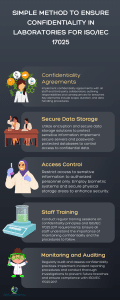
To meet ISO/IEC 17025 requirements, labs must put systems in place to control access to this information. That could mean:
Limiting who can view or edit client files
Using secure logins and passwords for your LIMS or database
Having staff sign confidentiality agreements
Keeping records of who accessed what—and when
And don’t forget: confidentiality applies both during and after the work is done. Even if a project ended two years ago, that data still needs to be treated with care.
So why does ISO/IEC 17025 Impartiality and Confidentiality place such strong emphasis on this? Because losing client trust can be just as damaging as producing bad results. A single data leak, even if unintentional, can lead to legal trouble or loss of business.
Confidentiality isn’t just about policies—it’s about culture. Everyone in the lab should understand that protecting client information is part of the job, not just an IT issue or management task.
In the next section, we’ll take this one step further and look at how to handle external disclosures, third-party access, and situations where the line between confidentiality and legal obligation can get a little tricky. Let’s keep going.
Managing Third-Party Access and Legal Disclosures
Here’s where things can get a little more complicated. While ISO/IEC 17025 Impartiality and Confidentiality emphasizes the need to protect client information, there are moments when sharing that information becomes necessary—like when the law requires it, or when you’re working with external service providers.
Let’s break this down clearly.
Under ISO/IEC 17025, labs must maintain confidentiality unless disclosure is required by law. So, if a regulatory body or court order demands access to specific records, the lab is obligated to comply—but with conditions. You must inform the client in advance, unless you’re legally prohibited from doing so. This keeps everything transparent and preserves trust.
Another common scenario? Subcontracting. Sometimes labs send certain tests or calibrations to external labs. In those cases, ISO/IEC 17025 still expects you to uphold your client’s confidentiality. That means:
Carefully selecting subcontractors who are also bound by confidentiality agreements
Not sharing more information than necessary
Making sure clients are aware and have agreed to subcontracting in advance
This aspect of ISO/IEC 17025 Impartiality and Confidentiality is often overlooked, but it’s just as important as internal data protection. Any third party you bring into the process becomes part of your responsibility.
Also, think about IT providers, auditors, or consultants who may access your systems. Even if they’re not directly involved in testing, they could still view sensitive data. So it’s essential to:
Use non-disclosure agreements (NDAs)
Limit system access by role or function
Keep a record of who has temporary access and why
ISO/IEC 17025 Impartiality and Confidentiality isn’t just about locking away files—it’s about managing how information flows in and out of the lab. And that includes being clear with clients about when disclosures might happen, and how their data is being handled at every step.
Next, we’ll talk about how to build a lab culture where impartiality and confidentiality are second nature—so these practices don’t just live on paper, but show up in daily behavior across your team. Let’s get into that.
Building a Culture of ISO/IEC 17025 Impartiality and Confidentiality
Policies and procedures are important—but they’re only as effective as the people using them. That’s why ISO/IEC 17025 Impartiality and Confidentiality isn’t just about documents on a shelf. It’s about creating a day-to-day lab environment where fairness and discretion are second nature to everyone involved.
So how do you build that kind of culture? It starts with clarity. Everyone in the lab—technicians, admin staff, quality managers—should clearly understand what impartiality and confidentiality mean in the context of their own role.
Here are a few simple ways to make it part of your lab’s DNA:
Include impartiality and confidentiality in onboarding and refresher training New team members should know right from the start what the expectations are. Reinforce those expectations regularly, not just during audits.
Encourage open discussion about risks Make it normal to speak up if something feels like it could create bias or compromise confidentiality. The more comfortable your team feels flagging concerns, the easier it is to fix small issues before they grow.
Incorporate ISO/IEC 17025 Impartiality and Confidentiality into internal audits Don’t just check for missing signatures or incomplete forms. Look at behaviors, access logs, and decision-making patterns. Are people sticking to their roles? Are data access points properly secured?
Lead by example If leadership doesn’t take impartiality and confidentiality seriously, no one else will. Show your team that these values matter—not just for accreditation, but for client trust and lab integrity.
Remember, ISO/IEC 17025 Impartiality and Confidentiality isn’t a one-time setup. It’s something that needs to be reinforced and reviewed regularly. As your client base, team, and technology evolve, so should your approach.
By weaving these principles into everyday operations, your lab can move from just complying with the standard to fully embodying it. And that’s when your system really starts to shine—not just to auditors, but to your clients and your team.
Next, we’ll bring everything together and look at why impartiality and confidentiality are such non-negotiable elements of ISO/IEC 17025—and how they support the credibility and success of your lab in the long run.
Why ISO/IEC 17025 Impartiality and Confidentiality Are Non-Negotiable
At this point, you can probably see just how essential ISO/IEC 17025 Impartiality and Confidentiality are to any accredited laboratory. But let’s take a moment to step back and really understand why these principles are considered non-negotiable in the eyes of the standard—and your clients.
The whole point of ISO/IEC 17025 is to ensure that laboratories produce reliable, trustworthy results. And that can’t happen if bias creeps into the process, or if client data isn’t handled with care. When you commit to impartiality, you’re saying, “Our results are free from influence—we’re here to tell the truth, not what someone wants to hear.” And when you prioritize confidentiality, you’re telling your clients, “Your information is safe with us.”
In fact, ISO/IEC 17025 Impartiality and Confidentiality serve as the foundation for everything else in the standard. You can have the most technically competent team and the most advanced equipment, but if impartiality or confidentiality is compromised, the credibility of your entire system is at risk.
That’s why accreditation bodies focus heavily on these areas during audits. They want to see that your lab:
Understands the risks to impartiality and manages them consistently
Has clear controls for handling confidential information
Applies these principles across all departments—not just in theory, but in real, day-to-day actions
It’s not about perfection—it’s about awareness, responsibility, and commitment. When your whole team understands what’s at stake and knows how to uphold ISO/IEC 17025 Impartiality and Confidentiality, your lab becomes more than just compliant—it becomes trusted.
So, whether you’re building your system from scratch or strengthening what you already have, make sure these two core principles are front and center. Because in the world of testing and calibration, trust isn’t just earned through results—it’s earned through integrity.
I hold a Master’s degree in Quality Management, and I’ve built my career specializing in the ISO/IEC 17000 series standards, including ISO/IEC 17025, ISO 15189, ISO/IEC 17020, and ISO/IEC 17065.
My background includes hands-on experience in accreditation preparation, documentation development, and internal auditing for laboratories and certification bodies.
I’ve worked closely with teams in testing, calibration, inspection, and medical laboratories, helping them achieve and maintain compliance with international accreditation requirements.
I’ve also received professional training in internal audits for ISO/IEC 17025 and ISO 15189, with practical involvement in managing nonconformities, improving quality systems, and aligning operations with standard requirements.
At QSE Academy, I contribute technical content that turns complex accreditation standards into practical, step-by-step guidance for labs and assessors around the world.
I’m passionate about supporting quality-driven organizations and making the path to accreditation clear, structured, and achievable.
Take the next step
Prepare your ISO/IEC 17025 certification with the complete kit
The complete documentation package to deploy an ISO/IEC 17025:2017-compliant laboratory management system: ready-to-use document architecture covering competence, methods, metrological traceability, uncertainty, and statements of conformity.