Last Updated on November 25, 2026 by Hafsa J.
Follow QSE Academy on Google
Add us as a preferred source to see our ISO and compliance articles more often in your Google results and Discover.

Hafsa J.
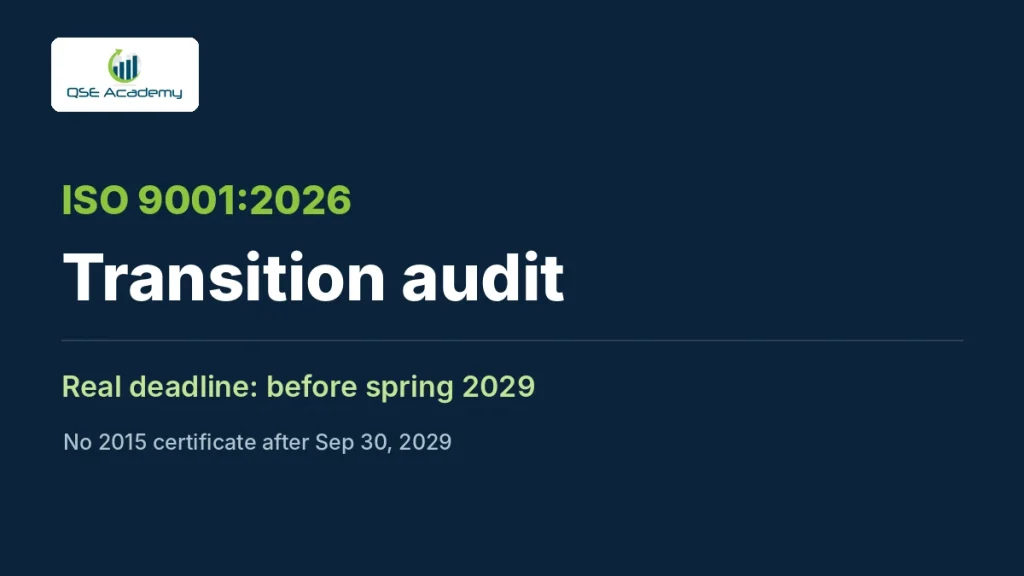
Everyone quotes September 30, 2029 as the end of ISO 9001:2015 certificates. That date is real, but it is the day it becomes too late, not the day to plan around. For your transition audit, the deadline that counts falls much earlier, and it is set by your own audit cycle. I would not plan around 2029 at all: put the transition on your last scheduled audit before spring 2029 at the latest, and earlier if you can.
Below I lay out the full calendar from the Global ACI transition document and the ANAB process for US certification bodies, then show where your real deadline sits depending on when your surveillance and recertification audits fall. Keep your audit schedule open next to this page.
Questions about your own case? Leave them in the comments at the bottom of the article, we read and answer every one.
Let’s get into it.
ISO 9001:2026 transition audit: the essentials in 30 seconds
The ISO 9001:2026 transition calendar, date by date
The calendar comes from Global ACI-TECH-3-TR 2029-09-30 (M), the Global ACI transition requirements for ISO 9001:2026, issued September 4, 2026 and applicable since September 16. Every period runs from the last day of the publication month, which makes the starting point September 30, 2026.
Global ACI, which took over from IAF and ILAC, makes the document mandatory for the accreditation bodies that signed its arrangement and for every certification body they accredit. In the United States, ANAB applies it through its own process, described in its Heads Up 564 on the ISO 9001:2026 transition of October 9, 2026. Global ACI counts more than one million accredited ISO 9001 certificates in scope.
Mar 31, 2027: accreditation bodies get ready
By this date, each accreditation body must be able to assess certification bodies against the new edition. If one is not ready, Global ACI section 6.1 requires it to notify Global ACI and every affected certification body in writing, with the delay and its possible impact. You have nothing to do at this stage except note the date.
Jun 30, 2027: the forgotten date
This is when certification bodies file their transition declaration with their accreditation body, using Annex A of the Global ACI document or an equivalent form. ANAB runs it as a self-declaration in its Audeee system, through a workflow it said would be issued by October 16, 2026, and set the same June 30, 2027 deadline for the completed form and supporting documents. ANAB also announced a revision of its QMS accreditation rule, AR 20.
Section 6.2.1 adds a duty toward you. A certification body that decides not to transition must inform all affected clients in writing by June 30, 2027, with information on certificate validity and on the consequences. Read the absence of a letter carefully. No letter on July 1 only means your body has not withdrawn in writing. It does not mean its 2026 accreditation is granted.
Sep 30, 2027: certification bodies switch to ISO 9001:2026
Accreditation bodies make their decisions by this date at the latest. Global ACI is clear that accredited certification to the 2026 edition follows the transition of the certification body’s own accreditation, and ANAB says the same in plain terms: no ANAB-accredited 2026 certificate until ANAB has made its transition decision and formally notified the body.
An audit is not a certificate. If someone offers you a 2026 audit before fall 2027, ask in writing under which accreditation your certificate will be issued, and when.
Mar 31, 2028: no more initial certifications to the 2015 edition
After this date, no first certification can be issued against the old edition. For a company already certified, nothing changes that day. For a company starting out, everything does: a 2015 certificate earned in March 2028 still expires on September 30, 2029. That is half a normal cycle for the same effort. If you are starting now, build on the 2026 text; the stages themselves are laid out in our step-by-step guide to the ISO 9001 certification process.
Sep 30, 2029: the deadline
All accredited 2015 certifications and accreditations lapse. Global ACI sets the transition of certified clients, certificate issuance included, before this date. The audit alone is not enough: the certification decision and the new certificate must be done too.
A company can still be audited against the old edition if it chooses not to transition (section 6.4), but its certificate ends that day, even if its cycle runs longer. A certification body may shorten the printed expiry date to avoid confusion in the market. It is the day it is too late, not the day you start.
What the ISO 9001:2026 transition audit covers
Global ACI section 5.2 first. The transition visit can be combined with a surveillance audit or a recertification audit, or run as a separate special audit. It must review, at a minimum, the changed requirements of ISO 9001:2026, changes to your context, and the need for any other changes to your management system. It can be carried out remotely under IAF MD 4 if the certification body can show the audit objectives are met.
Knowing what changed is your side of the work. Our article on what changes in ISO 9001:2026 and the transition timeline lists the clauses that move, and the ISO 9001:2026 requirements, clause by clause give the full detail an auditor will check.
How much extra audit time?
Global ACI answers possibly. The certification body must consider whether more time is needed and justify the calculation under ISO/IEC 17021-1 and IAF MD 5. At a minimum it looks at how much your system changes and whether the transition rides on an annual audit or a special one. A note adds that additional time may not be needed for a full system audit.
So ask for the justification before you sign. If the transition is planned on a recertification, the full system is audited anyway, and the note is on your side.
Surveillance or recertification: where your transition audit should land
That is the text. Here is my reading, case by case. The dates come from Global ACI; the advice is mine, and it assumes your certification body gets its 2026 accreditation before the September 30, 2027 deadline.
Your audit cycle sets your real deadline
Where the transition should fall, depending on your next scheduled audits
Recertification before fall 2027
Likely 2015
- Your body will often lack its 2026 accreditation. Plan the switch on the 2028 surveillance.
Recertification from late 2027 to early 2029
Best window
- A full system audit, where extra time may not be needed, provided your body is already accredited for 2026.
Recertification after Sep 2029
Use a surveillance
- Your last chance is a surveillance, ideally the 2028 one. Otherwise a special audit, quoted separately.
Surveillance between May and Sep 2029
Red zone
- A major nonconformity must be closed and the decision issued before Sep 30. I would not bet a certificate on it.
Source: Global ACI-TECH-3-TR 2029-09-30 (M), sections 4, 5.2 and 6; author’s reading of the timeline.
Two more cases. If ISO 9001 and ISO 14001 are audited together, your pivot becomes April 30, 2029, the end date in the Global ACI transition requirements for ISO 14001:2026. Put both transitions on the same visit, before that date.
Why push for margin? Because a transition audit can end with a finding, and a finding takes time to close. The certification decision then has to be made and the certificate issued before the end date. A plan that uses the last possible visit leaves no room for any of that.
Check your certification body before anything else
Your certification body’s dates are the ones that decide your plan, so verify who accredits it. The ANAB directory of accredited certification bodies listed 70 bodies accredited for ISO 9001 on November 25, 2026, 35 of them headquartered in the United States. ANAB is not the only route: IAS and accreditation bodies outside the US also accredit certification bodies working here, so check the body named on your certificate.
Then ask three questions in writing. When will it be accredited for the 2026 edition? Until when will it schedule audits against the 2015 edition? Will it bill extra transition time, and on what justification? The answers give you the two dates that matter for your certificate.
Four things to do this week
Not in two years. This week, in this order.
Ask for its expected 2026 accreditation date, its last date for 2015 audits, and its position on extra audit time with the justification.
Confirm the accreditation body and the ISO 9001 scope, in the ANAB directory or with the accreditation body named on your certificate.
Pick a surveillance or recertification that leaves at least one surveillance of margin before Sep 30, 2029, or before Apr 30, 2029 with ISO 14001.
Work through the changed clauses with your team before the audit, starting from documentation already written to the 2026 text.
For that last step, the ISO 9001:2026 documentation package gives you a manual, procedures and records built on the 2026 clauses, so the transition becomes a review of your system rather than a rewrite.
Where I put the real deadline
September 30, 2029 is the day it is too late. Your real limit is your last scheduled audit before spring 2029, and April 30, 2029 if ISO 14001 is audited with ISO 9001. One thing is left to do, and it fits in an email to your certification body.
ISO 9001:2026 transition audit: frequently asked questions
What is the deadline for the ISO 9001:2026 transition audit?+
The transition, certificate issuance included, must be completed before September 30, 2029. In practice, aim for your last scheduled audit before spring 2029, so you keep time to close a finding and get the certification decision.
Is the transition audit done at surveillance or recertification?+
Either one, or as a special audit. Global ACI allows a remote visit if the audit objectives are met. Recertification covers the whole system; surveillance comes earlier and leaves margin.
When does my ISO 9001:2015 certificate stop being valid?+
On September 30, 2029 at the latest, even if a later expiry date is printed on it. Until then it follows its normal cycle: surveillance audits, and recertification if it expires before that date.
When is the last possible ISO 9001:2015 audit?+
That depends on your certification body. Ask yours in writing until when it will schedule audits against the 2015 edition, and plan the transition before that date.
How much extra audit time should I expect?+
Global ACI says extra time is possible, to be justified by the certification body under ISO/IEC 17021-1 and IAF MD 5. It may not be needed for a full system audit. Ask for the justification before you sign.
What if my certification body does not transition?+
It must tell you in writing by June 30, 2027 (Global ACI section 6.2.1). You then have time to change bodies, after checking that the new one is accredited for the 2026 edition.
Which rules apply to ANAB-accredited certification bodies?+
ANAB applies the Global ACI document. Certification bodies file a self-declaration with supporting documents by June 30, 2027 and cannot issue ANAB-accredited 2026 certificates before ANAB’s decision. All accredited 2015 certifications must be transitioned by September 30, 2029.
I hold ISO 9001 and ISO 14001: which date should I use?+
Global ACI closes the ISO 14001:2026 transition on April 30, 2029, five months earlier. If both standards are audited together, group the two transitions before April 30.
Sources
- ISO 9001:2026, Quality management systems, Requirements (French edition), ISO, September 2026
- Global ACI-TECH-3-TR 2029-09-30 (M), Transition Requirements for ISO 9001:2026, version 1.1, issued September 4, 2026, sections 3.2, 4, 5, 6.1, 6.2.1 and 6.4
- Global ACI-TECH-3-TR 2029-04-30 (M), Transition Requirements for ISO 14001:2026, version 1.0, issued September 4, 2026
- ANAB Heads Up, Issue 564, ISO 9001:2026 Transition Process, October 9, 2026
- ANAB CB Directory, accredited certification bodies for ISO 9001, consulted November 25, 2026
Hafsa J. is the founder of QSE Academy. She is an engineer specialized in the food and agricultural industry, with a master's degree in QHSE management and more than 12 years as a quality manager.
She has helped more than 15 companies implement ISO 9001, ISO 22000, ISO 22716 and GMP, for food producers, cosmetics manufacturers, laboratories and service companies.
At QSE Academy, she writes about ISO 9001, food safety standards and the conformity assessment standards ISO/IEC 17020, ISO/IEC 17065 and ISO/IEC 17021-1. Her rule: a quality system should be simple, useful and efficient.