
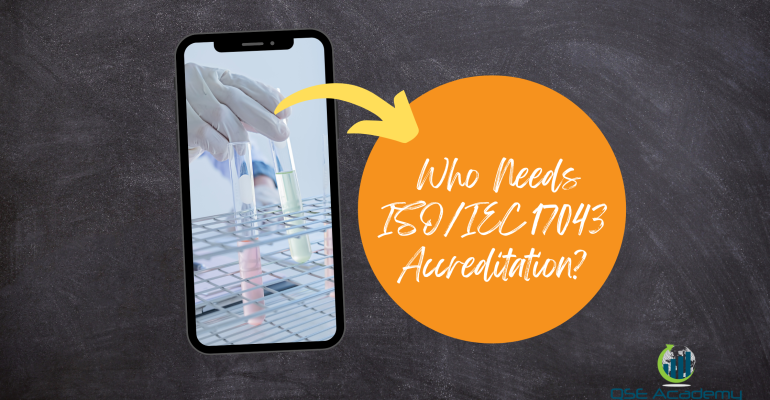
Who Needs ISO/IEC 17043 Accreditation?
Last Updated on December 23, 2025 by Hafsa J.
Who ISO/IEC 17043 Is Really For (and Who It Isn’t)
Here’s what I’ve noticed.
ISO/IEC 17043 often gets ignored until an assessor asks one uncomfortable question.
“Who designed your proficiency testing scheme?”
Suddenly, organizations realize they’re operating in a space they didn’t plan for.
ISO/IEC 17043 isn’t for every lab.
But if you’re coordinating, evaluating, or issuing performance results for other laboratories, this standard matters—a lot.
By the end of this article, you’ll know exactly:
- Whether ISO/IEC 17043 applies to your activities
- Where the common grey areas are
- How to avoid applying for the wrong accreditation
Let’s start with what the standard actually covers.
What ISO/IEC 17043 Accreditation Covers: Proficiency Testing in Plain Language
ISO/IEC 17043 applies to proficiency testing (PT) providers.
Not participants.
Not routine testing labs.
Providers.
A PT provider designs and runs schemes that evaluate how well laboratories perform.
That includes:
- Selecting and distributing test items
- Defining evaluation criteria
- Applying statistical analysis
- Reporting performance results
This is important because PT results influence:
- Accreditation decisions
- Regulatory confidence
- Client trust
One misconception I hear all the time is,
“We’re just coordinating results.”
But coordination is responsibility.
And responsibility triggers ISO/IEC 17043 expectations.
 Proficiency Testing Providers: When ISO/IEC 17043 Is Mandatory

If your organization offers PT schemes to external laboratories, ISO/IEC 17043 isn’t optional.
This includes:
- Commercial PT providers
- Industry or sector-specific PT scheme operators
- Independent interlaboratory comparison organizers
If you:
- Advertise PT services
- Charge participants
- Issue performance evaluations
Then accreditation bodies expect ISO/IEC 17043 alignment.
I’ve seen PT providers try to operate under ISO/IEC 17025 instead.
It doesn’t work.
Assessors stop the process early.
Pro tip:
If your output is a performance score, not a test result, you’re in ISO/IEC 17043 territory.
Laboratories Running PT or ILC Schemes: Do You Need ISO/IEC 17043?
This is where things get tricky.
Many ISO/IEC 17025 laboratories run interlaboratory comparisons.
Sometimes internally.
Sometimes externally.
If the activity is:
- Internal
- Informal
- Used only for internal quality improvement
ISO/IEC 17043 usually doesn’t apply.
But once you:
- Invite external participants
- Issue formal evaluations
- Use results beyond internal learning
You’ve crossed a line.
I’ve worked with labs that didn’t realize this until surveillance audits.
That’s not the moment you want clarity.
Pro tip:
Ask one question:
“Would an external party rely on these results to judge competence?”
If yes, ISO/IEC 17043 likely applies.
Regulators, Scheme Owners, and Accreditation Bodies: Indirect ISO/IEC 17043 Expectations
Some organizations don’t provide PT directly but still influence it.
Regulators.
Industry scheme owners.
Accreditation bodies.
They often:
- Specify PT participation requirements
- Approve or recognize PT providers
- Reference ISO/IEC 17043 explicitly
Over time, non-accredited PT schemes lose credibility.
Labs stop trusting the results.
Accreditation bodies stop accepting them.
That’s why many schemes eventually move toward ISO/IEC 17043 accreditation—even if it wasn’t required at the start.
Who Does NOT Need ISO/IEC 17043 Accreditation?
Let’s be clear. Not everyone needs this standard.
You typically do not need ISO/IEC 17043 if you are:
- A laboratory participating in PT schemes only
- Using PT solely for internal quality control
- A consultant or trainer not operating PT schemes
- A lab sharing informal comparison data with no evaluation
I’ve seen organizations overreact and pursue ISO/IEC 17043 unnecessarily.
That costs time.
And money.
Pro tip:
Accreditation should match activities—not ambitions.
ISO/IEC 17043 vs ISO/IEC 17025: Choosing the Right Accreditation
Here’s the simplest way I explain it to clients.
ISO/IEC 17025 says:
“We can test competently.”
ISO/IEC 17043 says:
“We can evaluate how well others test.”
Different goals.
Different risks.
Different assessments.
If you test samples, ISO/IEC 17025 applies.
If you evaluate testers, ISO/IEC 17043 applies.
If you do both, you may need both.
FAQs: Who Needs ISO/IEC 17043 Accreditation?
Do internal interlaboratory comparisons require ISO/IEC 17043?
No, as long as they’re strictly internal and not used for external evaluation or decision-making.
Can a laboratory hold both ISO/IEC 17025 and ISO/IEC 17043 accreditation?
Yes. This is common for organizations that test samples and also operate PT schemes.
Is ISO/IEC 17043 accreditation legally mandatory?
Not always by law, but often required by accreditation bodies, regulators, or industry programs.
Conclusion: Knowing Whether ISO/IEC 17043 Applies to You
ISO/IEC 17043 isn’t about paperwork.
It’s about trust.
If your organization influences how laboratory competence is judged, this standard matters.
The biggest mistakes I see aren’t technical.
They’re strategic.
Choosing the wrong standard.
Or realizing too late which one applies.
The smartest next step is simple.
Map what you actually do.
Then assess which standard truly fits.
I hold a Master’s degree in Quality Management, and I’ve built my career specializing in the ISO/IEC 17000 series standards, including ISO/IEC 17025, ISO 15189, ISO/IEC 17020, and ISO/IEC 17065. My background includes hands-on experience in accreditation preparation, documentation development, and internal auditing for laboratories and certification bodies. I’ve worked closely with teams in testing, calibration, inspection, and medical laboratories, helping them achieve and maintain compliance with international accreditation requirements. I’ve also received professional training in internal audits for ISO/IEC 17025 and ISO 15189, with practical involvement in managing nonconformities, improving quality systems, and aligning operations with standard requirements. At QSE Academy, I contribute technical content that turns complex accreditation standards into practical, step-by-step guidance for labs and assessors around the world. I’m passionate about supporting quality-driven organizations and making the path to accreditation clear, structured, and achievable.
Related Posts








ISO/IEC 17065 Training Course : Product, Process, and Service Certification
ISO 22716 2017 Online Training : Good Manufacturing Practices for Cosmetics

ISO/IEC 17021-1 Online Training – Management System Certification