NEW — The ISO 14001:2026, ISO/IEC 17020:2026 and FSSC 22000 V7 documentation kits are now available.
FSSC 22000 Version 7.0 published in May 2026 — V6 audits are no longer permitted after April 30, 2027. A V7 transition audit is mandatory.
FSSC 22000 Version 7.0 · Food Safety Management System (FSMS)

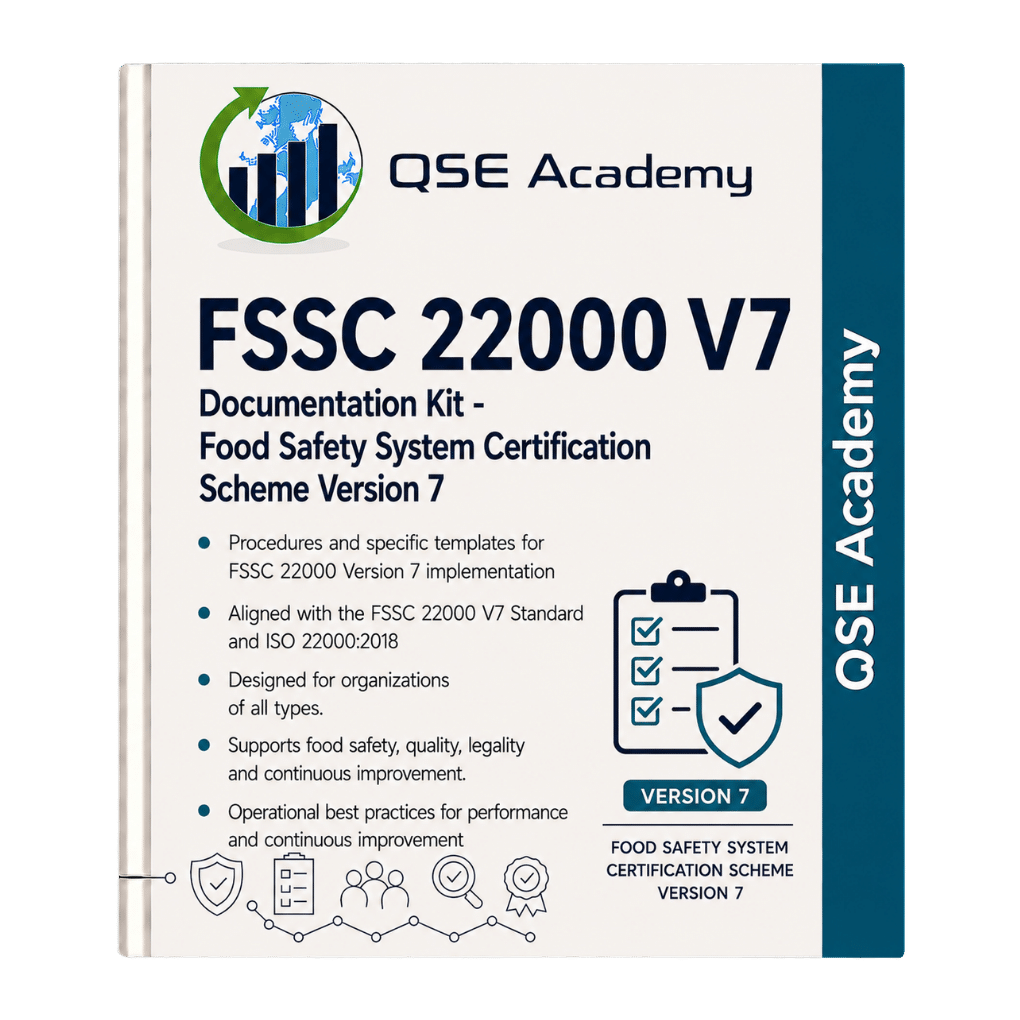
FSSC 22000 Version 7 Documentation Kit — food safety management system

Build your audit-ready FSSC 22000 V7 food safety management system in weeks, not months.

  • 129 documents built clause by clause
  • ISO 22000:2018 + prerequisite programs (ISO 22002-x:2025) + the 18 additional FSSC requirements
  • Editable procedures, HACCP plans, OPRPs, food defense (TACCP), food fraud (VACCP) and records
  • Built for accredited certification bodies (Bureau Veritas, SGS, DNV, LRQA, TÜV)
Get the FSSC 22000 V7 Kit — $389
Equivalent to $15,000 — $30,000 in consulting fees
Instant download 30-day guarantee Editable Word format
FSSC 22000 V7 Documentation Kit
129
Documents included
10
Scheme sections covered
152
FSSC V7 requirements mapped
98
Fundamental requirements covered
Who this kit is for

Built for food businesses pursuing FSSC 22000 certification.

The FSSC 22000 V7 kit is for any operator in the food chain preparing a first certification, transitioning from V6 to V7, or consolidating an existing system ahead of a recertification audit.

1

Sites pursuing first certification

Manufacturers in processing, packaging, storage or food transport preparing their first FSSC 22000 V7 certification with an accredited certification body (Bureau Veritas, SGS, DNV, LRQA, TÜV).

2

Sites transitioning from V6 to V7

Organizations already certified to V6 that need to align their system with the new ISO 22002-x:2025 series, the GFSI 2024 benchmark and the reinforced requirements (culture, allergens, fraud). A V7 upgrade audit is required starting May 1, 2027.

3

Quality and food safety managers

Quality managers, food safety managers and HACCP teams who want a complete documentation base rather than starting from a blank page for 129 documents.

4

Consultants and advisory firms

Food safety consultants and advisory firms that want a validated documentation base to launch FSSC 22000 V7 engagements quickly (consultant license available on request).

Why this kit exists

An FSSC 22000 V7 system isn't written from a blank page.

FSSC 22000 V7 combines ISO 22000:2018 (clauses 4 to 10), the ISO 22002-x:2025 prerequisite program series and 18 additional FSSC requirements (2.5.1 to 2.5.18). That adds up to 152 requirements to cover, including 98 fundamental requirements. Each requirement calls for written procedures, documented plans and records as evidence. Building it all in-house takes 6 to 10 months and exposes you to major nonconformities at audit.

01

Generic templates don't cover the FSSC scheme

Most templates online are ISO 22000 adaptations. They ignore the requirements unique to the FSSC V7 scheme: food defense (TACCP), food fraud prevention (VACCP), allergen management with test evidence, risk-based environmental monitoring, and food safety culture.

02

V6 is no longer auditable after April 30, 2027

The FSSC Foundation set a 12-month transition period from publication (May 2026). Audits against V6 are no longer permitted after April 30, 2027; V7 upgrade audits run from May 1, 2027 to April 30, 2028. Sites that fail to transition lose their certification.

03

Your supply chain requires GFSI certification

FSSC 22000 is GFSI-recognized and required by major retailers and brands as a condition for approved-supplier status. Without a current certification, access to export markets and key accounts is structurally at risk.

04

A consulting engagement costs $15,000 to $30,000

A full FSSC 22000 implementation billed by a specialized firm represents 20 to 50 days of work. The documentation kit gives you the complete written base — you keep your budget for on-site implementation and validation of your control measures.

What's included

129 documents organized by scheme section and by requirement.

The kit covers the 10 sections of the FSMS scheme: ISO 22000:2018 (clauses 4 to 10), the ISO 22002-x prerequisite programs (PRP.01 to PRP.20), the 18 additional FSSC 22000 V7 requirements (2.5.1 to 2.5.18) and the certification process (CERT.01 to CERT.04).

Clause 4

Context of the organization

  • Context analysis procedure (PESTEL / SWOT)
  • Internal and external context analysis form
  • Climate change assessment form
  • Interested parties register
  • Food safety regulatory watch procedure
  • FSMS process map
Clause 5

Leadership

  • Top management commitment and leadership
  • Food safety policy
  • Evidence of policy communication
  • Org chart, roles and authorities
  • Responsibility matrix and job descriptions
Clause 6

Planning

  • Risk and opportunity management procedure
  • Risk register and action plan
  • Measurable food safety objectives table
  • Management of change procedure
Clause 7

Support

  • FSMS management system manual
  • Control of documented information procedure
  • Competence matrix and training plan
  • Supplier and purchasing control procedure
  • Internal and external communication plan
  • Staff awareness procedure
Clause 8 — HACCP

Operational realization

  • Food safety team charter and composition
  • Raw material and finished product specifications
  • Flow diagrams verified on site
  • Hazard analysis study (biological, chemical, physical, allergen)
  • Hazard control plan — HACCP plan and OPRPs
  • CCP and OPRP monitoring records
  • Upstream and downstream traceability procedure
  • Product withdrawal and recall procedure
Clause 9

Performance evaluation

  • Monitoring, measurement and analysis plan
  • Annual internal audit program
  • Internal audit report and finding sheet
  • Management review procedure
  • Management review minutes
Clause 10

Improvement

  • Nonconformity handling procedure
  • Nonconformity and corrective action register
  • FSMS continual improvement plan
Section 11 — PRP

Prerequisite programs (22 docs)

  • Facility layout, zoning and flow (risk-based separation)
  • Control of utilities (water, air, steam)
  • Cleaning and sanitation plan (+ ATP validation)
  • Pest control plan
  • Hygiene, maintenance and CIP procedures
  • Cross-contamination prevention
  • Shipping, transport, storage
Section 12 — FSSC

Additional requirements (32 docs)

  • Food defense plan (TACCP)
  • Food fraud vulnerability assessment (VACCP)
  • Allergen management plan + testing
  • Environmental monitoring program
  • Food safety culture plan
  • Control of foreign matter, weight, quantity
  • Management of services, labeling, FSSC logo
  • Notification to the CB within 3 business days
  • Multi-site and central function management
Section 13

Certification process

  • Draft scope statement validated with the CB
  • Audit nonconformity response procedure
  • Certificate data verification form
  • ICT agreement and feasibility test
Cross-cutting tools

Checklists, matrices, grids

  • FSSC 22000 V7 internal audit grid — 10 sections
  • FSSC V7 requirement mapping matrix
  • Implementation checklist for all 152 FSSC V7 requirements
  • Annual recall plan test procedure (mock recall)
  • Annual mock recall exercise report
Delivery formats

Editable Word & Excel

  • 82 editable Word documents (.docx)
  • 47 Excel files (.xlsx): registers, matrices, grids
  • Neutral design ready for your logo
  • No locked PDFs, no software dependency
Delivery format: all documents are delivered as fully editable Microsoft Word (.docx) files, with a neutral design ready to take your logo. No locked PDFs, no software dependency. Registers, matrices, grids and checklists are delivered as Excel files.
Section-by-section mapping

Every FSSC 22000 V7 requirement → a document in the kit.

FSSC 22000 Version 7.0 was published in May 2026. The scheme has 152 requirements across 10 sections, including 98 fundamental requirements — 36 in section 12 alone (additional FSSC requirements) and 28 in section 8 (operational realization). Here is the section-by-section correspondence between the scheme and the documents provided — this is what a certification body auditor checks first.

Section FSSC 22000 V7 requirement Documents provided in the kit
Cl. 4 Context of the organization: internal and external issues, climate change, interested parties, scope, process map Context analysis Climate change Interested parties Regulatory watch Scope statement Process map
Cl. 5 Leadership: top management commitment, food safety policy, roles, responsibilities and authorities Management commitment Food safety policy Policy communication Org chart Responsibility matrix
Cl. 6 Planning: risks and opportunities, measurable food safety objectives, management of change Risk management Risk register Food safety objectives Management of change
Cl. 7 Support: resources, competence and training, suppliers, communication, manual, documented information FSMS manual Documented information Competence & training Supplier control Communication Awareness
Cl. 8 Operational realization: food safety team, HACCP, hazard analysis, control plan (CCP / OPRP), traceability, emergencies, withdrawal / recall Food safety team charter Flow diagrams Hazard analysis HACCP & OPRP plan CCP monitoring Traceability Withdrawal / recall
Cl. 9 Performance evaluation: monitoring and measurement, internal audit, management review Monitoring plan Internal audit program Audit report Management review
Cl. 10 Improvement: nonconformities and corrective actions, continual improvement NC handling NC register Continual improvement
Sec. 11 Prerequisite programs (ISO 22002-x): facilities, zoning, utilities, waste, cleaning, pest control, hygiene, transport, storage Facility layout & zoning Control of utilities Cleaning & sanitation Pest control Personnel hygiene Cross-contamination Shipping & transport
Sec. 12 The 18 additional FSSC requirements (2.5.1 to 2.5.18): management of services, labeling and artwork, food defense (TACCP), fraud (VACCP), logo, allergens, environmental monitoring, food safety culture, quality control, inventory, foreign matter, PRP inspections, design, equipment, food loss and waste, notification to the CB, multi-site Food defense (TACCP) Food fraud (VACCP) Allergen management Environmental monitoring Food safety culture FSSC logo Foreign matter
Sec. 13 Certification process: scope validated with the CB, response to audit nonconformities, certificate verification, ICT agreement CB-validated scope Audit NC response Certificate verification ICT agreement
Cross-cutting Management and verification tools: internal audit grid, requirement mapping matrix, checklist of all 152 requirements, mock recall procedure and report V7 internal audit grid Requirement mapping 152-requirement checklist Mock recall
Not included Documents specific to each process and each product — which must be established case by case by your team based on the nature of your products and process Product-specific technical specifications Laboratory analysis methods Actual test results (allergen, micro) Site-specific flow diagrams Equipment calibration certificates Specific supplier contracts
Why these documents cannot appear in any kit — from any vendor.

Product technical specifications, analysis methods, actual test results and flow diagrams are by nature specific to each site and each process. They depend on the nature of your raw materials, your production lines, your target populations and your regulatory context.

A kit claiming to provide these elements pre-filled would expose the site to a major nonconformity with clause 8: a generic hazard analysis is not defensible, a HACCP plan not tailored to the process compromises control, and copied test results invalidate the validation of your control measures.

The QSE Academy kit instead provides every procedure, every plan, every grid and matrix in which these technical deliverables take shape: a structured hazard analysis study, a HACCP plan, a significance evaluation grid, an allergen management plan — the complete documentation framework into which your specific process fits.
For food safety professionals

Technical compliance — what an experienced FSSC auditor checks first.

Beyond the section-by-section mapping, here are the points of technical rigor that food safety managers, quality managers and certification auditors examine first in V7.

  • New ISO 22002-x:2025 series — the PRPs are based on the revised 2025 series, including ISO 22002-100:2025 as a cross-cutting foundation; documented alignment is mandatory
  • Hazard analysis — reasonably foreseeable biological, chemical, physical and allergen hazards (§ 8.5.2.2), with acceptable levels, a significance evaluation grid and categorization of control measures as CCPs or OPRPs
  • HACCP plan and OPRPs — clear CCP / OPRP distinction, critical limits, monitoring, corrective actions and documented validation of control measures
  • Food defense (TACCP) — documented threat assessment and defense plan, reviewed annually
  • Food fraud (VACCP) — vulnerability assessment and mitigation plan, a reinforced requirement in V7
  • Allergen management — cross-contact risk assessment and test evidence now required (2.5.6)
  • Environmental monitoring — risk-based program, Listeria / Salmonella results, documented action thresholds
  • Food safety culture — a food safety culture plan with measurable objectives and evidence of staff engagement (2.5.8)
  • Food loss and waste reduction — policy and objectives with measurable targets and deadlines (2.5.16.a), aligned with the UN SDGs
  • Traceability and mass balance — periodic upstream and downstream tests including mass balance and rework traceability (§ 8.3)
  • Notification to the certification body — any serious event must be reported to the CB within 3 business days (2.5.17.a): public recalls, regulatory actions, prosecutions, fraud
  • Audit with ICT approach — by written agreement with the CB: feasibility assessment, an on-site component of at least 1 day and 50% of total duration, full audit completed within 30 calendar days (CERT.04)
  • V6 to V7 transition — a requirement mapping matrix identifying new or reinforced requirements. V6 audits are no longer permitted after April 30, 2027.
G

FSSC 22000: GFSI international recognition

FSSC 22000 is a GFSI-recognized scheme (Global Food Safety Initiative), required by major retailers and brands worldwide. A compliant kit positions you for a certification recognized by leading accredited bodies.

Bureau Veritas SGS DNV LRQA TÜV GFSI recognition (global) Major retail
Comparison

Why the QSE Academy kit over the alternatives.

Criterion QSE Academy FSSC 22000 V7 Kit
$389
Free templates
$0
Consulting firm
$15,000 — $30,000
Specific to the FSSC V7 scheme (not just ISO 22000)
Coverage of all 10 V7 scheme sections ✓ 100% Partial ✓ 100%
TACCP, VACCP, allergens, food safety culture included ✓ Included Depends on engagement
Checklist of all 152 FSSC V7 requirements ✓ Excel Depends on engagement
Editable Word format, neutral design Varies
Time to availability Immediate Immediate 6 to 10 months
Money-back guarantee ✓ 30 days
On-site implementation and validation Your responsibility Your responsibility Included
The kit does not replace the on-site implementation of your PRPs or the validation of your control measures — it gives you the complete written base and the management tools. That is precisely the part where firms bill the most. For support tailored to your process or preparation for your certification audit, we also offer custom services.
FSSC 22000 V7 flash audit

Where do you stand today?

Answer 12 questions section by section to get your FSSC 22000 V7 maturity score. Instant result, free, no personal information required.

Question 1 / 12
Clause 4 — Context
0
/ 100

Get the FSSC 22000 V7 Kit — $389
Deployment plan

From order to certification audit, here's the path.

The kit isn't just delivered. Here is the concrete path to put it into production at your site, phase by phase, aligned with the kit's deployment plan.

1
Weeks 1 to 6

Customization

Adapting the 30 core documents to the site: policy, commitment, org chart, process map, food safety team, HACCP study (materials, products, flows, hazard analysis, control plan), manual and FSMS scope.

2
Weeks 6 to 14

Implementation

Deploying the 78 field documents: PRPs, staff training, monitoring records, traceability, food defense (TACCP), food fraud (VACCP), allergen management.

3
Weeks 14 to 18

Mock audit

Full internal audit against the V7 grid, validation and verification, environmental monitoring, mock recall, gap identification and corrective action plan (15 documents).

4
Week 18 and beyond

Certification audit

Management review, annual verifications, scope preparation and nonconformity response, certification audit by the accredited body (6 documents).

Typical timeline: 18 to 24 weeks between the order and "certification-audit ready." The most structured organizations get there in 12 weeks; those starting from scratch can take up to 36 weeks. It's the on-site implementation that makes the difference, not the kit.
Trusted by certified sites

What quality managers who used it have to say.

★★★★★

A huge time-saver. The procedures were clear, complete and immediately usable. We passed our FSSC 22000 certification on the first try, and the HACCP control plan with the OPRP records saved us weeks.

D
David R.
Quality Manager · Dairy processing
★★★★★

Written by people who really know the FSSC scheme. The V6-to-V7 transition matrix kept us from missing the April 2027 deadline. The food defense plan and the fraud assessment were exactly what I needed.

S
Sarah M.
Food Safety Manager · Canned foods
★★★★☆

Unbeatable value. We deployed our FSSC V7 system in 16 weeks instead of the 8 months we'd expected with an outside consultant. The cleaning plans, the environmental monitoring and the 152-requirement checklist were operational right away.

M
Michael T.
Technical Director · Ready meals
★★★★★

Fully customizable Word documents, neutral design, precise terminology, an FSSC 22000 V7 scheme perfectly aligned with what the certification body expects. The allergen management procedure and the food safety culture plan are operational. Solid work.

J
Jennifer L.
Quality Systems Manager · Industrial bakery
Risk-free

30-day money-back guarantee.

30-DayMoney-BackGuarantee

Try the kit. If you change your mind, we refund you.

You have 30 days to download the kit, review its contents, open the documents and confirm the writing quality meets your expectations. If something isn't right, you send us a simple email — no justification needed — and your refund is processed within 5 business days.

The kit evolves with you

Updates included free of charge.

The FSSC scheme evolves with FSSC Foundation decisions, ISO 22002-x revisions and GFSI requirements. The kit you buy today shouldn't become obsolete in 6 months. That's why updates are included.

Standard updates included

The kit already incorporates FSSC 22000 Version 7.0, ISO 22000:2018, the ISO 22002-x:2025 series and GFSI 2024 alignment. If the FSSC Foundation issues a new decision, an ISO 22002-x revision or a change in requirements, you receive the kit updates free of charge.

  • FSSC Foundation decisions and guidance
  • ISO 22002-x (PRP) revisions
  • Changes to the GFSI benchmark
  • ISO 22000 amendments
  • Email notifications at publication
Frequently asked questions

Answers to your most common questions.

Is the kit enough to obtain FSSC 22000 V7 certification?

The kit gives you the complete documentation base required by FSSC 22000 Version 7.0 (ISO 22000:2018 + ISO 22002-x prerequisite programs + additional FSSC requirements). To obtain certification, you also need to complete the documents with your real data (site-specific hazard analysis, HACCP plan, validation of control measures), deploy the PRPs on site, and pass the certification audit with an accredited body. The kit saves you the 6 to 10 months of writing. On-site implementation remains your work (typically 12 to 16 additional weeks).

I'm certified to FSSC 22000 V6. Is the transition urgent?

Yes — the deadline is approaching. The FSSC Foundation set a 12-month transition period from the publication of V7 (May 2026). Audits against V6 are no longer permitted after April 30, 2027; V7 upgrade audits run from May 1, 2027 to April 30, 2028. Your practical deadline is your next surveillance or recertification audit. The kit includes a requirement mapping matrix identifying the new and reinforced requirements (ISO 22002-x:2025 PRPs, allergens, fraud, food safety culture) to accelerate your transition.

What are the main changes in V7 compared with V6?

V7 incorporates the new ISO 22002-x:2025 series (including ISO 22002-100:2025 as a cross-cutting foundation), aligns with the GFSI 2024 benchmark, reinforces requirements for food safety culture, allergen management (test evidence now required) and food loss and waste reduction (measurable objectives, UN SDG alignment), and clarifies the structure of the food chain categories. The kit covers all of these changes.

Does the kit cover the ISO 22002-x prerequisite programs?

Yes. Section 11 of the kit includes 22 PRP documents: facility layout and zoning, control of utilities (water, air, steam), waste management, cleaning and sanitation plan (+ ATP / micro validation), pest control, personnel hygiene, cross-contamination prevention, cleaning-in-place (CIP), shipping and transport, storage. These documents are based on the ISO 22002-x:2025 series.

How is this different from free FSSC templates?

Most free templates are ISO 22000 adaptations without the FSSC scheme. They ignore the additional requirements unique to V7: food defense (TACCP), food fraud prevention (VACCP), allergen management with testing, risk-based environmental monitoring, food safety culture, management of services and the FSSC logo. The QSE Academy kit is written specifically for FSSC 22000 V7 and includes the verifiable section-by-section mapping plus the checklist of all 152 requirements.

How long does it take to adapt the kit to my site?

Allow 4 to 6 weeks for the customization phase of the 30 core documents: logo, org chart, scope, food safety team, HACCP study (materials, products, flows, hazard analysis). Then plan for the on-site implementation of the PRPs, training and monitoring records — another 8 to 12 weeks depending on process complexity.

Is the kit delivered in Word or PDF?

All procedures, policies, plans and manuals are delivered as fully editable Microsoft Word (.docx) files (82 documents). Registers, matrices, audit grids, checklists and dashboards are delivered as Excel (.xlsx) files (47 files). No locked PDFs, no software dependency. The design is neutral, ready to take your logo and colors.

Does the kit cover food defense and food fraud?

Yes. Section 12 includes the threat assessment and food defense plan (TACCP), the food fraud vulnerability assessment (VACCP) and the fraud mitigation plan. These additional FSSC requirements are reinforced in V7 and systematically checked at the certification audit.

How many users and sites does the license cover?

The single-site license covers one legal entity, with unlimited internal use (your entire food safety staff can use the kit). For a multi-site deployment, a group with several subsidiaries, or consultant use across multiple clients, contact us for a suitable license.

What happens if I'm not satisfied?

You're covered by a 30-day money-back guarantee, no conditions. You send us a simple email — no justification needed — and your refund is processed within 5 business days.

Take action

Your certification-ready FSSC 22000 V7 base. Available today.

129 documents, all 10 FSMS scheme sections covered + ISO 22002-x:2025 PRPs + the 18 additional FSSC requirements + a checklist of all 152 requirements (including 98 fundamental) + the requirement mapping matrix included. Instant download after payment.

Equivalent to $15,000 — $30,000 in consulting fees
$389 Single-site license · Secure payment · Instant download
Get the FSSC 22000 V7 Kit — $389
30-day guarantee Instant download Updates included Editable Word format