
Last Updated on May 15, 2026 by Hafsa J.
Follow QSE Academy on Google
Add us as a preferred source to see our ISO and compliance articles more often in your Google results and Discover.
ISO/IEC 17025 2017 Main changes
If you’re working in a testing or calibration laboratory, you’ve probably heard about the ISO/IEC 17025 2017 main changes—and if you haven’t, now’s the perfect time to catch up. This revision marked a major update to the standard, and it’s not just about tweaking a few terms or rearranging sections. The 2017 version brought a full refresh of how laboratories are expected to operate, manage risk, and prove their competence.
Why does it matter? Because staying compliant isn’t just about checking boxes—it’s about keeping your lab trustworthy, efficient, and internationally recognized. The ISO/IEC 17025 2017 main changes affect everything from how labs handle documentation to how they define competence, impartiality, and even risk.
Here’s a quick look at what this revision focused on:
-
Aligning with modern ISO standards like ISO 9001
-
Introducing risk-based thinking instead of old-school preventive actions
-
Broadening the scope to include IT systems and sampling
-
Offering more flexibility in lab methods and management systems
Whether you’re updating your system or starting from scratch, understanding the ISO/IEC 17025 2017 main changes is a critical first step. Let’s break it all down—simply, clearly, and one section at a time.
Shift to a Process-Based Approach
One of the most important ISO/IEC 17025 2017 main changes is the shift toward a fully process-based approach. If you’re wondering what that really means, don’t worry—it’s not as complicated as it sounds. Essentially, the 2017 revision encourages laboratories to think about their work as a series of connected processes rather than isolated tasks. This approach helps improve consistency, accountability, and overall performance.
The update brings ISO/IEC 17025 in line with other modern ISO standards, especially ISO 9001. This alignment is a big deal. It makes life easier for organizations that follow multiple standards by creating a more unified structure across different systems.
Let’s look at what this shift includes:
-
High-Level Structure (HLS): This is the core framework used across many ISO standards now. It standardizes key terms, headings, and structures, so if you already work with ISO 9001, the new layout of ISO/IEC 17025 will feel more familiar.
-
Risk-Based Thinking: Instead of waiting for problems to occur and reacting to them, the new version asks labs to be proactive. You’re expected to identify potential risks, evaluate them, and take steps to prevent issues before they happen. This replaces the old “preventive action” requirement.
-
Clearer Process Links: Activities like equipment calibration, personnel training, document control, and customer communication are no longer treated as standalone items. They’re viewed as part of an interconnected system that flows from one process to the next.
By focusing on how each part of the lab’s workflow connects, these ISO/IEC 17025 2017 main changes help create a more logical and efficient quality management system. It also makes it easier to spot weak points, streamline operations, and demonstrate technical competence to clients and accreditation bodies.
This process-based model may take a bit of adjusting, but once it’s in place, it often leads to smoother operations and fewer surprises. And that’s a win for any lab.
Updated Terminology and Definitions
Another key area where the ISO/IEC 17025 2017 main changes really stand out is in the language. Now, you might not think word choices matter all that much, but in a standard like this, they absolutely do. Even small tweaks in terminology can change how labs approach everything from documentation to how they prove impartiality or competence.
Let’s break down a few of the more noticeable updates.
First off, the 2017 revision introduces clearer and more modern definitions that reflect how laboratories actually work today. Terms like “decision rule,” “risk,” and “impartiality” are now defined more precisely, leaving less room for interpretation and confusion. This is a big improvement over earlier versions, where some terms felt a little vague or outdated.
Here are some terminology updates you’ll want to pay attention to:
-
“Decision Rule” is now clearly defined, and labs must apply it when making pass/fail judgments. This ensures consistency and transparency in how results are reported to customers.
-
“Impartiality” has become more than just a nice idea—it’s a requirement. Labs must identify and manage risks to impartiality, and show evidence that they’re staying neutral and unbiased.
-
“Risk” is now a central concept. It’s no longer limited to just health or safety risks—it includes anything that could affect the lab’s ability to produce valid results.
These changes might seem small on the surface, but they make a big difference in day-to-day operations. The updated language helps labs understand exactly what’s expected and how to align with the standard more effectively.
Also, one of the most practical ISO/IEC 17025 2017 main changes is how these new definitions affect documentation. Labs are now expected to describe processes and maintain records using this updated terminology. That means procedures may need to be rewritten or restructured to reflect the new vocabulary.
At the end of the day, these adjustments aren’t just about being technically correct—they’re about creating a shared understanding. When everyone’s speaking the same language, it’s easier to ensure quality, avoid misunderstandings, and stay compliant with the revised standard.
So, yes, the ISO/IEC 17025 2017 main changes go beyond structure—they touch the very words we use to talk about quality and competence. And that clarity? It’s a big step forward.
Expanded Scope of Laboratory Activities
One of the most practical and forward-thinking ISO/IEC 17025 2017 main changes is the expansion of the standard’s scope. In the past, there was sometimes confusion about what exactly fell under ISO/IEC 17025—was it just about testing and calibration? What about sampling? Or using software for data analysis?
Well, the 2017 revision clears all that up. Now, it’s crystal clear that sampling, testing, calibration, and even the use of laboratory information systems are all officially part of the scope. That means the standard now fully recognizes how modern labs operate in the real world—not just in theory.
Here’s what’s been added or clarified in the expanded scope:
-
Sampling is now explicitly included. This is big. If your lab performs sampling as part of testing or calibration, you’re now directly covered under the standard. You’ll need to demonstrate that your sampling processes are technically valid and well-documented.
-
Digital tools and IT systems are acknowledged. The standard now accepts that laboratories rely on software, spreadsheets, and automated equipment. That means validation and control of these tools are expected—something that wasn’t clearly addressed before.
-
Flexibility in methods is now supported. Labs can use non-standard or in-house developed methods, as long as they’re validated and fit for purpose. This is one of the most welcomed ISO/IEC 17025 2017 main changes, especially for labs dealing with unique or highly specialized testing.
The idea behind all of this is to make the standard more adaptable to different types of labs and industries. Whether you’re working in pharmaceuticals, food safety, environmental science, or electronics, the expanded scope means the standard now fits your work more naturally.
So, if you’re implementing or updating your system, keep in mind that the ISO/IEC 17025 2017 main changes don’t just affect how you document or manage—it also impacts what parts of your operation are officially recognized. And that kind of clarity makes it easier to build a system that actually supports your work, instead of just checking off requirements.
In short, the standard grew up—and it finally caught up with the way labs really function today.
Reorganized Standard Structure
Now let’s talk about something that might not seem exciting at first—but actually makes a huge difference: how the standard is organized. One of the more noticeable ISO/IEC 17025 2017 main changes is the complete reorganization of the standard’s structure. If you’ve worked with the previous version, you’ll quickly see that things don’t look the same anymore—and that’s a good thing.
The 2017 revision groups the requirements into five clearly defined sections. This layout makes it easier to understand what the standard expects from your lab, and how all the different parts of your management system fit together.
Here’s a quick breakdown of the new structure:
-
General Requirements: This section covers impartiality and confidentiality—two foundational principles that every lab must demonstrate.
-
Structural Requirements: Think of this as the “who’s in charge” section. It focuses on organizational roles, responsibilities, and the overall structure of the lab.
-
Resource Requirements: This includes everything you need to do the work—personnel, facilities, equipment, and support services.
-
Process Requirements: Here’s where the day-to-day activities live—things like sampling, method validation, handling test items, and reporting results.
-
Management System Requirements: This part focuses on maintaining and improving your quality system. It includes internal audits, management reviews, and corrective actions.
Another important part of the ISO/IEC 17025 2017 main changes is the introduction of two options for managing your quality system:
-
Option A follows the process-based structure laid out in this version of the standard. It’s designed for labs that don’t necessarily use ISO 9001 but still want a solid internal system.
-
Option B allows labs to align their management system with ISO 9001. If your lab is already ISO 9001 certified, this route makes integration a lot smoother.
This reorganized layout brings much-needed clarity. Instead of jumping around trying to figure out where requirements live, everything is laid out in a logical flow. It’s one of those ISO/IEC 17025 2017 main changes that might not seem groundbreaking, but it really improves how you navigate and apply the standard.
So, if the old layout ever felt a bit confusing or scattered, the new structure is like getting a clear roadmap—everything’s in its place, and it’s easier to follow from start to finish.
Enhanced Focus on Impartiality and Confidentiality
Let’s be honest—when you think about lab operations, “impartiality” and “confidentiality” might not be the first things that come to mind. But in the world of accreditation, they’re absolutely essential. And that’s why one of the standout ISO/IEC 17025 2017 main changes is the much sharper focus on both.
In the previous version of the standard, impartiality and confidentiality were addressed, but not in great depth. The 2017 revision gives these concepts the attention they really deserve. Now, they’re not just scattered mentions—they have their own dedicated clauses, with clear expectations and responsibilities.
Here’s what’s changed:
-
Impartiality is front and center. Labs are now required to identify any risks to impartiality in their work—things like conflicts of interest, external pressures, or internal biases—and take action to address them. The key idea is that labs must be able to prove that their results aren’t influenced by anyone or anything, even unintentionally.
-
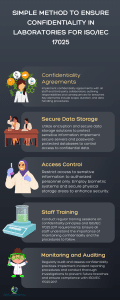
Confidentiality is more than a policy—it’s a system. The standard now expects labs to have formal procedures in place to protect client information. Whether it’s proprietary test data, business-sensitive details, or personal information, labs must show that they’re handling it all with care and discretion.
These ISO/IEC 17025 2017 main changes send a strong message: it’s not enough to say you’re impartial and respectful of privacy—you have to show it, manage it, and document it.
And here’s why it matters so much: labs play a huge role in supporting public health, safety, and industry. If stakeholders can’t trust that results are neutral and information is protected, everything falls apart. That’s why these changes aren’t just about compliance—they’re about trust and credibility.
So if you’re reviewing your current system, don’t skip over these sections. These ISO/IEC 17025 2017 main changes ask you to take a closer look at how your lab protects its integrity. It’s not about making things more complicated—it’s about making sure your lab can stand behind every result it delivers, with confidence and transparency.