Last Updated on November 25, 2026 by Hafsa J.
Follow QSE Academy on Google
Add us as a preferred source to see our ISO and compliance articles more often in your Google results and Discover.

Hafsa J.
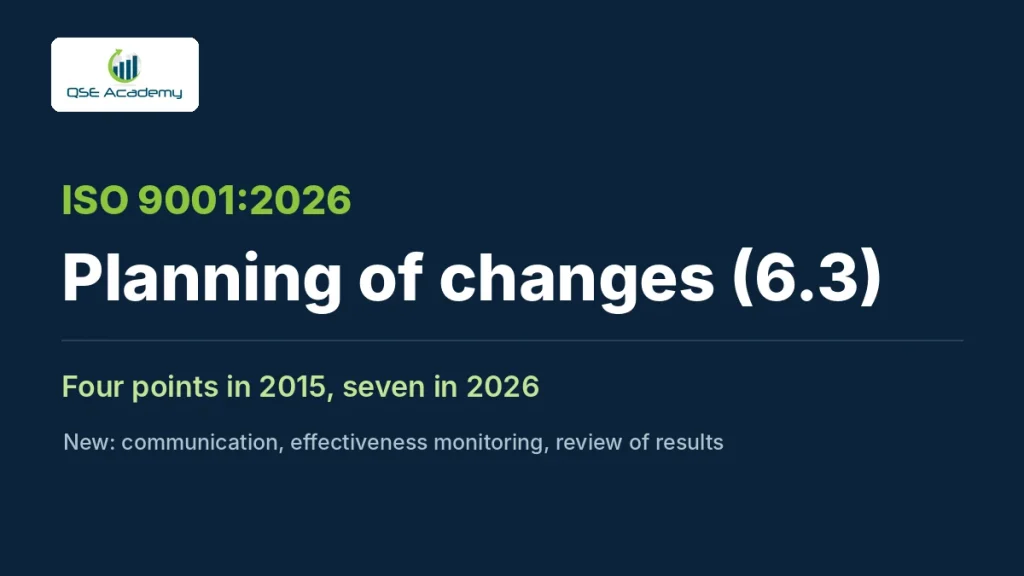
One document decides how clause 6.3 goes at your next audit: the change record you filled in before the change started. In ISO 9001:2026, the list of points that record has to cover grows from four to seven. Three are new and two are reworded in a way that changes what the auditor expects to see.
Below I walk through the seven points of planning of changes as the 2026 text sets them out, what each one means for a small business, and the one-page record that answers all of them. A new ERP, a move to a new building, a quality manager who leaves: this clause covers all three. My position is that you do not need a new procedure for any of it. You need a seven-line record, and the line most companies will leave blank is the one about what happens after the change.
Questions about your own case? Leave them in the comments at the bottom of the article, we read and answer every one.
Let’s get into it.
ISO 9001:2026 planning of changes: the essentials in 30 seconds
Clause 6.3 in ISO 9001:2026, point by point
The clause is short. It opens with a principle: when the organization decides its quality management system needs to change, the change is carried out in a planned way. Then comes a sentence that did not exist in 2015. To make sure the changes are implemented effectively and reach their intended results, the organization has to consider seven points.
That purpose sentence matters more than it looks. It turns 6.3 from a preparation checklist into a clause about results. You can read the full standard on the ISO page for ISO 9001:2026, and I take the seven points in order, with what each one looks like on the day the ERP goes live or the shop floor moves.
a) The purpose of the changes and their potential consequences
Why are you changing, and what can follow from it? For a new ERP, the purpose fits in one line: replace a system that no longer keeps up.
The potential consequences fill the page. Double data entry during migration. History that has to be reloaded. KPIs whose definition shifts without anyone noticing. This point already existed in 2015 and it is often answered in one line. An auditor wants to read the side effects, not only the hoped-for benefit.
b) The potential impact on continuity and maintenance of the QMS
This is the point that changes in nature. In 2015, the text asked you to consider the integrity of the quality management system. In plain words: do not break anything.
The 2026 wording talks about continuity and maintenance. The system has to keep working during the operation, not just come out of it intact. While a production line moves, who releases product? With which measuring equipment? Where are the records the week of the transfer? That is the whole difference between the two editions: the point now covers the period while the change happens, not only the state of the system once it is over.
c) The availability of resources and information
Information now sits next to resources on the list. You already budgeted resources, meaning money, people and time.
Information is new on the list: data to migrate, procedures to rewrite, the know-how of a quality manager who is about to leave. This point connects with clause 7.1.6 on organizational knowledge, which requires the knowledge you need to be kept, applied and shared as needed. When a key person leaves, the system changes. What that person carries in their head has to be planned for as well.
d) The allocation or reallocation of responsibilities and authorities
Unchanged since 2015. It comes down to three questions: who runs the change, who decides when there is a conflict, and who keeps the quality system running in the meantime.
The third question points to clause 5.3 f), covered further down. My advice is simple: three names, not three job titles.
e) The communication of the changes
First addition. Who gets told what, when and through which channel. A new critical supplier has to be announced to purchasing and production, then to receiving inspection, and sometimes to the customer when the contract requires it.
The standard does not say how. Clause 7.4 already asks you to decide what to communicate, when, with whom and how, so you can reuse that logic. What 6.3 e) adds is timing: the communication of changes is thought through before the change, not after the first rejected delivery.
f) How the effectiveness of the changes will be monitored and evaluated
Second addition, and the most demanding one. Before you touch anything, you state how you will know it worked: which indicator, which observation period, which acceptable threshold.
The method is written first and the measurement comes after. The result is that the project has a written end, and not only a start. Monitoring effectiveness is the point I expect most 2015-era forms to miss.
g) How the results of the changes will be reviewed
Third addition: decide who looks at the result, and in which meeting. The natural answer is the management review. Under 9.3.3, its outputs include decisions on any need for changes to the quality management system. A process review works too, as long as it is planned in writing.
Point g) closes the loop opened by point a). Two of the seven points, f) and g), look at what happens after the change, where the 2015 clause stopped at preparation. That matches the foreword of ISO 9001:2026, which lists the strengthening of change management among the main changes of the edition, with the aim of helping organizations achieve their intended results.
What changed between the 2015 and 2026 versions?
Here is your current change form, field by field, with what the 2026 edition does to it. The comparison is direct: the 2015 clause had four points, a) to d), and the 2026 clause has seven.
Clause 6.3 grows from four points to seven, and three of them are new
Points to consider when planning a change to the quality management system, by edition
New in 2026
Add three fields
- e) Communication of the changes.
- f) How effectiveness will be monitored and evaluated.
- g) How results will be reviewed.
Reworded
Rewrite two fields
- b) Integrity becomes continuity and maintenance of the system.
- c) Resources become resources and information.
Unchanged
Keep as is
- a) Purpose and potential consequences.
- d) Responsibilities and authorities.
Source: ISO 9001:2015 and ISO 9001:2026, clause 6.3.
Three more lines, one that changes meaning, one that gets wider. If you want the same field-by-field reading for every other clause, our guide to the ISO 9001:2026 requirements clause by clause does that work. Here I stay on the clause that old change forms miss most often.
The timing is not urgent, but it is fixed. Under the transition requirements published by Global ACI, ISO 9001:2015 certificates are no longer valid after September 30, 2029. From your transition audit onward, every change you plan will be read against the seven points.
The clauses an auditor reads together with 6.3
Clause 6.3 does not stand alone. Four other passages are read with it, and an auditor will read them together.
5.3 f): who keeps the system running
Top management assigns the responsibility and authority for the continuity and maintenance of the quality management system, including when changes to it are planned and carried out. In 2015, item e) of the same clause spoke of integrity. Annex A.5.3 adds that effective allocation of responsibilities can help identify, prevent or manage unintended consequences and inconsistencies in the system. The standard talks about a role. I would put a name on it.
8.1: the changes you did not choose
Clause 8.1 asks you to control planned changes, review the consequences of unintended changes and take action to mitigate adverse effects as necessary. That sentence has not moved since 2015. It covers the breakdown, the unannounced resignation, the supplier that closes.
8.5.6: changes in production
Unchanged in substance. It still requires documented information describing the results of the review of changes, the people who authorized them and any actions that followed.
9.3.3: where the decision is made
Management review outputs include decisions on opportunities for improvement, on any need for changes to the QMS and on resource needs. That makes it the natural meeting for the review required by point g).
Annex A.6.3 also says where changes come from: external or internal issues, decisions made by the organization, or changes in other management systems. Its note points to ISO/TS 10020 for guidance on change management. That is guidance, not a requirement.
6.3, 8.5.6 or 8.3.6: which one applies?
The simple rule: 6.3 is the system changing. 8.5.6 is production or service provision changing. A new management software, a move, the departure of the quality manager: that is 6.3. A raw material, a machine setting, an inspection plan: that is 8.5.6.
A new critical supplier is very often both. Clause 8.5.6 covers the production change that follows, such as a trial batch or tightened inspection. Clause 6.3 applies if the purchasing process itself changes its rules. A change to the design of a product or service, made during design and development or afterwards, falls under 8.3.6.
Three clauses, one form. The record states which clause it serves and carries the evidence 8.5.6 requires. Your risk register gets updated at the same moment, and our page on ISO 9001 risks and opportunities explains how to keep that register useful.
The minimum change record that passes
The standard does not impose a format. A change record is still your best evidence and your best steering tool, and seven lines are enough, one per point. Who signs each line is my suggestion for a small business, not a requirement of the text, so adjust it to your org chart. What matters is that every line has an owner.
Write the purpose in one sentence, then the possible consequences process by process, side effects included. Top management or the project sponsor signs.
List what has to keep running during the switch and how you keep it running: double entry, an overlap period, temporary records. The person named under 5.3 f) signs this line, because it is their job for the duration.
Budget, people and time go here. So do the data to migrate, the documents to rewrite and the knowledge to transfer before someone leaves. Management approves the resources and the quality manager approves the information.
One name per role, with the date each person takes it on.
Who needs to know, what they need to know, when, through which channel, and what trace you keep. Internal and external recipients both belong on this line. The change owner signs it.
State the indicator, the observation period, the acceptable threshold and who measures, then have the quality manager sign.
Name the meeting and the planned date, then record the decision once it is taken. For significant changes, that meeting is the management review under 9.3.3, and the line stays open until the decision is written in.
On audit day, you pull out the record and each line answers one point, in order. A Word form or a spreadsheet tab does the job, as long as the seven lines are filled in before the change starts.
If you would rather start from a complete base than rewrite your forms one by one, the ISO 9001:2026 documentation package includes the manual, the procedures and their records, ready to edit.
Which changes deserve a change record?
Nothing in the standard requires a record for every change. Every change to the QMS has to be planned, but Annex A.6.3 accepts that the approach differs with the reason, the complexity and the potential impact. The threshold is therefore your decision.
Mine, for a small business, fits in four questions. Open a record if the answer to any one of them is yes:
- Does the change affect a process on your process map?
- Does it affect a site or an activity within the scope of your certification?
- Does it affect a skill held by a single person?
- Does it affect an external provider on which the conformity of your products depends?
Four noes, and a line in the meeting minutes is enough. Write this threshold into your management procedure or your manual. A written rule beats an explanation improvised in the hallway, and it is the first thing an auditor asks about when one change had a record and the next one did not.
What the auditor will ask for on a recent change
I do not speak for auditors. But I know what they read: the clause, then your evidence. On a recent change, expect a request for each of these:
- The record, with all seven points covered and filled in before the change.
- The name of the person who kept the system running during the change, under 5.3 f).
- A trace of the communication under point e): an email, meeting minutes, a posted notice.
- The measurement under point f): the indicator announced beforehand and its value after the observation period.
- The review under point g): the meeting where the result was looked at, and the decision that came out of it.
- The unintended consequences under 8.1: what was not planned, and what you did about it.
Notice the order: before, during, after. A well-filled 2015 form covers the before. The 2026 edition also wants the during and the after. In my view, the after will be missing most often, because by the time a change is finished the team has already moved on to the next one, usually with great enthusiasm and no indicator.
The same logic applies to your own checks. When you plan your next ISO 9001 internal audit, pick one recent change and trace it through the seven points before the certification body does.
What clause 6.3 does not require
This is the part that saves money. The clause asks for planning and thinking before acting, and it stops there.
What 6.3 asks
- Changes to the QMS are carried out in a planned way.
- The seven points a) to g) are considered before the change.
- A responsibility for continuity is assigned under 5.3 f).
What 6.3 does not ask
- A documented procedure: the clause cites no documented information.
- A record for every change: the threshold is yours under A.6.3.
- Applying ISO/TS 10020: Annex A points to it as guidance only.
- A change management methodology or a full-time change manager.
If a change management method helps you, keep it. The standard does not ask for one. Clause 5.3 f) asks for an assigned responsibility, not a new position. The rest is discipline: fill in before, measure after, review in a meeting that is already on your calendar.
To see whether 6.3 is the only clause your system is missing, the overview of what changes in ISO 9001:2026 and the transition timeline walks through the main changes clause by clause and the dates you have to meet.
ISO 9001:2026 planning of changes: frequently asked questions
Does clause 6.3 of ISO 9001:2026 require a documented procedure?+
No. It asks you to consider seven points when the quality management system has to change. It does not call for any documented information. A change record is therefore your decision, and a sound one, because the auditor needs evidence that the seven points were considered.
What is the difference between clause 6.3 and clause 8.5.6?+
Clause 6.3 covers changes to the system: a management tool, a reorganization, a move, the departure of a key person. Clause 8.5.6 covers changes in production or service provision, and it requires documented information on the review of those changes. In substance, 8.5.6 has not changed since 2015.
Is my 2015 change form still good enough?+
It covers points a) and d), and part of b) and c). It is missing communication (e), effectiveness monitoring (f) and review of results (g). Its point b) has to move from integrity to continuity and maintenance of the system, and its point c) has to include information. Three fields to add, two to rewrite.
Does every change to the QMS need its own record?+
No. Annex A.6.3, which is informative, says the planning approach can differ with the reason for the change, its complexity and the potential significance of its impacts. The threshold is a decision of the organization. Write it down, because the auditor will ask why one change had a record and another did not.
Who approves the planning of a change under ISO 9001:2026?+
The standard names no job title. Under 5.3 f), top management assigns the responsibility and authority for the continuity and maintenance of the quality management system, including when changes are planned and carried out. In a small business, I recommend a name next to each role.
Does every change have to go through management review?+
Clause 9.3.3 says management review outputs include decisions on any need for changes to the QMS and on resource needs. It is the natural meeting for significant changes and for reviewing their results under point g). For smaller changes, a process review can be enough, provided it is planned in writing.
Here is one action for this week. Take the last significant change your company made, run it through the seven points, and keep the completed record in your management review file. It is the document an auditor will open first on clause 6.3, and you will have it before anyone asks.
Sources
- ISO 9001:2026, Quality management systems, Requirements (French edition), ISO, September 2026: foreword, clauses 5.3, 6.3, 7.1.6, 7.4, 8.1, 8.3.6, 8.5.6, 9.3.3, Annex A.5.3 and A.6.3
- ISO 9001:2015, Quality management systems, Requirements, ISO, September 2015: clauses 5.3 e), 6.3, 8.1 and 8.5.6
- Global ACI, Transition Requirements for ISO 9001:2026, TECH-3-TR 2029-09-30 (M), September 2026
Hafsa J. is the founder of QSE Academy. She is an engineer specialized in the food and agricultural industry, with a master's degree in QHSE management and more than 12 years as a quality manager.
She has helped more than 15 companies implement ISO 9001, ISO 22000, ISO 22716 and GMP, for food producers, cosmetics manufacturers, laboratories and service companies.
At QSE Academy, she writes about ISO 9001, food safety standards and the conformity assessment standards ISO/IEC 17020, ISO/IEC 17065 and ISO/IEC 17021-1. Her rule: a quality system should be simple, useful and efficient.