
Follow QSE Academy on Google
Add us as a preferred source to see our ISO and compliance articles more often in your Google results and Discover.
ISO 14001:2026 Environmental Aspects and the Life-Cycle Perspective (6.1.2)
Clause 6.1.2 asks you to do three things and document them: determine the environmental aspects of your activities, products and services that you can control or influence (with their impacts) while considering a life-cycle perspective, decide which of those aspects are significant by applying your own established criteria, and keep the aspects, the criteria, and the significant aspects as documented information. ISO 14001:2026 keeps that core intact but tightens the wiring around it. The determination of potential emergency situations is now anchored inside 6.1.2 itself, the life-cycle perspective shows up again at scope-setting (4.3) and in operational control (8.1), and the supply-chain language in 8.1 has widened from “outsourced processes” to “externally provided processes, products or services.”
In my consulting work, the aspects register is where audits are won or lost, and it is also where most organizations quietly bluff. They copy a generic list, score it once, and never touch it again. This guide does the opposite. I will define aspect against impact and control against influence so the language stops slipping, walk through how to identify aspects without drowning in detail, and hand you a worked significance-scoring matrix and a worked aspects register you can adapt. Both tables are illustrative examples to show the mechanics, not data from a real client. The standard is deliberate on one point that saves enormous wasted effort: a life-cycle perspective is not a life-cycle assessment, and there is no single prescribed method for significance. The criteria are yours to set.
Aspect vs Impact, Control vs Influence: Get the Words Right First
An environmental aspect is an element of your activities, products or services that interacts or can interact with the environment. An environmental impact is the change to the environment, adverse or beneficial, that results wholly or partially from that aspect. The standard states the relationship plainly: aspects and impacts are one of cause and effect. The aspect is the cause; the impact is the effect. “Discharge of process water” is an aspect. “Degradation of a receiving stream” is the impact. If your register lists “water pollution” in the aspect column, you have already collapsed the cause into the effect, and your scoring will wobble for the rest of the assessment.
Control and influence is the second pair people blur. Clause 6.1.2 tells you to determine the aspects you can control and those you can influence. Control covers what happens inside your fence line, where you set the operating conditions directly. Influence covers aspects tied to products and services that others provide to you, and to the products and services you provide to others, where you can shape behavior through specification, contract or design but cannot dictate it. Annex A is explicit that for products you provide, you may have limited influence over their use and end-of-life treatment, and that it is the organization itself that decides how far it can exercise control and how far it chooses to exercise influence. That decision is yours to make and to defend, not the auditor’s to impose.
The third distinction is operating condition. When you determine aspects, the standard requires you to take into account normal and abnormal conditions, change (including planned or new developments and new or modified activities, products and services, with a cross-reference to the new planning-of-changes clause 6.3), and potential emergency situations. Normal conditions are routine, in-spec operation. Abnormal conditions are situations that are not typical, that happen rarely or that are unplanned, such as start-up and shut-down phases or an upset process that lifts emissions. Emergency situations are unplanned events, a fire, a chemical spill, flooding, that demand urgent response. Many registers only score normal running and miss the abnormal and emergency rows entirely, which is exactly where a low-frequency aspect can turn out to be significant because of its severity. The full list of clause-by-clause expectations sits in our ISO 14001:2026 requirements guide if you want the wider planning context.
How to Identify Aspects Without Drowning in Detail
The practical method is to walk each activity, product or service and list its process inputs and outputs, both intended and unintended. Annex A is generous here in two ways that keep the exercise manageable. First, you do not have to assess every product, component or raw material individually; you can group or categorize activities, products and services when they share common characteristics. Second, it gives you a working checklist of aspect categories to scan against each activity.
- Emissions to air.
- Releases to water.
- Releases to land.
- Use of raw materials and natural resources.
- Use of energy.
- Energy emitted, such as heat, radiation, vibration, sound or light.
- Generation of waste and by-products.
- Land use.
- Use of marine and coastal areas.
Run each activity through those categories under normal, abnormal and emergency conditions, and your aspect column writes itself. The harder discipline is keeping the aspect at the right altitude. “Use of natural gas in the boiler” is a usable aspect. “Climate change” is not an aspect, it is closer to an environmental condition; the aspect is the combustion, the impact is the emission of greenhouse gases, and the contribution to climate change is the downstream effect. Annex A also reminds you to consider aspects you only influence, including the environmental performance and practices of external providers, which is where the life-cycle perspective begins to bite. I will come to that next.
Where I push back on teams is the temptation to make this a one-off spreadsheet exercise. Clause 6.1.2 sits inside a planning process you have to maintain, and the new cross-reference to 6.3 means that when you plan a change, a new line, a new supplier, a new product variant, you revisit the aspects it introduces or alters rather than waiting for the annual review. Treat the register as a living document tied to your change process, not as evidence you generate the week before the audit.
The Life-Cycle Perspective Is Not a Life-Cycle Assessment
Let me be direct, because this is the single most over-engineered requirement in the standard. A life-cycle perspective means considering the environmental aspects and impacts at each life-cycle stage: acquisition of raw materials, design, production, transportation and delivery, use, end-of-life treatment, and final disposal. Annex A states plainly that this does not require a detailed life-cycle assessment. Thinking carefully about the aspects you can control or influence at each stage is sufficient. You do not need ISO 14040 modeling, software, or a consultant’s quantified cradle-to-grave study to satisfy 6.1.2. You need to look up and down the chain and ask, at each stage, what interacts with the environment and how far my control or influence reaches.
The practical test for a perspective rather than an assessment: for each life-cycle stage, can you name the aspect, say whether you control or influence it, and point to where it is handled? If yes, you have a perspective. The moment you reach for impact-category modeling and characterization factors, you have crossed into an assessment the clause never asked for.
What is easy to miss in 2026 is that the life-cycle perspective is not confined to 6.1.2. It threads through two other clauses, and the auditor will check the thread. At scope-setting, clause 4.3 requires you to consider your authority and ability to exercise control and influence over the life cycle of your activities, products and services when you draw the boundaries of the environmental management system. Annex A is firm that scoping must not be used to exclude activities, products, services or facilities that have or can have significant aspects, or to evade compliance obligations. The scope is a factual, representative statement, not a way to wall off the inconvenient parts of your supply chain.
The perspective then reappears in operational control. Clause 8.1, consistent with a life-cycle perspective, requires you to establish controls so that your environmental requirements are addressed in design and development for the product or service, considering each life-cycle stage; determine environmental requirements for procurement; communicate relevant environmental requirements to external providers, including contractors; and consider providing information about potential significant environmental impacts associated with transportation or delivery, use, end-of-life treatment and final disposal. This is the operational payoff of the aspects work: the significant aspects you identified at the design and procurement stages in 6.1.2 are the ones you have to actually control in 8.1. If you want the full implementation sequence, our step-by-step ISO 14001:2026 implementation guide sets the order of operations.
Setting Significance Criteria: A Worked Scoring Matrix
Clause 6.1.2 requires you to determine which aspects are significant by using established criteria, and to keep those criteria as documented information. It does not tell you which criteria to use or how to weight them. Annex A is clear that there is no single method, but the method and criteria you choose should produce consistent results. It also gives strong guidance on what the criteria can be. Environmental criteria are the primary and minimum criteria. They can relate to the aspect itself, for example type, size or frequency, or to the impact, for example scale, severity, duration or exposure, or to environmental conditions. You may add other criteria, such as legal requirements or interested-party concerns, and an aspect that is not significant on environmental criteria alone can cross the threshold once those other criteria are added.
There is one guardrail in Annex A that experienced auditors look for: the other criteria, such as legal or stakeholder concern, are not meant to downgrade an aspect that is already significant on its environmental impact. You can use legal or stakeholder pressure to lift an aspect up, never to argue a genuinely high-impact aspect back down. Below is an illustrative scoring matrix that shows one defensible way to operationalize this. The numbers and the threshold are an example to demonstrate the mechanics; your organization sets its own criteria, scales and cut-off.
| Criterion | Relates to | Score 1 (low) | Score 3 (medium) | Score 5 (high) |
|---|---|---|---|---|
| Severity of impact | Impact | Minor, fully reversible | Moderate, reversible with effort | Serious or irreversible harm |
| Scale or extent | Impact | Confined to point of release | Local or site-wide | Regional or global |
| Frequency of release | Aspect | Rare or one-off | Intermittent | Frequent or continuous |
| Regulatory or compliance link | Other | No specific obligation | Permitted or monitored | Limit, permit condition or legal exposure |
| Interested-party concern | Other | No expressed concern | Occasional community or customer interest | Active community, customer or NGO pressure |
In this example scheme you score each aspect on all five criteria, sum the scores for a range of 5 to 25, and treat any aspect at or above a significance threshold of 15 as significant. You can also apply an override rule, common in practice and consistent with Annex A: any aspect that scores 5 on severity alone is significant regardless of the total, so a rare but catastrophic event cannot be averaged into insignificance. Whatever you choose, document the scale, the threshold and the override, because the criteria themselves are required evidence under 6.1.2.
A Worked Aspects Register You Can Adapt
The register is where the matrix gets applied. A good register column set captures the activity, the aspect (the cause), the impact (the effect), the operating condition, whether you control or influence the aspect, the score, and the significance verdict. The rows below are illustrative, built to show how normal, abnormal and emergency conditions and control versus influence flow through the same scoring scheme from the previous section. They are not data from any real organization. Scores use the 5-to-25 sum and the threshold of 15, with the severity-5 override.
| Activity | Aspect (cause) | Impact (effect) | Condition | Control or influence | Score | Significant |
|---|---|---|---|---|---|---|
| Boiler operation | Combustion of natural gas | Greenhouse gas emissions to air | Normal | Control | 17 | Yes |
| Parts washing | Use of solvent degreaser | VOC emissions and hazardous waste | Normal | Control | 19 | Yes |
| Bulk chemical storage | Tank or bund failure | Spill to land and groundwater | Emergency | Control | 21 (severity override) | Yes |
| Wastewater treatment | Effluent discharge above set point | Degradation of receiving water | Abnormal | Control | 16 | Yes |
| Purchased packaging | Supplier material choice | Upstream resource use and end-of-life waste | Normal | Influence | 12 | No |
| Product in use by customer | Energy consumed during use phase | Indirect emissions to air | Normal | Influence | 16 | Yes |
Two rows in that register carry most of the 2026 message. The bulk-storage spill is an emergency condition, scored and significant precisely because the determination of potential emergency situations now lives in 6.1.2; that row is the hand-off to your emergency preparedness process in 8.2. The packaging and product-in-use rows are influence rather than control, identified through the life-cycle perspective, and they are where the broadened 8.1 wording on externally provided products and services turns into procurement specifications and customer information. A register that contains only inside-the-fence, normal-condition, control rows is the most common gap I find, and under the 2026 edition it is also the easiest nonconformity for an auditor to raise.
What 2026 Tightened Around 6.1.2
The aspects clause is not a brand-new requirement, so the work is mostly about updating the wiring rather than starting over. Three changes deserve your attention when you revise the procedure and the register.
Emergency situations are now anchored in 6.1.2
Clause 6.1.2 now states that the organization shall determine potential emergency situations, including those that can have an environmental impact, and clause 8.2 prepares for and responds to the emergency situations determined in 6.1.2. In the 2015 edition the emergency cross-reference pointed to 6.1.1; in 2026 it points to 6.1.2. The practical effect is that determining the full set of potential emergency situations is part of the aspects exercise, not a separate afterthought in the emergency plan. Annex A even tells you what to weigh: the nature of onsite hazards, the most likely type and scale of an emergency, and the potential for an emergency at a nearby facility. By considering emergencies while determining aspects, you can uncover a new aspect or, because of the potential severity, a significant one. That is the logic behind the severity override in the matrix.
Externally provided processes, products and services widened the net
In 8.1 the 2015 phrase “outsourced processes” has been replaced by “externally provided processes, products or services.” Annex A defines these as items used by the organization but supplied by others, and an external provider as an external supplier or contractor. This is broader than classic outsourcing. It pulls purchased materials, components and bought-in services into the control-or-influence question, which is exactly the influence side of your aspects register. The aspect determination and the operational control now share the same supply-chain scope, so your register and your procurement controls have to agree.
The documented information is non-negotiable
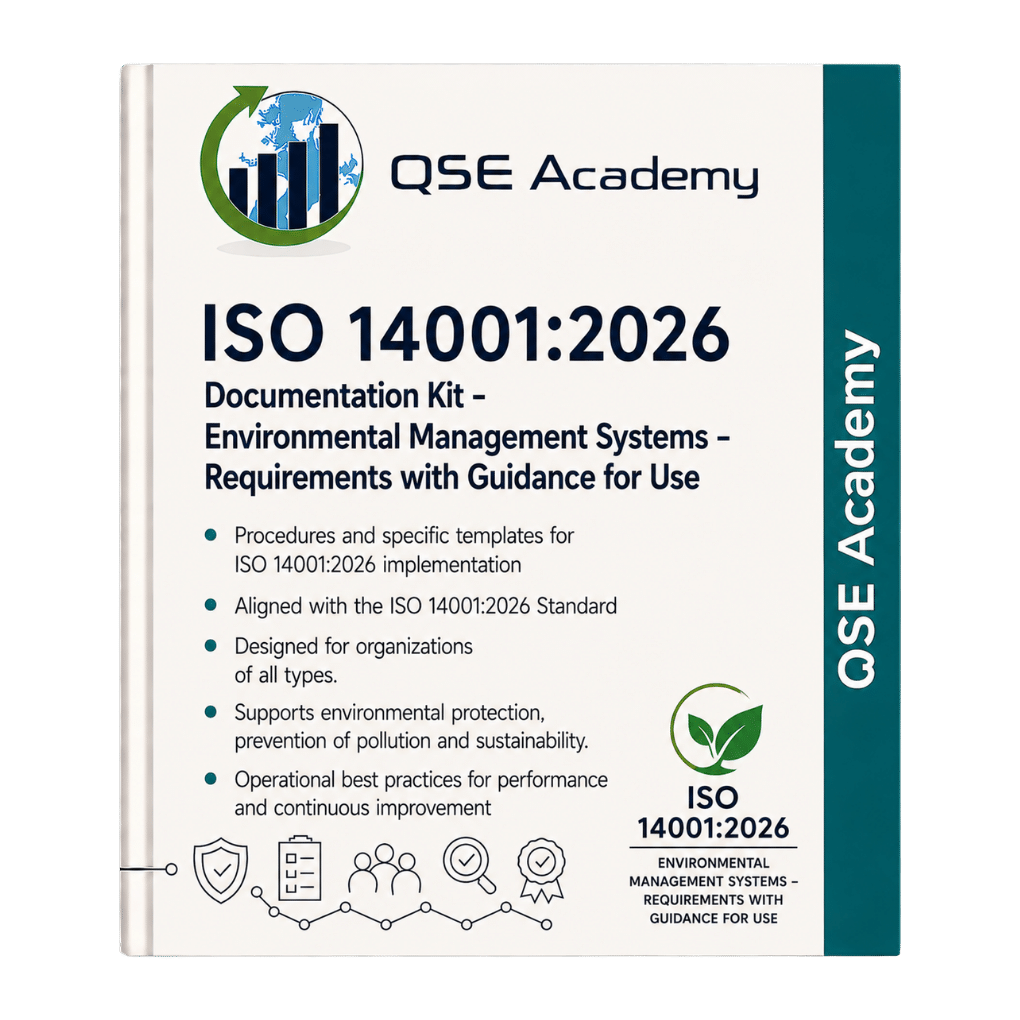
Three things shall be available as documented information under 6.1.2: the environmental aspects and their associated impacts, the criteria used to determine significance, and the significant aspects themselves. Many organizations keep the register and the significant-aspects list but never write down the criteria as a standalone, defensible document. That missing criteria document is a frequent finding. If you build the matrix from the previous section into a one-page significance procedure, you close that gap directly. For teams that would rather start from a structured template set than from a blank page, our ISO 14001:2026 Documentation Kit includes the aspects procedure, the scoring criteria and a register format already aligned to the clause. The authoritative source for the standard itself remains the ISO 14001 environmental management page on iso.org.
Frequently Asked Questions
If you take one thing from clause 6.1.2 into your next review, make it this: the aspects register is not a compliance artifact you dust off once a year, it is the engine that feeds your emergency planning, your operational controls and your objectives. Define aspect against impact and control against influence with discipline, score against criteria you have actually written down, and let the life-cycle perspective pull in the supply-chain rows that the 2026 edition now expects to see. Do that, and the rest of the environmental management system has something solid to stand on.

👋 Hi, I’m HAFSA, and for the past 12 years, I’ve been on a journey to
make ISO standards less intimidating and more approachable for everyone.
Whether it’s ISO 9001, ISO 22000, or the cosmetics-focused ISO 22716, I’ve spent my career
turning complex jargon into clear, actionable steps that businesses can actually use.
I’m not here to call myself an expert—I prefer “enthusiast” because I truly love what I do.
There’s something incredibly rewarding about helping people navigate food safety and quality management systems
in a way that feels simple, practical, and even enjoyable.
When I’m not writing about standards, you’ll probably find me playing Piano 🎹, connecting with people, or diving into my next big project💫.
I’m an engineer specialized in the food and agricultural industry
I have a Master’s in QHSE management and over 12 years of experience as a Quality Manager
I’ve helped more than 15 companies implement ISO 9001, ISO 22000, ISO 22716, GMP, and other standards
My clients include food producers, cosmetics manufacturers, laboratories, and service companies
I believe quality systems should be simple, useful, and efficient.