
Follow QSE Academy on Google
Add us as a preferred source to see our ISO and compliance articles more often in your Google results and Discover.
How to Implement ISO 14001:2026: A Step-by-Step Project Plan
Implementing ISO 14001:2026 is a project, not a document drop. You run it in Plan-Do-Check-Act order, you assign an owner and a deliverable to every step, and you finish with a two-stage certification audit. For a US small or mid-sized company starting from no formal system, plan on roughly 8 to 14 months of real elapsed time. For a larger or multi-site organization, 12 to 20 months is more honest. The two new things the 2026 edition forces into that plan are a documented management-of-change process (clause 6.3) and explicit treatment of climate and four other environmental conditions in your context analysis (clause 4.1). Both are covered below, mapped to the step where they actually bite.
In my consulting work the projects that stall are almost always the ones that started as a generic “10 steps to ISO 14001” checklist with no owner and no dates. So this guide is built the other way around. The centerpiece is a phased project-plan table that ties every step to a responsible role, the deliverable it produces, a realistic US timeframe, and the specific 2026 clause requirement it satisfies. Read the table first, then use the section-by-section notes to run each phase. If you want the underlying clause-by-clause detail, our ISO 14001:2026 requirements explained article is the companion piece to this plan.
Start With a Gap Analysis, Not a Template
Before step one, find out where you actually stand. A gap analysis compares what you already do against the requirements in clauses 4 through 10 and tells you which of three project sizes you are running. If you have an ISO 9001 system, you already own a chunk of clause 7 (resources, competence, awareness, documented information) and clause 9.2 internal audit, so your environmental project is narrower than you think. If you are starting cold, every clause is in scope.
Where most implementation plans get this wrong is treating 2026 as a brand-new build. It is not. Of the requirements in the standard, the large majority are unchanged from ISO 14001:2015. The transition change table classifies them as two new requirements, thirteen modified, two renumbered, and eighteen substantially unchanged. So if you already run a 2015 system, your “implementation” is really a focused upgrade. If you are new to the standard, you build the whole system once and the 2026 items are simply part of the first build. Either way, scope the project against the gap, then load the plan below.
The two genuinely new items to budget time for: clause 6.3 Planning of changes (a documented management-of-change process, with no 2015 equivalent) and clause 6.1.4 Risks and opportunities (now its own dedicated sub-clause with its own register, where in 2015 it sat inside 6.1.1). Everything else is either a modification you fold into an existing step or a verify-only check.
The Full ISO 14001:2026 Implementation Project Plan
Here is the whole project in one place. The steps run in Plan-Do-Check-Act order, the way the standard itself is built. Each row carries a typical owner role, the deliverable that proves the step is done, a realistic elapsed-time band for a US small or mid-sized company, and the specific 2026 clause the step satisfies. Timeframes overlap in practice, so the bands add up to more than the 8-to-14-month total. Treat them as planning estimates you adjust to your own size and starting point, not as fixed durations.
| # | Step / phase | Owner role | Key deliverable | Realistic US SME timeframe | 2026 requirement it satisfies |
|---|---|---|---|---|---|
| 0 | Gap analysis and project setup | Top management / project lead | Gap report, project charter, dated plan | 2 to 4 weeks | Scopes the whole project; identifies the 2 new and 13 modified items |
| 1 | Context and environmental conditions | Top management | Context analysis covering the named environmental conditions | 1 to 2 weeks | 4.1 (pollution levels, natural resources, climate change, biodiversity, ecosystem health) |
| 2 | Interested parties and their expectations | Top management / EMS lead | Interested-party map, expectations matrix | 1 week | 4.2 (expectations now linked to environmental conditions) |
| 3 | Scope, policy, roles | Top management | Scope statement, signed environmental policy, RACI | 2 to 3 weeks | 4.3, 5.1, 5.2 (policy commitments widened to resources, climate, biodiversity, ecosystems where relevant), 5.3 |
| 4 | Environmental aspects and life-cycle perspective | EMS lead / environmental manager | Aspects register, significance criteria, emergency-situations list | 3 to 6 weeks | 6.1.2 (life-cycle perspective; potential emergency situations now anchored here; link to 6.3) |
| 5 | Compliance obligations | EMS lead | Compliance-obligations register with applicability | 2 to 4 weeks | 6.1.3 (unchanged; verify-only if you have a 2015 system) |
| 6 | Risks and opportunities register | EMS lead | Dedicated R&O register | 1 to 2 weeks | 6.1.4 (now a dedicated sub-clause; keep a separate register) |
| 7 | Objectives and action planning | Top management / EMS lead | Objectives table with indicators, action plan | 2 to 3 weeks | 6.1.5, 6.2 |
| 8 | Change-management process | EMS lead | Management-of-change procedure, change-evaluation form | 1 to 2 weeks | 6.3 (new clause; planned, controlled change) |
| 9 | Operational controls and supply chain | Operations / purchasing | Operating criteria, procurement environmental requirements, supplier clauses | 4 to 8 weeks | 8.1 (externally provided processes, products and services; life-cycle controls) |
| 10 | Emergency preparedness and response | EMS lead / EHS | Emergency procedures, test/drill records | 2 to 4 weeks | 8.2 (now cross-references 6.1.2) |
| 11 | Competence, awareness, communication, documents | HR / EMS lead | Competence matrix, awareness records, communication plan, document control | 3 to 5 weeks | 7.2, 7.3, 7.4, 7.5 (mostly unchanged) |
| 12 | Monitoring, measurement and compliance evaluation | EMS lead | Monitoring plan, measured performance data, compliance-status records | 8 to 12 weeks of operating data | 9.1.1, 9.1.2 (calibrated equipment, documented results) |
| 13 | Internal audit | Internal auditor (independent of the area) | Audit programme, audit plans with objectives, audit reports | 2 to 3 weeks | 9.2.1, 9.2.2 (audit objectives now explicitly required per audit) |
| 14 | Management review | Top management | Management-review minutes covering the required inputs and results | 1 week | 9.3.1, 9.3.2, 9.3.3 (now split into three sub-clauses) |
| 15 | Corrective action and continual improvement | EMS lead | Nonconformity and corrective-action records, improvement plan | Ongoing | 10.1, 10.2 (10.1 merges old 10.1 and 10.3) |
| 16 | Certification audit (Stage 1 and Stage 2) | Accredited certification body | Stage 1 readiness report, Stage 2 findings, certificate | 4 to 12 weeks between stages | Conformity assessment against the full standard |
Plan: Build the Foundation (Steps 1 to 8)
Context and the five environmental conditions (4.1, 4.2)
Start by determining the external and internal issues relevant to your purpose. The 2026 edition makes one thing explicit that the 2015 text left implied: your issues must include the environmental conditions affecting you or being affected by you, named in the standard as pollution levels, availability of natural resources, climate change, biodiversity, and ecosystem health. This is a determination, not a carbon-reduction mandate. You assess each of the five, decide which are material to your site, and document the judgment. A documented “not material, and here is why” is a legitimate answer for a condition that does not apply to you. Then determine your interested parties and their relevant expectations, and decide which of those expectations become compliance obligations you will manage.
Scope, policy and roles (4.3, 5.1, 5.2, 5.3)
Set the boundaries of the system, considering your issues, obligations, units and functions, physical boundaries, activities, and your authority and ability to control or influence over the life cycle. Top management then establishes a signed environmental policy. In 2026 the policy still commits you to protect the environment, prevent pollution, meet compliance obligations, and continually improve, but it now explicitly invites context-specific commitments around resource conservation, climate, biodiversity, and ecosystems where they are relevant to you. Assign responsibilities and authorities, including the role accountable for EMS conformity and for reporting performance to top management. A RACI matrix and updated job descriptions are the evidence here.
Aspects, life cycle and emergency situations (6.1.2)
This is the technical heart of the system and where I see the most rework. Determine the environmental aspects you can control and those you can influence, with their impacts, considering a life-cycle perspective. Take into account normal and abnormal conditions, planned or new developments and modified activities (which is the explicit hook to your change-management process under 6.3), and potential emergency situations. Note where the 2026 edition put emergency situations: the determination of “all potential emergency situations” is now anchored in 6.1.2, and your emergency plan under 8.2 references that list. Apply your significance criteria, record the significant aspects, and keep the aspects register, the criteria, and the significant aspects as documented information. For a deeper treatment of significance scoring and the life-cycle perspective, see our companion guide on environmental aspects.
Compliance obligations and the R&O register (6.1.3, 6.1.4)
Determine the compliance obligations tied to your aspects, decide how each applies, and keep the register current. This clause is unchanged, so if you run a 2015 system it is a verify-only step. The risks and opportunities work is where 2026 asks for a structural change. In the 2015 edition the determination of risks and opportunities lived inside clause 6.1.1. In 2026 it is its own dedicated sub-clause, 6.1.4. Keep a separate R&O register that derives risks and opportunities from your aspects, your compliance obligations, and the issues you identified in 4.1 and 4.2, including the potential for external environmental conditions to affect you. Auditors will look for that register by name.
Objectives, action planning and change management (6.1.5, 6.2, 6.3)
Plan the actions that address your significant aspects, obligations, and risks and opportunities, and set environmental objectives at the relevant functions and levels. Make objectives measurable where practicable, with indicators, owners, resources, and target dates. Then build the genuinely new piece. Clause 6.3 Planning of changes has no 2015 equivalent. When you determine a need to change something that affects the EMS, the change has to be carried out in a planned, controlled way so the system still delivers its intended outcomes. The deliverable is a short management-of-change procedure plus a change-evaluation record that captures the purpose of the change, its consequences, the resources required, and who is responsible. Common triggers are new products, processes or facilities, a new supplier, or a restructure. Keep this separate from emergency response under 8.2, which deals with unplanned events. Our requirements article walks through the exact evidence each of these clauses expects.
Do: Put Controls Into Operation (Steps 9 to 11)
The Do phase is where the plan stops being paperwork and starts running on the shop floor. Establish the operational controls and operating criteria needed to meet your requirements and carry out the actions from clause 6. The 2026 wording change to watch is in 8.1. The old term “outsourced processes” has been replaced by “externally provided processes, products and services,” which broadens the reach into your supply chain. You now ensure that externally provided items relevant to your intended outcomes are controlled or influenced, and you define the type and extent of that control inside the EMS. In practice that means environmental requirements in your procurement criteria, environmental clauses in supplier contracts, and life-cycle controls in design and development where you have a design function.
Next, stand up emergency preparedness and response under 8.2 for the potential emergency situations you determined back in 6.1.2. Plan the response actions, test them periodically where practicable, and revise after tests or real events. Then complete the support clauses: a competence matrix for people whose work affects environmental performance, awareness so those people know the policy and the significant aspects tied to their roles, internal and external communication processes, and document control covering creation, approval, access, storage, and retention. If you already run ISO 9001, most of clause 7 is reusable, so this step moves faster than it looks.
Check: Generate Real Data (Steps 12 to 14)
A certification body cannot audit a system that has never produced evidence, which is why the Check phase usually sets the floor on your timeline. Determine what to monitor and measure, the methods, the criteria and indicators, and the frequency. Use calibrated or verified equipment and keep the results as documented information. Run compliance evaluation against your obligations at the frequency you set, and maintain knowledge of your compliance status. You need a genuine run of operating data here, which is why the plan budgets roughly 8 to 12 weeks of running the system before the certification audit rather than measuring once and declaring victory.
Then run at least one full internal audit cycle across clauses 4 to 10. Establish an audit programme that accounts for the environmental importance of processes, changes, and previous results. The 2026 change to flag is in 9.2.2: you now have to define the audit objectives for each audit, not only the criteria and scope. Build an “objectives” field into your audit plan template and your auditors are covered. A practical way to make sure nothing is missed is to audit against a structured clause-by-clause list. Our free ISO 14001 internal audit checklist covers clauses 4 to 10 with the 2026-specific questions. Close out the Check phase with a management review. In 2026 that clause is split into 9.3.1 general, 9.3.2 inputs, and 9.3.3 results, so structure your minutes to follow the three sub-clauses; the substance of what you review is the same as before.
Act and Certify: Close Gaps, Then Audit (Steps 15 to 16)
The internal audit and management review will surface nonconformities. Handle them through clause 10.2: react and correct, evaluate the cause, implement the action, and verify it worked. Continual improvement now sits in a single clause 10.1, which merges the old 10.1 general and 10.3 continual improvement from the 2015 edition. If you run a 2015 system, this is a renumbering of internal cross-references rather than new work.
With the system running and corrected, you go to certification. An accredited certification body runs a two-stage initial audit. Stage 1 is a readiness check of your documentation and system design, often partly offsite, and it tells you whether you are ready for Stage 2. Stage 2 is the on-site assessment of how the system actually operates, against the full standard. The gap between the two stages is typically a few weeks to a few months, depending on how many Stage 1 findings you have to close. After certification, you move into a surveillance cycle. The full text of the standard is published by ISO; the authoritative overview lives on the ISO 14001 page at iso.org.
How Long It Really Takes: SME vs Larger Organization
Let me be direct about timing, because the “implement in 90 days” claims you will see online are rarely honest. The binding constraint is not how fast you can write documents. It is how long the system has to run before it has generated enough real monitoring data, one completed internal audit, and one management review for a certification body to assess. That floor is hard to compress below a few months no matter how much consulting horsepower you throw at it.
For a US small or mid-sized company, single site, starting from no formal environmental system, plan on roughly 8 to 14 months end to end. If you already hold ISO 9001, trim a few months because clause 7 and your internal-audit machinery carry over. For a larger or multi-site organization, 12 to 20 months is the more realistic band, driven by the number of sites to assess, the breadth of aspects, and the supply-chain controls now in scope under the broadened 8.1. These ranges are planning estimates, not promises. Your actual schedule depends on management attention, how clean your starting documentation is, and certification-body availability.
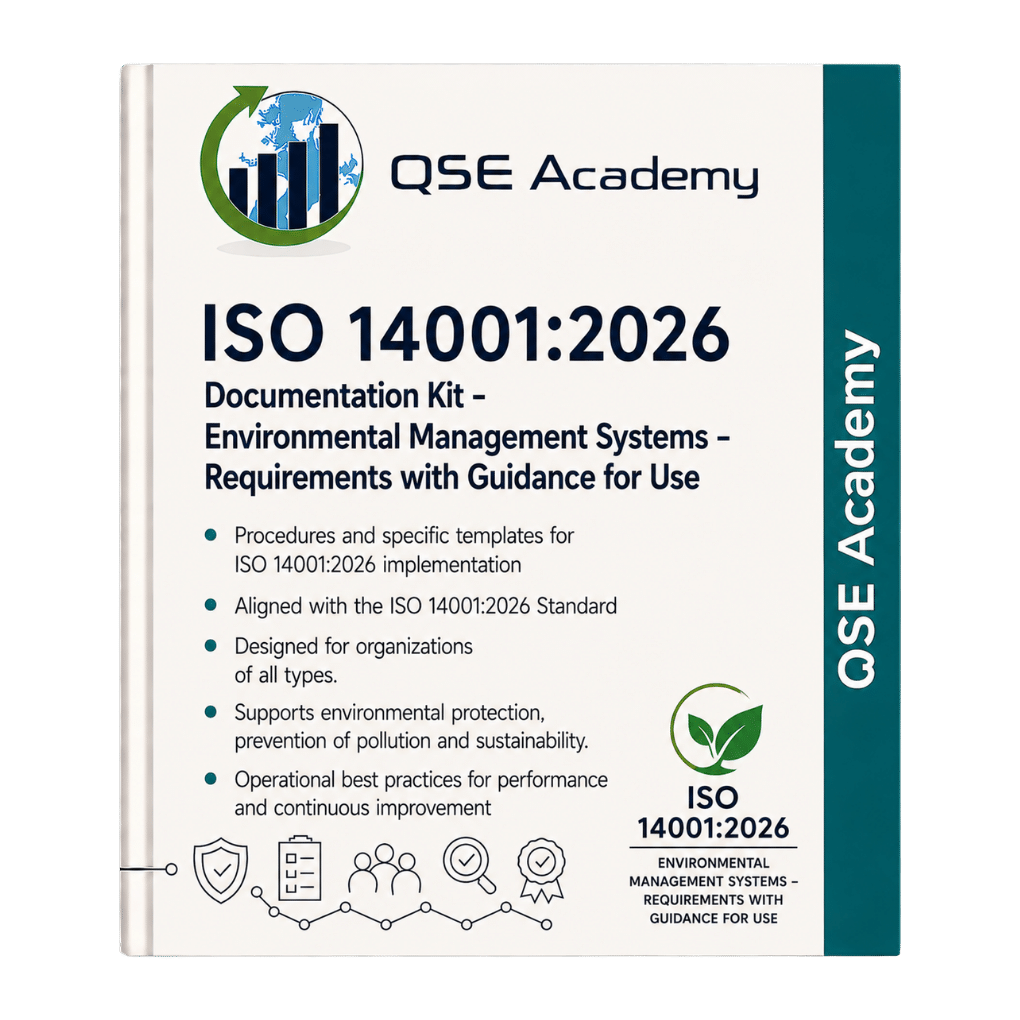
Where you can genuinely save time is the documentation build. Writing the procedures, registers, and the new 6.3 change process from scratch is the slowest desk work in the project. A ready-made document set that already reflects the 2026 structure removes that drag, and you spend your time tailoring rather than authoring. Our ISO 14001:2026 Documentation Kit gives you the full set of procedures and records aligned to the 2026 edition, including the 6.3 management-of-change procedure and the 6.1.4 risk-and-opportunity register, so the plan above starts at step one with the paperwork already drafted.
Frequently Asked Questions
Run the project in PDCA order, give every step an owner and a deliverable, and treat the table above as your tracker. The version that gets certified is rarely the one with the prettiest manual. It is the one where the system has been running long enough to prove it works, and where the two new 2026 items, the 6.3 change process and the 6.1.4 register, are in place and being used rather than written and shelved.

👋 Hi, I’m HAFSA, and for the past 12 years, I’ve been on a journey to
make ISO standards less intimidating and more approachable for everyone.
Whether it’s ISO 9001, ISO 22000, or the cosmetics-focused ISO 22716, I’ve spent my career
turning complex jargon into clear, actionable steps that businesses can actually use.
I’m not here to call myself an expert—I prefer “enthusiast” because I truly love what I do.
There’s something incredibly rewarding about helping people navigate food safety and quality management systems
in a way that feels simple, practical, and even enjoyable.
When I’m not writing about standards, you’ll probably find me playing Piano 🎹, connecting with people, or diving into my next big project💫.
I’m an engineer specialized in the food and agricultural industry
I have a Master’s in QHSE management and over 12 years of experience as a Quality Manager
I’ve helped more than 15 companies implement ISO 9001, ISO 22000, ISO 22716, GMP, and other standards
My clients include food producers, cosmetics manufacturers, laboratories, and service companies
I believe quality systems should be simple, useful, and efficient.