
Follow QSE Academy on Google
Add us as a preferred source to see our ISO and compliance articles more often in your Google results and Discover.
ISO 14001 Certification: Cost, Timeline and Process (2026)
For most US small and mid-sized organizations, getting certified to ISO 14001 costs roughly $8,000 to $30,000 in the first year, and that figure splits into three very different buckets. About a third is the certification body’s audit fee. The rest is how you get ready: a documentation toolkit and your own staff time at the low end, or a full consultant at the high end. The single biggest driver of the audit fee is not your revenue or your industry reputation. It is your headcount inside the management-system scope, scored against a published audit-day table.
Let me be direct about why that band is so wide. A 20-person professional-services firm and a 20-person metal-finishing shop can both certify to the same standard, but the second one will sit through more audit days because its environmental aspects are heavier. Where most cost articles go wrong is treating ISO 14001 certification as a single sticker price. It is not. It is an audit-day calculation you can rebuild yourself, plus a preparation choice you control, spread across a three-year certification cycle. This article walks through all three so you can build a number that fits your operation rather than a vendor’s.
What ISO 14001 certification actually costs in 2026
Three separate costs sit behind the headline number, and it helps to keep them apart because you control each one differently.
- Certification body fees. The accredited registrar charges for the initial audit (Stage 1 plus Stage 2), then for surveillance audits in each of the next two years, plus a certificate and an annual account fee. This is the one cost you cannot avoid, because only an accredited body can issue the certificate.
- Getting ready. Building the environmental management system: writing the documentation, running the aspects analysis, training people, doing internal audits. You can do this with a toolkit and internal time, or hand most of it to a consultant.
- Internal time. The hours your own staff spend on the project. It rarely shows up on an invoice, which is exactly why it gets underestimated.
The certification-body portion is the most predictable, because it follows a published formula rather than a salesperson’s mood. The table below shows indicative initial-audit fees (Stage 1 plus Stage 2 combined) for a medium-complexity operation, using audit-day bands from IAF MD5 and a US day-rate of $1,200 to $2,800. Treat these as planning estimates, not quotes.
| Employees in EMS scope | Typical initial audit days (Stage 1 + 2) | Indicative initial-audit fee (USD) |
|---|---|---|
| 1 to 5 | about 2.5 days | $3,000 to $7,000 |
| 11 to 15 | about 3.5 days | $4,200 to $9,800 |
| 26 to 45 | about 5.5 days | $6,600 to $15,400 |
| 86 to 125 | about 8 days | $9,600 to $22,400 |
These figures are audit fees only. They do not include consultancy, training, the certificate fee, or the surveillance audits you will pay for in years two and three. A higher-complexity operation, such as a chemical plant or a waste handler, moves up a band and adds days.
Build your own quote: audit days times day-rate
Here is the part most certification bodies do not spell out. Your audit fee is not a mystery number. It comes from an international rule, IAF Mandatory Document 5 (IAF MD5), which sets how many auditor days a registrar should spend based on the number of people in your management-system scope and the environmental complexity of what you do. Multiply those days by the body’s day-rate and you have the core audit fee. That is the formula behind almost every quote you will receive.
Two inputs move the day count. The first is headcount inside the scope. The second is complexity: an office-based services firm sits in a low band, food, construction and logistics in a medium band, and manufacturing, chemicals, mining, waste and energy in a high band. A high-complexity site of the same headcount can carry several more audit days than a low one. On the price side, US registrar day-rates commonly run around $1,200 (lower), $2,000 (mid) and $2,800 (upper) per auditor day, so the same audit-day count can produce quotes that differ by more than double depending on the body you pick.
Once you know your initial audit days, the rest of the three-year cycle follows a rough rhythm. A surveillance audit runs about one third of the initial audit effort (Stage 1 plus Stage 2 combined), and recertification at year three runs about two thirds. So if your Stage 1 plus Stage 2 came to six days, plan for roughly two days at each surveillance visit and about four at recertification.
Run your own combination below. Pick your headcount band, your complexity, and a day-rate, and the estimator returns the audit days and an indicative fee using the same IAF MD5 logic a registrar applies.
The number it returns is the audit fee only. It does not cover the work of building your system, the certificate fee, or the surveillance audits to come. It is there to let you sanity-check any quote against the published method, so a registrar cannot pad the day count without you noticing.
The certification process and a realistic timeline
Certification is an audit in two stages, followed by a three-year cycle. You cannot shortcut the order, and the parts you can speed up are mostly on your side of the fence, not the registrar’s.
Before the registrar arrives
First you build the environmental management system itself: determine your context and significant environmental aspects, set objectives, write the documented information the standard asks for, and run the system long enough to generate records. A registrar will expect to see at least one full internal audit and one management review completed before they certify you, because those are the checks that prove the system actually runs. If you want the clause-level detail of what the system must contain, our ISO 14001 requirements guide walks through clauses 4 to 10 in plain language.
Stage 1: the readiness review
The auditor reviews your documentation, confirms your scope and aspects, and checks that you are ready for the full audit. Stage 1 often surfaces gaps you still have time to close. Think of it as a dress rehearsal the registrar charges you for.
Stage 2: the certification audit
This is the real assessment. The auditor goes on site, interviews people, samples records, and tests whether the system meets the standard in practice. Any nonconformities have to be closed out before the certificate is issued. Clear them, and the registrar recommends you for certification. The certificate itself can only be issued by an accredited certification body, which is why the choice of registrar matters as much as the price.
The three-year cycle
The certificate lasts three years. You host a smaller surveillance audit in year one and year two to confirm the system is still running, then a recertification audit in year three to renew for another cycle. Budget for all three up front, because the surveillance audits are not optional extras, they are how you keep the certificate alive.
For a small or mid-sized US organization starting from scratch, the realistic span from kickoff to certificate is about three to nine months. The deciding factor is rarely the registrar. It is how fast you can build the system and accumulate the records, which is the one part of the schedule that is genuinely in your hands.
Do it yourself with a toolkit, or hire a consultant
The certification-body fee is fixed by the formula. The preparation cost is where you actually have a lever, and it comes down to one decision: build the system yourself, or pay someone to build it for you.
A full consultant takes the work off your plate. They run the aspects analysis, write your documentation, train your team, and sit beside you through the audit. For a small or mid-sized organization that convenience typically lands in the five figures, and it buys speed and a lower chance of a failed Stage 2. The risk is that the system becomes the consultant’s, not yours, and you struggle to keep it running once they leave.
The do-it-yourself route uses a documentation toolkit: ready-made procedures, registers and templates you adapt to your operation, paired with your own staff time. It costs a fraction of a consultant and leaves the knowledge inside your building, which matters because you are the one who has to live with the system for three years. The tradeoff is hours and a steeper learning curve. In my experience this route works well for lower-complexity operations and for teams that already have someone comfortable with management systems.
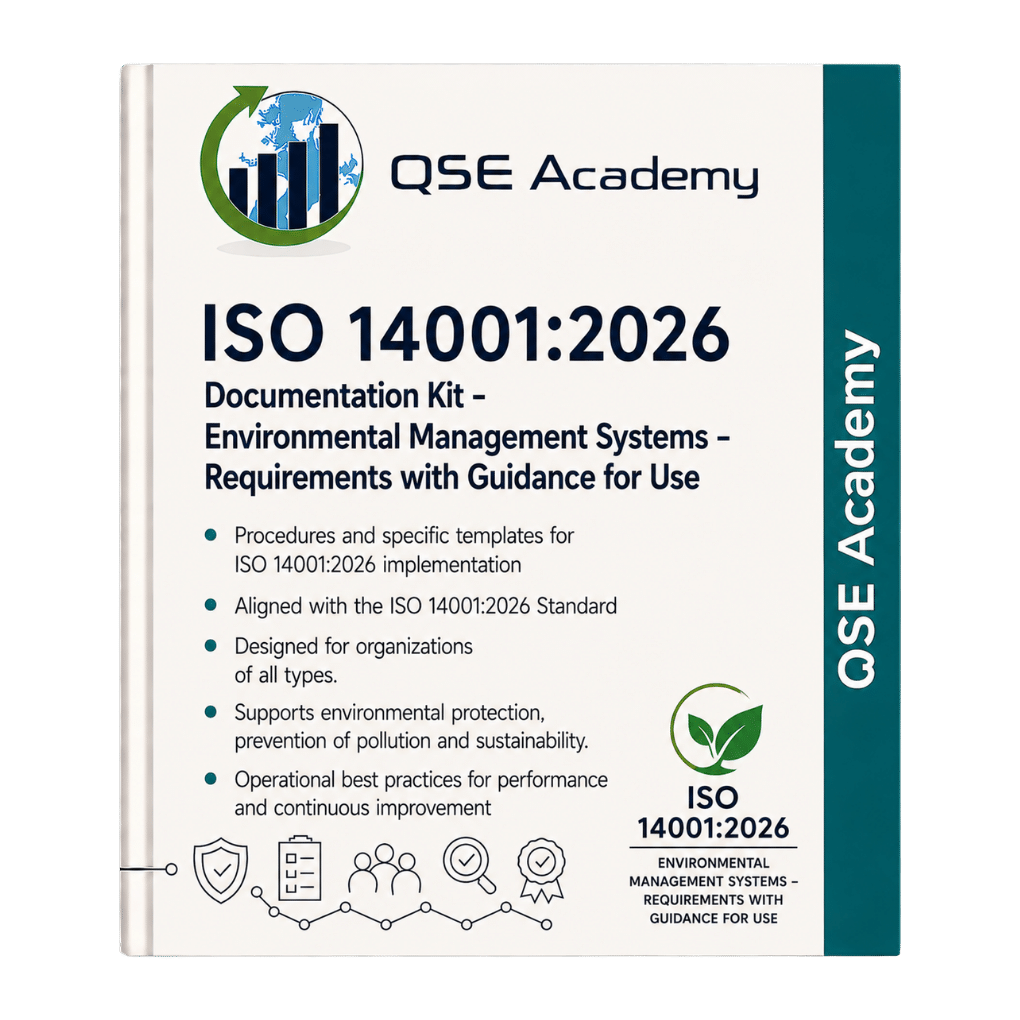
Most small organizations I work with land in the middle: a toolkit for the documents and structure, plus a few hours of expert review at the points that carry audit risk, such as the aspects analysis and the internal audit. If you want to see what a ready-made document set covers, the ISO 14001 documentation kit is built around the 2026 clause structure and gives you the templates without the consultant day-rate.
A practical test: if a failed first audit would cost you a major contract, pay for help at the high-risk steps. If your aspects are light and your timeline is flexible, a toolkit plus internal time is usually the better value.
What the 2026 edition adds to your bill
ISO 14001:2026 is the fourth edition of the standard, published on 15 April 2026. It folds in the 2024 climate amendment and pulls climate squarely into the body of the standard. For certification cost, two changes matter most.
First, climate is now a named part of your context. Clause 4.1 makes you weigh environmental conditions such as pollution levels, availability of natural resources, climate change, biodiversity and ecosystem health, and clause 4.2 ties interested-party expectations to those same conditions. Second, clause 8.1 widens the old idea of outsourced processes into externally provided processes, products and services, which pulls more of your supply chain into the system.
Neither change carries a fixed surcharge. The cost effect is indirect: both can widen the set of significant environmental aspects an auditor has to examine, and a broader scope can add audit time at the margins. If your operation has real climate exposure or a sprawling supplier base, expect the auditor to spend longer in those areas than under the 2015 edition. If your footprint is light, the practical effect on audit days may be small. Either way, it is a scope question, not a new line item.
The timing also shapes the cost decision. Certification bodies stop issuing new certificates against the 2015 edition on 31 October 2027, and every 2015 certificate must migrate to the 2026 edition by 30 April 2029, after which it is no longer valid. If you are certifying for the first time now, go straight to the 2026 edition so you are not paying to transition a brand-new certificate within a couple of years. If you already hold a 2015 certificate, our ISO 14001 transition guide lays out the dated steps to migrate without paying twice.
For the official scope and purpose of the standard, ISO publishes a public overview on its ISO 14001 hub. Read it alongside any quote so you know what the certificate you are paying for actually covers.
Frequently asked questions
The honest version of ISO 14001 pricing is that you can estimate it yourself before any salesperson sends a quote. Work out your audit days from the published method, multiply by a realistic day-rate, decide how much of the preparation you want to own, and add the three-year cycle. Do that, and the number stops being a surprise and starts being a budget you control.

👋 Hi, I’m HAFSA, and for the past 12 years, I’ve been on a journey to
make ISO standards less intimidating and more approachable for everyone.
Whether it’s ISO 9001, ISO 22000, or the cosmetics-focused ISO 22716, I’ve spent my career
turning complex jargon into clear, actionable steps that businesses can actually use.
I’m not here to call myself an expert—I prefer “enthusiast” because I truly love what I do.
There’s something incredibly rewarding about helping people navigate food safety and quality management systems
in a way that feels simple, practical, and even enjoyable.
When I’m not writing about standards, you’ll probably find me playing Piano 🎹, connecting with people, or diving into my next big project💫.
I’m an engineer specialized in the food and agricultural industry
I have a Master’s in QHSE management and over 12 years of experience as a Quality Manager
I’ve helped more than 15 companies implement ISO 9001, ISO 22000, ISO 22716, GMP, and other standards
My clients include food producers, cosmetics manufacturers, laboratories, and service companies
I believe quality systems should be simple, useful, and efficient.