
Last Updated on May 15, 2026 by Hafsa J.
Follow QSE Academy on Google
Add us as a preferred source to see our ISO and compliance articles more often in your Google results and Discover.
Main Requirements of ISO/IEC 17025 : 2017 – Part 1
If you’re working in a testing or calibration laboratory, you’ve likely heard of ISO/IEC 17025. But understanding the main requirements of ISO/IEC 17025—and how to actually apply them—can sometimes feel overwhelming. That’s why we’re breaking it all down into simple, straightforward parts. This is Part 1 of our deep dive into the 2017 version of the standard, where we’ll explore the foundational clauses that every accredited lab needs to get right.
The main requirements of ISO/IEC 17025 cover everything from impartiality and confidentiality to how your lab is structured, staffed, and equipped. These aren’t just formalities—they form the backbone of a system that supports reliable, repeatable, and trustworthy results.
In this article, we’ll focus on:
-
General requirements: impartiality and confidentiality
-
Structural requirements: legal identity and management roles
-
Resource requirements: staff competence, equipment, environment, and traceability
Each of these plays a key role in making sure your lab not only meets the standard—but actually operates better because of it. So if you’re preparing for accreditation, updating your system, or just want to better understand the main requirements of ISO/IEC 17025, you’re in the right place. Let’s take it step by step.
General Requirements
Let’s start with the foundation. One of the main requirements of ISO/IEC 17025 is making sure your lab operates in a way that’s both impartial and trustworthy. This might sound like common sense—and it is—but ISO/IEC 17025 takes it a step further by asking you to prove it.
These general requirements are covered in Clause 4 of the standard, and they focus on two key areas: impartiality and confidentiality.
Impartiality in Lab Activities
Impartiality means that your lab is free from any influence that could affect the results. That could be internal pressure, like a manager pushing for “favorable” outcomes, or external, like a client asking for a specific result.
According to the main requirements of ISO/IEC 17025, your lab must:
-
Be able to show that all testing and calibration is done objectively
-
Identify and manage any risks to impartiality
-
Ensure that all personnel are aware of the importance of being neutral
It’s not enough to say you’re impartial—you need to document how your lab stays that way and what steps you take to address potential conflicts of interest.
Confidentiality of Client Information
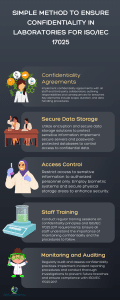
The second piece of the general requirements puzzle is confidentiality. Clients trust labs with sensitive data—whether it’s proprietary formulas, health information, or regulatory results. One of the main requirements of ISO/IEC 17025 is to handle that information with care.
This means:
-
Making sure all staff understand what information is confidential
-
Having procedures in place to protect client data
-
Clearly defining who has access to what—and why
Confidentiality isn’t just a privacy issue—it’s a quality issue too. If clients don’t trust that their data is safe, it impacts your lab’s reputation and credibility.
In short, the main requirements of ISO/IEC 17025 start by asking a simple question: Can your lab be trusted? With impartial results and secure information? If the answer is yes—and you can prove it—you’re off to a great start.
Structural Requirements
Once your lab has a handle on impartiality and confidentiality, the next step is to look at how it’s set up behind the scenes. That’s where the structural requirements come in—and yes, they’re another key part of the main requirements of ISO/IEC 17025.
This section of the standard (Clause 5) focuses on how your lab is legally and organizationally structured. In plain terms, it’s about making sure your lab is a real, clearly defined entity that has the authority and accountability to perform its work properly.
Being a Legally Identifiable Laboratory
One of the main requirements of ISO/IEC 17025 is that your lab must be a legal entity. This might seem obvious, but it’s an important detail. It means that your lab needs to be officially registered or recognized under the law—whether you’re part of a larger organization or operating independently.
Why does this matter? Because it shows that the lab takes full responsibility for its testing and calibration work. Accreditation bodies want to know exactly who is in charge, and who is accountable if something goes wrong.
Defining Roles and Responsibilities
Another big part of the main requirements of ISO/IEC 17025 is having a clear organizational structure. This doesn’t mean your org chart has to be fancy—but it should be clear who does what, who reports to whom, and who has final say over technical decisions.
Your lab should be able to show:
-
Who’s responsible for the quality system
-
Who makes technical decisions
-
Who ensures the lab meets ISO/IEC 17025 requirements
-
That there’s no overlap or confusion in roles that could affect impartiality
When everyone knows their role—and how it fits into the bigger picture—your lab runs more smoothly, and it’s easier to maintain consistent, accurate results.
So, when thinking about the main requirements of ISO/IEC 17025, don’t skip over structure. It might not seem as hands-on as method validation or equipment calibration, but it’s what holds the whole system together. A strong structure builds trust, prevents miscommunication, and makes sure your lab is set up for long-term success.
Resource Requirements
Now that we’ve covered structure, let’s talk about the actual tools, people, and environment your lab uses every day. These are known as resource requirements, and they make up a major part of the main requirements of ISO/IEC 17025. After all, even the best procedures won’t get you far without competent staff, reliable equipment, and the right conditions to do the job well.
This section of the standard (Clause 6) dives into what your lab needs in place to produce valid results—and how to prove that those resources are under control.
Qualified Personnel
One of the most important main requirements of ISO/IEC 17025 is ensuring that the people doing the work actually know what they’re doing. That doesn’t mean everyone needs a PhD—but it does mean they need to be trained, evaluated, and competent for the specific tasks they perform.
Here’s what auditors will expect to see:
-
Clear job descriptions with defined responsibilities
-
Training records for each staff member
-
Ongoing assessments to confirm competence (not just once at hiring)
It’s not just about having smart people—it’s about having a system that ensures they stay sharp and capable in their roles.
Equipment Calibration and Maintenance
Another critical piece of the main requirements of ISO/IEC 17025 is making sure your lab equipment is suitable, properly calibrated, and well-maintained. If your instruments are off, your results will be too—so the standard takes this seriously.
To stay compliant, your lab needs:
-
A list of all relevant equipment used in testing or calibration
-
Valid calibration certificates with traceability to recognized standards
-
A maintenance schedule—and records to prove it’s being followed
Even small tools like pipettes or thermometers count. If you rely on it to get a result, it needs to be under control.
Environmental Conditions
Environmental conditions are often overlooked, but they’re a key part of the main requirements of ISO/IEC 17025. If your testing relies on things like temperature, humidity, lighting, or cleanliness, then those factors need to be monitored and managed.
That might include:
-
Temperature logs for storage areas
-
Humidity controls in testing zones
-
Contamination control procedures in microbiology labs
The goal here is to make sure the environment isn’t affecting the integrity of your results.
Metrological Traceability
Lastly, traceability. This part of the main requirements of ISO/IEC 17025 ensures that your measurement results can be linked back to national or international standards. In simple terms, your lab’s results should be part of a bigger measurement system that everyone can trust.
To meet this requirement, you’ll need:
-
Calibration services from accredited providers
-
Certificates that show traceability to SI units (like grams, meters, seconds)
-
Internal procedures that verify and record traceability across the board
When it comes to resources, ISO/IEC 17025 isn’t just asking if you have what you need—it’s asking if you can prove that your tools, staff, and conditions are fully supporting reliable, high-quality testing. And that’s exactly why resource management is one of the main requirements of ISO/IEC 17025 that you simply can’t ignore.
Final Thoughts on Main Requirements of ISO/IEC 17025
So, now that we’ve walked through the general, structural, and resource clauses, you’ve got a solid start on understanding the main requirements of ISO/IEC 17025. While these areas might seem like the background operations of a lab, they actually lay the foundation for everything else—valid results, customer confidence, and a strong quality system.
To quickly recap, the main requirements of ISO/IEC 17025 we covered in this part include:
-
Impartiality and confidentiality, which ensure trust in your results
-
Organizational structure, so roles and responsibilities are clear
-
Resources, like trained personnel, calibrated equipment, and stable lab environments
-
Metrological traceability, to connect your measurements to international standards
These aren’t just boxes to check—they’re core elements that help your lab run effectively and credibly every single day. And when they’re implemented well, everything else (methods, results, reporting) flows much more smoothly.
In Part 2, we’ll dive deeper into the main requirements of ISO/IEC 17025 that deal with testing processes and the management system. Those are the hands-on and day-to-day parts of the standard that really bring the system to life.
Until then, just remember: ISO/IEC 17025 isn’t about making things harder—it’s about making your lab stronger, more consistent, and easier to trust. And that starts with getting these core requirements right.
I hold a Master’s degree in Quality Management, and I’ve built my career specializing in the ISO/IEC 17000 series standards, including ISO/IEC 17025, ISO 15189, ISO/IEC 17020, and ISO/IEC 17065. My background includes hands-on experience in accreditation preparation, documentation development, and internal auditing for laboratories and certification bodies. I’ve worked closely with teams in testing, calibration, inspection, and medical laboratories, helping them achieve and maintain compliance with international accreditation requirements. I’ve also received professional training in internal audits for ISO/IEC 17025 and ISO 15189, with practical involvement in managing nonconformities, improving quality systems, and aligning operations with standard requirements. At QSE Academy, I contribute technical content that turns complex accreditation standards into practical, step-by-step guidance for labs and assessors around the world. I’m passionate about supporting quality-driven organizations and making the path to accreditation clear, structured, and achievable.