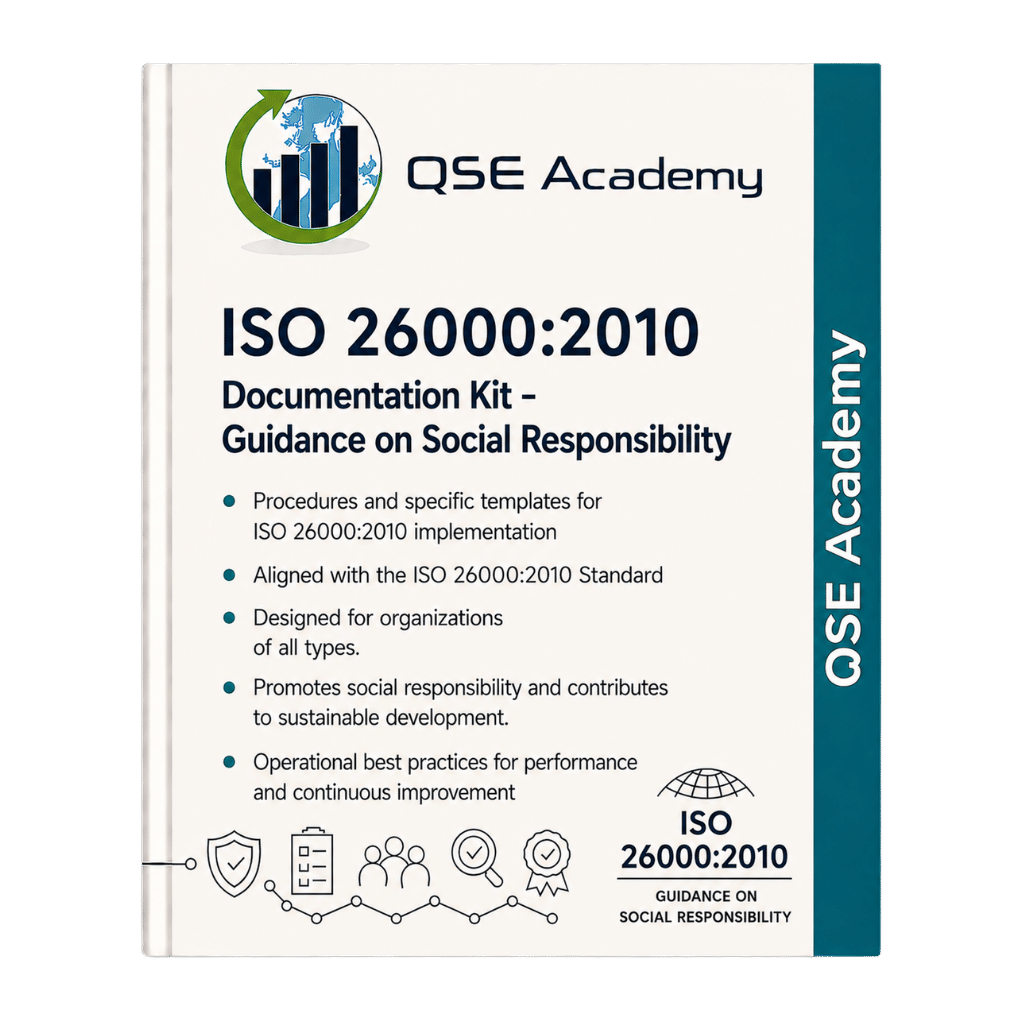
Voluntary international standard — ISO 26000 is the global reference for social responsibility, aligned with UN SDGs, the UN Global Compact, GRI, SASB, and TCFD frameworks.
ISO 26000:2010 · Social Responsibility & ESG

ISO 26000 Documentation Package — ESG & Social Responsibility

Structure your ESG / CSR program in weeks, not months.

  • 90 documents built clause by clause
  • Full mapping Art. 4 + Art. 5 + 7 core subjects + 36 issues
  • Cross-walk to GRI, SASB, TCFD, UN SDGs — investor and customer-grade
  • Foundation for ESG vendor questionnaires, sustainability ratings, and SEC climate disclosure readiness
Get the ISO 26000 Package — $489
Equivalent to $12,000 — $30,000 of ESG consulting fees
Instant download 30-day guarantee Editable Word format
ISO 26000:2010 Documentation Package
90
Documents included
7
Core subjects covered
36
Issues mapped
7
Fundamental principles (Art. 4)
Who this package is for

Designed for organizations that want to structure their ESG / CSR program credibly.

The ISO 26000 package is for any organization — corporation, nonprofit, public agency — that wants to formalize its social responsibility program, respond to stakeholder requirements, and align with international frameworks (UN SDGs, UN Global Compact, GRI, SASB, TCFD, SEC climate disclosure, B Corp).

1

SMBs & mid-market firms

Companies that want to formalize their ESG / CSR program to respond to growing requests from enterprise customers, federal contractors, investors, and supply chain partners — without spending 6 months of internal time building documentation from scratch.

2

Chief Sustainability Officers & ESG leads

Newly appointed CSOs, Heads of ESG, and Sustainability Directors structuring their function. They need an operational framework to quickly build a CSR policy, a stakeholder map, and a materiality matrix that holds up to investor and rating agency scrutiny.

3

Companies under CSRD or SEC climate disclosure

Organizations entering the scope of EU CSRD (sustainability reporting) or US SEC climate disclosure rules, who want to use ISO 26000 as a structuring framework, complementary to ESRS, IFRS S1/S2, GRI, SASB, and TCFD.

4

ESG consultants & advisory firms

Sustainability consultants and ESG advisory firms who want a validated documentation foundation to start client engagements quickly (consultant license available on request).

Why this package exists

A credible ESG program isn't built from an annual report.

ISO 26000:2010 is a 145-page standard that defines 7 principles, 7 core subjects, and 36 issues of social responsibility. Structuring a coherent ESG program takes 4 to 9 months of writing, stakeholder mapping, and materiality assessment work — and exposes you to "greenwashing" criticism if the documents don't hold up against an investor, ESG rating agency, or auditor.

01

Generic templates miss the standard

Most online ESG templates are limited to a values statement and a carbon footprint. They ignore the structural requirements of ISO 26000: the 7 principles (Art. 4), stakeholder mapping and sphere of influence (Art. 5), due diligence, the 36-issue matrix (Art. 6), and the 7 integration practices (Art. 7) — which is what investors, rating agencies, and enterprise customers actually examine.

02

Customers and investors require evidence

Fortune 500 buyers, PE funds, banks, federal contractors, and procurement platforms (EcoVadis, Sedex, CDP, MSCI ESG, Sustainalytics, ISS ESG) now require detailed, auditable ESG questionnaires aligned with recognized frameworks. Without a structured dossier, scores are mediocre and commercial opportunities are lost.

03

SEC climate disclosure and CSRD raise the bar

SEC climate disclosure rules (for US-listed companies) and EU CSRD (for any company with significant EU operations) impose deep sustainability reporting on a growing perimeter. Without a structured methodological framework — stakeholders, materiality, KPIs, governance — reporting becomes a costly formal exercise, fragile in audit.

04

An ESG consulting engagement costs $12,000 to $30,000

A complete ESG structuring engagement billed by a sustainability consulting firm represents 20 to 50 days of intervention. The documentation package gives you the complete written foundation — you keep your budget for team mobilization, stakeholder engagement, and operational deployment.

What is included

90 documents aligned with the 7 principles, 7 core subjects, and 36 issues.

The package fully covers ISO 26000:2010 — the 7 principles of social responsibility (Article 4), stakeholder identification and engagement (Article 5), the 7 core subjects and 36 issues (Article 6), and the integration practices (Article 7) — plus the related international frameworks (UN Global Compact, UN SDGs, GRI, SASB, TCFD, IFRS S1/S2) that any credible ESG program must connect to.

Article 4 — 7 principles

Principles of social responsibility

  • Consolidated CSR / ESG policy covering the 7 principles (§ 4.1 to § 4.8)
  • Code of ethics — accountability, transparency, ethical behavior (§ 4.2 to § 4.4)
  • Statement of recognition of stakeholder interests (§ 4.5)
  • Statement of respect for the rule of law and international norms (§ 4.6 & § 4.7)
  • Universal commitment to human rights (§ 4.8)
  • Self-assessment grid for the 7 principles
Article 5 — Identification & engagement

Stakeholders & sphere of influence

  • Social responsibility identification procedure (§ 5.2.1 — impacts, interests, expectations)
  • Core subject relevance matrix (§ 5.2.2)
  • Sphere of influence mapping (§ 5.2.3)
  • Stakeholder mapping (§ 5.3.2)
  • Stakeholder engagement procedure (§ 5.3.3)
  • Annual consultation plan
§ 6.2 — Core subject 1

Organizational governance

  • CSR / ESG policy signed by top management (§ 6.2.3)
  • Decision-making structures and processes
  • ESG governance procedure and ESG committee charter
  • Whistleblower / escalation procedure
  • Conflict of interest management procedure
  • ESG steering KPI dashboard
§ 6.3 — Core subject 2 (8 issues)

Human rights

  • Human rights due diligence procedure (Issue 1 — § 6.3.3, UNGP-aligned)
  • Human rights risk situations mapping (Issue 2 — § 6.3.4)
  • Avoidance of complicity procedure (Issue 3 — § 6.3.5)
  • Grievance and remediation mechanism (Issue 4 — § 6.3.6)
  • Non-discrimination & vulnerable groups policy (Issue 5 — § 6.3.7)
  • Civil and political rights procedure (Issue 6 — § 6.3.8)
  • Economic, social, cultural rights procedure (Issue 7 — § 6.3.9)
  • Fundamental principles and rights at work procedure (Issue 8 — § 6.3.10, ILO core conventions)
  • Modern slavery / forced labor statement (UK Modern Slavery Act, CA SB 657, Federal Acquisition Regulation 52.222-50 alignment)
§ 6.4 — Core subject 3 (5 issues)

Labor practices

  • Employment and employment relationships policy (Issue 1 — § 6.4.3)
  • Conditions of work and social protection procedure (Issue 2 — § 6.4.4)
  • Social dialogue procedure (Issue 3 — § 6.4.5)
  • Health and safety at work procedure (Issue 4 — § 6.4.6, OSHA-aligned)
  • Human capital development plan (Issue 5 — § 6.4.7)
  • Diversity, Equity & Inclusion (DEI) procedure — pay equity and workplace culture
§ 6.5 — Core subject 4 (4 issues)

The environment

  • Pollution prevention procedure (Issue 1 — § 6.5.3, EPA / CWA / CAA aligned)
  • Sustainable resource use procedure (Issue 2 — § 6.5.4)
  • Climate change mitigation and adaptation procedure (Issue 3 — § 6.5.5, TCFD-aligned)
  • Environment protection & biodiversity procedure (Issue 4 — § 6.5.6)
  • Environmental policy
  • GHG inventory methodology (Scopes 1, 2, 3 — GHG Protocol aligned, SEC climate disclosure ready)
§ 6.6 — Core subject 5 (5 issues)

Fair operating practices

  • Anti-corruption procedure (Issue 1 — § 6.6.3, FCPA / UK Bribery Act / DOJ Compliance Program-aligned)
  • Responsible political involvement procedure (Issue 2 — § 6.6.4, FEC compliance)
  • Fair competition policy (Issue 3 — § 6.6.5, antitrust)
  • Promotion of social responsibility in the value chain (Issue 4 — § 6.6.6)
  • Respect for property rights procedure (Issue 5 — § 6.6.7)
  • Responsible sourcing policy (supplier code of conduct)
§ 6.7 — Core subject 6 (7 issues)

Consumer issues

  • Fair marketing, factual and unbiased information procedure (Issue 1 — § 6.7.3, FTC Act-aligned)
  • Protecting consumers' health and safety procedure (Issue 2 — § 6.7.4, CPSC-aligned)
  • Sustainable consumption procedure (Issue 3 — § 6.7.5)
  • Consumer service, support, complaint and dispute resolution (Issue 4 — § 6.7.6)
  • Consumer data protection and privacy procedure (Issue 5 — § 6.7.7, CCPA/CPRA + GDPR aligned)
  • Access to essential services procedure (Issue 6 — § 6.7.8)
  • Education and awareness procedure (Issue 7 — § 6.7.9)
§ 6.8 — Core subject 7 (7 issues)

Community involvement and development

  • Community involvement procedure (Issue 1 — § 6.8.3)
  • Education and culture procedure (Issue 2 — § 6.8.4)
  • Employment creation and skills development procedure (Issue 3 — § 6.8.5)
  • Technology development and access procedure (Issue 4 — § 6.8.6)
  • Wealth and income creation procedure (Issue 5 — § 6.8.7)
  • Community health procedure (Issue 6 — § 6.8.8)
  • Social investment & corporate philanthropy procedure (Issue 7 — § 6.8.9)
Article 7 — Integration

Integration practices

  • Issue relevance & prioritization matrix (§ 7.3.2 and § 7.3.4) — double materiality assessment
  • Sphere of influence analysis (§ 7.3.3)
  • Awareness and competency development plan (§ 7.4.1)
  • ESG orientation note (§ 7.4.2)
  • Integration in governance, systems, processes procedure (§ 7.4.3)
  • Review and continual improvement procedure (§ 7.7)
  • Indicator dashboard and monitoring (§ 7.7.2)
§ 7.5 and § 7.6 — Communication

Communication & credibility

  • ESG communication procedure (§ 7.5.1 to § 7.5.4) — anti-greenwashing safeguards
  • Information characteristics matrix (§ 7.5.2)
  • Credibility enhancement procedure (§ 7.6.1) — third-party assurance readiness
  • Disagreement resolution procedure (§ 7.6.3)
  • Annual sustainability report template (GRI / SASB / TCFD-ready)
  • Voluntary initiatives matrix (§ 7.8 & Annex A)
International frameworks

Global alignment matrices

  • Mapping matrix ISO 26000 ↔ UN Global Compact (10 principles)
  • Mapping matrix ISO 26000 ↔ UN SDGs (17 goals)
  • Mapping matrix ISO 26000 ↔ ILO (fundamental conventions)
  • Mapping matrix ISO 26000 ↔ OECD Guidelines for MNEs
  • Mapping matrix ISO 26000 ↔ GRI Standards (universal & topic-specific)
  • Mapping matrix ISO 26000 ↔ SASB Standards (industry-specific)
  • Mapping matrix ISO 26000 ↔ TCFD recommendations (4 pillars)
  • Mapping matrix ISO 26000 ↔ IFRS S1/S2 (sustainability disclosure)
  • Mapping matrix ISO 26000 ↔ SEC climate disclosure rules
  • Mapping matrix ISO 26000 ↔ B Corp Impact Assessment
Delivery format: all documents are delivered as fully editable Microsoft Word (.docx) files, with a neutral graphic charter ready to receive your logo. No locked PDFs, no proprietary software dependency. The mapping matrices (ISO 26000 issues, SDGs, GRI, SASB, TCFD, IFRS S1/S2, SEC, UN Global Compact, ILO, OECD, B Corp) are delivered in Excel format.
Clause-by-clause mapping

Every ISO 26000:2010 article and issue → documents in the package.

ISO 26000 is a guidance standard — not a certifiable management system. What investors, ESG rating agencies, and enterprise customer auditors look at is whether your program structurally covers the 7 core subjects and 36 issues. Below is the clause-by-clause mapping between the standard and the documents provided.

ISO 26000 paragraph Normative requirement Documents provided in the package
Art. 4 — 7 principles Accountability (4.2), Transparency (4.3), Ethical behavior (4.4), Respect for stakeholder interests (4.5), Respect for the rule of law (4.6), Respect for international norms of behavior (4.7), Respect for human rights (4.8) CSR / ESG policy Code of ethics Stakeholder commitment Rule of law statement International norms statement Human rights commitment 7 principles self-assessment grid
Art. 5 — Identification & engagement Impacts, interests and expectations (5.2.1), Identifying core subjects and issues (5.2.2), Sphere of influence (5.2.3), Identifying stakeholders (5.3.2), Engaging with stakeholders (5.3.3) Social responsibility identification procedure Relevance matrix Sphere of influence mapping Stakeholder mapping Engagement procedure
§ 6.2 — Governance Decision-making structures and processes (6.2.3) integrating social responsibility principles throughout the organization CSR / ESG policy ESG governance ESG committee charter Conflicts of interest Whistleblower procedure Steering KPIs
§ 6.3 — Human rights Issue 1 Due diligence (6.3.3), Issue 2 Risk situations (6.3.4), Issue 3 Avoidance of complicity (6.3.5), Issue 4 Resolving grievances (6.3.6), Issue 5 Discrimination and vulnerable groups (6.3.7), Issue 6 Civil and political rights (6.3.8), Issue 7 Economic, social and cultural rights (6.3.9), Issue 8 Fundamental principles and rights at work (6.3.10) Due diligence (UNGP) Risk mapping Avoidance of complicity Grievance remediation Non-discrimination Vulnerable groups Civil & political rights Economic & social rights Rights at work (ILO) Modern slavery statement (UK MSA, CA SB 657)
§ 6.4 — Labor practices Issue 1 Employment (6.4.3), Issue 2 Conditions of work (6.4.4), Issue 3 Social dialogue (6.4.5), Issue 4 Health & safety at work (6.4.6, OSHA-aligned), Issue 5 Human capital development (6.4.7) Employment relationships Conditions of work Social dialogue Health & safety Human capital DEI procedure (pay equity)
§ 6.5 — The environment Issue 1 Pollution prevention (6.5.3, EPA / CWA / CAA aligned), Issue 2 Sustainable resource use (6.5.4), Issue 3 Climate change mitigation and adaptation (6.5.5, TCFD-aligned), Issue 4 Environment protection & biodiversity (6.5.6) Environmental policy Pollution prevention Sustainable resources Climate change Biodiversity GHG inventory (Scopes 1/2/3, GHG Protocol)
§ 6.6 — Fair operating practices Issue 1 Anti-corruption (6.6.3, FCPA / DOJ Compliance Program), Issue 2 Responsible political involvement (6.6.4, FEC compliance), Issue 3 Fair competition (6.6.5, antitrust), Issue 4 Promoting social responsibility in the value chain (6.6.6), Issue 5 Respect for property rights (6.6.7) Anti-corruption (FCPA) Political involvement Fair competition CSR in value chain Property rights Responsible sourcing
§ 6.7 — Consumer issues Issue 1 Fair marketing (6.7.3, FTC Act), Issue 2 Health and safety (6.7.4, CPSC), Issue 3 Sustainable consumption (6.7.5), Issue 4 Service, support, complaint resolution (6.7.6), Issue 5 Data protection and privacy (6.7.7, CCPA/CPRA + GDPR), Issue 6 Access to essential services (6.7.8), Issue 7 Education and awareness (6.7.9) Fair marketing Consumer health Sustainable consumption Complaint resolution Data protection (CCPA + GDPR) Essential services Consumer education
§ 6.8 — Community involvement & development Issue 1 Community involvement (6.8.3), Issue 2 Education and culture (6.8.4), Issue 3 Employment creation and skills development (6.8.5), Issue 4 Technology development and access (6.8.6), Issue 5 Wealth and income creation (6.8.7), Issue 6 Health (6.8.8), Issue 7 Social investment (6.8.9) Community involvement Education & culture Jobs & skills Technology & access Wealth & income Community health Corporate philanthropy
Art. 7 — Integration Organization characteristics and SR (7.2), Understanding SR (7.3 — due diligence, relevance, sphere of influence, priorities), Integration practices (7.4 — awareness, orientation, integration), Communication (7.5), Enhancing credibility (7.6), Reviewing and improving (7.7), Voluntary initiatives (7.8) Prioritization matrix (double materiality) Sphere of influence Awareness plan ESG orientation Governance integration ESG communication (anti-greenwashing) Credibility & resolution (assurance-ready) Review & monitoring Voluntary initiatives (Annex A)
International frameworks Alignment with complementary frameworks cited by ISO 26000 (Annex A and bibliography) plus US and EU requirements: UN Global Compact (10 principles), UN SDGs (Agenda 2030), ILO (fundamental conventions), OECD (MNE guidelines), GRI Standards, SASB Standards (industry-specific), TCFD (4 pillars), IFRS S1/S2, SEC climate disclosure, B Corp, EU CSRD/ESRS UN Global Compact matrix UN SDGs matrix ILO matrix OECD matrix GRI matrix SASB matrix TCFD matrix IFRS S1/S2 matrix SEC climate disclosure matrix B Corp Impact Assessment matrix CSRD/ESRS matrix
Not included Elements that depend on each organization — and that must be filled in, calculated, or assessed internally by your team or by a specialized provider Quantified GHG inventory (Scopes 1/2/3) Filled-in materiality matrix Filled-in stakeholder mapping CSRD/ESRS sustainability report content SEC climate disclosure filing EcoVadis / Sustainalytics / MSCI ESG score B Corp certification SBTi target validation
Why these elements can't be delivered turnkey in any documentation package — from any supplier.

The quantified GHG inventory, filled-in materiality matrix, complete stakeholder mapping, and CSRD/SEC sustainability reports depend by nature on the operational reality of each organization: activities, footprint, value chain, geographies, stakeholder typology, real impacts. This is precisely what ISO 26000 explicitly requires in § 7.3 ("Understanding the social responsibility of the organization"): every program must be context-specific.

A package claiming to provide these deliverables pre-filled would expose the buyer to a non-credible ESG program, even greenwashing risk and reclassification under the FTC Green Guides, EU Green Claims Directive, or SEC anti-fraud provisions. These data must be collected, calculated, and analyzed case by case by your internal team, a GHG Protocol-certified provider, or a sustainability consulting firm.

The QSE Academy package, however, provides all the procedures, methodologies, and matrices that frame the construction of these deliverables: GHG inventory procedure, single and double materiality methodology, stakeholder mapping procedure, GRI/SASB/TCFD/SEC/CSRD mapping matrices — the full documentation framework within which your company data takes shape.
This mapping is delivered as an Excel matrix in the package, with each line referencing the exact ISO 26000:2010 paragraph. It can be presented as-is to an ESG auditor, EcoVadis evaluator, MSCI/Sustainalytics/ISS rating analyst, B Corp B Lab, or to top management as proof of complete normative coverage of the 36 issues.
For experienced ESG / CSR professionals

Methodological rigor — the points an experienced Chief Sustainability Officer checks first.

Beyond the issue-by-issue mapping, here are the methodological rigor points that experienced CSOs, sustainability directors, and ESG raters verify first.

  • Principles-based approach — the 7 principles (accountability, transparency, ethical behavior, respect for stakeholder interests, rule of law, international norms, human rights) applied operationally, not declaratively
  • Human rights due diligence — structured procedure aligned with UN Guiding Principles (UNGP / Ruggie Framework) and OECD Due Diligence Guidance, not a simple ethical commitment
  • Sphere of influence — explicit analysis of direct and indirect relationships, including upstream and downstream value chain
  • Double materiality — methodology aligned with EFRAG / CSRD ESRS, distinguishing financial materiality (impact on enterprise value) and impact materiality (impact on people and environment). Increasingly expected by SEC for US-listed companies
  • Stakeholder mapping — structured method (identification, prioritization, engagement modalities), not a simple list. AA1000 Stakeholder Engagement Standard alignment
  • SMART KPIs — ESG objectives with baselines, milestones and quantifiable targets, not just intentions. Science-Based Targets initiative (SBTi) alignment for climate
  • Framework alignment — explicit mapping matrices with UN SDGs, GRI, SASB, TCFD, IFRS S1/S2, SEC climate disclosure, EU CSRD/ESRS — essential for multi-framework reporting
  • ESG management review procedure — top-management oversight, annual review with structured agenda and traceable minutes. Board-level ESG committee charter
  • GHG inventory framework — Scopes 1, 2, 3 aligned with GHG Protocol, ISO 14064-1, and ready for SEC climate disclosure (Scope 1+2 mandatory for large filers, Scope 3 if material)
  • FCPA / Anti-corruption program — corruption risk mapping, code of conduct, whistleblower hotline, accounting controls — aligned with DOJ Evaluation of Corporate Compliance Programs and FCPA Resource Guide
  • Climate scenario analysis (TCFD) — structured analysis under multiple climate scenarios (1.5°C, 2°C, business-as-usual), governance / strategy / risk management / metrics & targets pillars
  • Anti-greenwashing safeguards — FTC Green Guides compliance, EU Green Claims Directive readiness, third-party assurance trail (limited or reasonable assurance per ISAE 3000 / AA1000AS)
G

ISO 26000: international recognition

ISO 26000 is recognized as the international reference standard for social responsibility. An ISO 26000-aligned package positions you to respond to the major global ESG assessment and reporting frameworks.

UN SDGs — Agenda 2030 UN Global Compact GRI Standards SASB Standards TCFD IFRS S1/S2 SEC climate disclosure EU CSRD / ESRS B Corp EcoVadis CDP MSCI ESG / Sustainalytics / ISS ESG
Comparison

Why the QSE Academy package over the alternatives.

Criterion QSE Academy ISO 26000
$489
Free templates
$0
ESG consulting firm
$12,000 — $30,000
Coverage of the 7 ISO 26000 core subjects ✓ 100% Partial ✓ 100%
Mapping of the 36 issues ✓ Excel matrix Per engagement
Alignment with UN SDGs, GRI, SASB, TCFD ✓ 11 matrices Per engagement
SEC climate disclosure / IFRS S1/S2 / CSRD readiness ✓ Included Per engagement
Stakeholder engagement & double materiality procedures ✓ Included
Editable Word format, neutral charter Variable
Delivery time Instant Instant 4 to 9 months
Money-back guarantee ✓ 30 days
Stakeholder facilitation & internal mobilization On you On you Included
The package doesn't replace the work of internal facilitation and stakeholder dialogue — it gives you the complete written and methodological foundation. That's precisely the part where consulting firms charge the most. For materiality assessment, GHG inventory, ESG rating support, or B Corp certification, we also offer custom services.
ESG flash audit

Where do you stand today?

Answer the 14 questions across the 7 core subjects to get your ISO 26000 ESG maturity score. Instant result, free, no personal information required.

Question 1 / 14
Article 4 — Principles
0
/ 100

Get the ISO 26000 Package — $489
Deployment process

From order to credible ESG program, here is the path.

The package isn't just delivered. Here is the concrete path to bring it into production in your organization, step by step.

1
Day 1

Download

Secure payment, immediate access to the full package as a ZIP. Within minutes you have the 90 Word documents, the Excel matrices (SDGs, GRI, SASB, TCFD, SEC, CSRD), and the user manual.

2
Weeks 1 — 4

Customization

Adapting the documents to your organization: logo, governance, scope of activities, value chain, geographies, applicable disclosure regimes (SEC, CSRD, B Corp, etc.). Plan 2 to 4 weeks for thorough customization.

3
Weeks 5 — 12

Stakeholder engagement

Stakeholder mapping, double materiality assessment, engagement plan, GHG inventory kickoff, ESG committee setup. The methodology comes with the package; the engagement work is yours.

4
Weeks 12 — 16

Reporting & rating

Annual sustainability report (GRI / SASB / TCFD-ready), SEC climate disclosure preparation if applicable, EcoVadis / Sustainalytics / MSCI ESG questionnaire response, B Corp Impact Assessment if pursued.

Typical timeline: 12 to 16 weeks between order and a "ready for ESG rating / SEC filing / customer audit" state. The most structured organizations reach this state in 10 weeks; those starting from scratch may take up to 24 weeks. Your internal resources make the difference, not the package.
Used by ESG teams worldwide

What organizations that adopted it say.

★★★★★

A massive time-saver. The procedures were clear, complete, and directly usable. Our EcoVadis score went from 47 to 71 in less than a year, and the SDGs / GRI / SASB cross-walk was a game-changer for our enterprise customer audits.

M
Megan
Chief Sustainability Officer · Mid-market manufacturer, USA
★★★★★

Written by professionals who really know ESG. The double materiality methodology, the GHG inventory framework, and the TCFD / SEC alignment matrices were exactly what I needed to structure our sustainability program for our SEC climate disclosure preparation.

R
Robert
Head of ESG · Listed Services Company, USA
★★★★☆

Unbeatable value. We rolled out our ESG program in 14 weeks instead of the 6 months we expected with an external sustainability consultant. The B Corp Impact Assessment cross-walk was particularly well thought out.

D
David
VP Operations · B Corp candidate firm, Canada
★★★★★

Fully customizable Word documents, neutral charter, accurate ESG terminology, ISO 26000 fully aligned with global frameworks. The anti-greenwashing safeguards are well designed, the FCPA anti-corruption procedure is operational. Solid work.

A
Amanda
General Counsel · PE-backed industrial firm, UK
Risk-free

30-day guarantee, no questions asked.

30-day money-back guarantee

You test the package. If you change your mind, we refund you.

You have 30 days to download the package, review its content, open the documents, and verify that the writing quality matches your expectations. If something is off, you write us an email — no justification needed — and the refund is processed within 5 business days. That simple.

The package evolves with you

Updates included for 12 months.

The ESG regulatory and reporting landscape evolves rapidly. The package you buy today shouldn't become obsolete in 6 months. That's why updates are included.

12 months of regulatory and framework updates

The package already integrates ISO 26000:2010, UN SDGs, UN Global Compact, GRI, SASB, TCFD, IFRS S1/S2, SEC climate disclosure, EU CSRD/ESRS, B Corp, and FCPA / DOJ Compliance Program guidance. In case of new framework versions, SEC final rule changes, EFRAG guidance updates, or material new standards, you receive package updates free of charge for 12 months after your purchase.

  • SEC climate disclosure final rule and guidance
  • IFRS S1/S2 (ISSB) updates
  • EU CSRD / ESRS interpretations
  • GRI Universal Standards revisions
  • SASB / TCFD updates (post-IFRS Foundation merger)
  • B Corp standards revisions (B Lab v6)
  • FCPA / DOJ Compliance Program updates
  • Email notifications upon publication
Frequently asked questions

Answers to your most common questions.

Is the package enough to obtain an ESG rating or pass an enterprise customer audit?

The package gives you the complete documentation foundation aligned with ISO 26000 and the major global frameworks (GRI, SASB, TCFD, IFRS S1/S2, SEC climate disclosure, B Corp, CSRD). To obtain a high ESG rating (EcoVadis, Sustainalytics, MSCI ESG) or pass an enterprise audit, you also need to fill in the documents with your real data (GHG inventory, materiality matrix, stakeholder mapping, KPIs) and demonstrate operational implementation. The package saves you the 4 to 9 months of writing and methodological work. Operational work remains yours (typically 12 to 16 additional weeks).

Is ISO 26000 a certifiable standard?

No. ISO 26000:2010 is explicitly a guidance standard, not a management system standard like ISO 9001 or ISO 14001. It is not certifiable. However, several third-party recognition schemes use ISO 26000 as a structuring framework (B Corp Impact Assessment, EcoVadis, ISS ESG ratings). The package does not include a certification path but provides a documentation foundation that holds up to ESG rating agency review (EcoVadis, Sustainalytics, MSCI ESG, ISS ESG, CDP) and stakeholder scrutiny.

Does the package cover SEC climate disclosure rules?

Yes. The package includes a dedicated SEC climate disclosure mapping matrix aligned with the SEC final rule on climate-related disclosures (March 2024 and any subsequent updates). It covers Scope 1, Scope 2, and material Scope 3 GHG inventory framework (GHG Protocol-aligned), climate-related risks (physical and transition), governance, strategy, risk management, metrics & targets — the four TCFD pillars now embedded in SEC requirements. The package supports compliance preparation but does not replace the work of accounting and disclosure teams who must produce the actual filings.

What's the difference between this and free ESG templates?

Most free ESG templates are limited to a values statement and a carbon footprint outline. They ignore the structural requirements of ISO 26000: the 7 principles (Art. 4), stakeholder mapping and sphere of influence (Art. 5), human rights due diligence (UNGP-aligned), the 36-issue matrix (Art. 6), and the 7 integration practices (Art. 7). The QSE Academy package is written specifically for ISO 26000 + global frameworks (GRI, SASB, TCFD, IFRS S1/S2, SEC, CSRD, B Corp) and includes the 11 cross-walk matrices required for multi-framework reporting.

How long does it take to adapt the package to my organization?

Plan 2 to 4 weeks to customize the documents: logo, governance structure, scope of activities, value chain map, applicable disclosure regimes (SEC, CSRD, etc.). Then plan stakeholder engagement and methodological work: stakeholder mapping, double materiality assessment, GHG inventory, ESG committee setup — 12 to 16 additional weeks depending on company size and starting maturity.

Is the package delivered in Word or PDF format?

All policies, procedures, and templates are delivered in fully editable Microsoft Word (.docx) format. The 11 mapping matrices (UN SDGs, UN Global Compact, ILO, OECD, GRI, SASB, TCFD, IFRS S1/S2, SEC, B Corp, CSRD) are delivered in Excel format. No locked PDFs, no proprietary software dependency.

Does the package help with ESG rating responses (EcoVadis, Sustainalytics, MSCI ESG)?

Yes. The 7 core subjects, 36 issues, and the cross-walk matrices align directly with the questionnaire structures used by major ESG raters: EcoVadis (Environment, Labor & Human Rights, Ethics, Sustainable Procurement), Sustainalytics (ESG Risk Rating), MSCI ESG (Industry Materiality Map), ISS ESG (Quality Score), and CDP (Climate, Water, Forests). Having ISO 26000-structured documentation accelerates response time and improves scores significantly. EcoVadis score improvements of 15 to 30 points are typical after a structured ISO 26000 deployment.

Does the package support B Corp certification?

Yes. A dedicated ISO 26000 ↔ B Corp Impact Assessment cross-walk matrix is included. The 7 ISO 26000 core subjects map directly to the 5 B Impact Assessment areas (Governance, Workers, Community, Environment, Customers). The package provides the documentation foundation needed to support B Corp candidacy — though the certification process itself (B Lab assessment, verification, recertification every 3 years) remains yours to complete.

How many users / sites does the license cover?

The $489 license covers a single legal entity, with unlimited internal use (all your employees can use the package). For multi-site rollout, a group with multiple subsidiaries, or consulting use across multiple clients, contact us for an adapted license.

Do I receive updates if the frameworks evolve?

Yes. The package already integrates the latest 2025-2026 ESG landscape (ISO 26000:2010, GRI, SASB, TCFD, IFRS S1/S2, SEC climate disclosure, EU CSRD/ESRS, B Corp v6 standards). In case of significant framework updates, SEC final rule revisions, EFRAG guidance changes, or material new standards, you receive package updates free of charge for 12 months after your purchase.

What happens if I'm not satisfied?

You're covered by a 30-day money-back guarantee, no conditions. You write us a simple email — no justification required — and the refund is processed within 5 business days.

Take action

Your ISO 26000 ESG documentation foundation. Ready today.

90 documents, 7 core subjects + 36 issues mapped, 11 cross-walk matrices (UN SDGs, GRI, SASB, TCFD, IFRS S1/S2, SEC, B Corp, CSRD, etc.). Instant download after payment.

Equivalent to $12,000 — $30,000 of ESG consulting fees
$489 Single-organization license · Secure payment · Instant download
Get the ISO 26000 Package — $489
30-day money-back guarantee Instant download 12 months of updates Editable Word format