CLIA · CAP · ISO 15189 — medical laboratory accreditation requires a quality management system aligned with ISO 15189:2022, the international reference standard.
ISO 15189:2022 · Medical Laboratory Accreditation

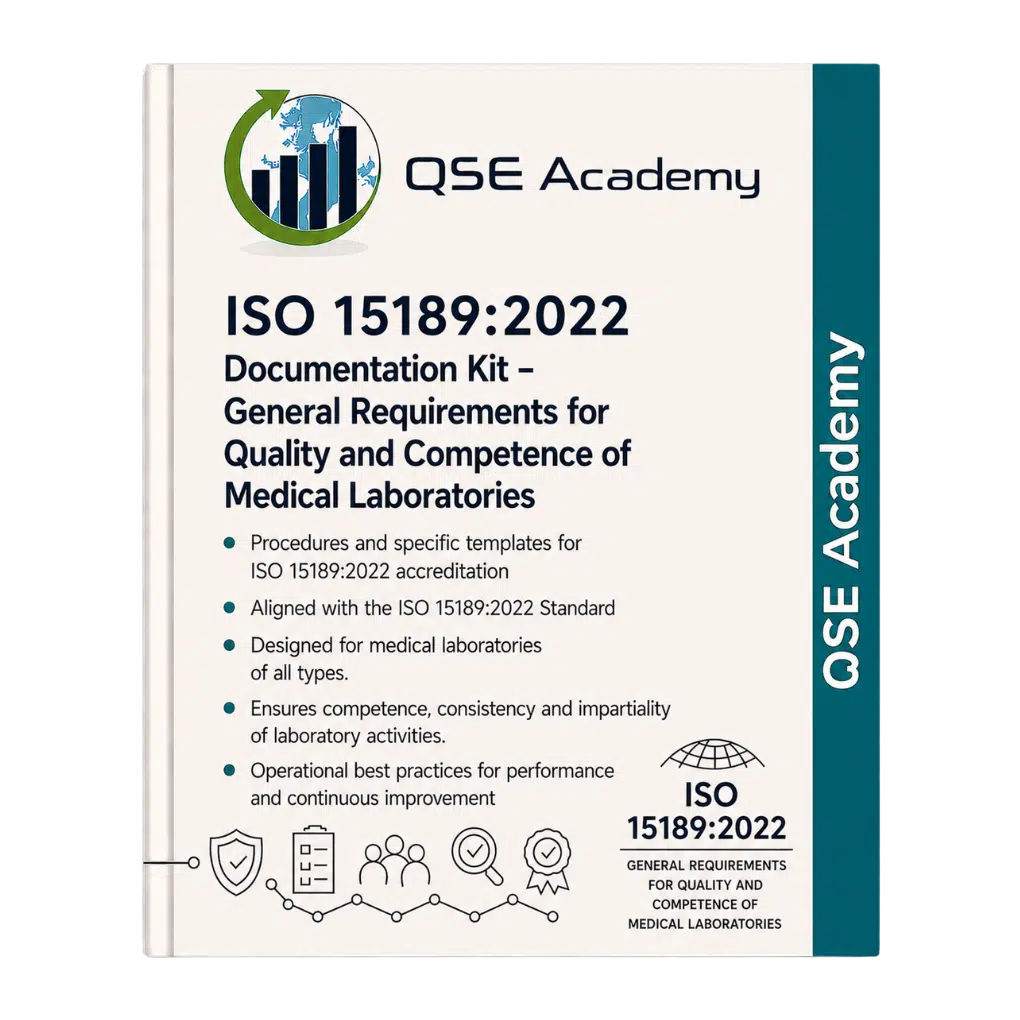
ISO 15189:2022 Documentation Package — Medical Laboratories

Prepare your laboratory accreditation in weeks, not months.

  • 122 documents built sub-clause by sub-clause
  • 100% coverage — clauses 4 to 8 + Annex A (POCT) of ISO 15189:2022
  • Editable procedures and records, fully aligned with the standard
  • Compatible with CAP, A2LA, ANAB, and other US accreditation bodies
Get the ISO 15189 Package — $689
Equivalent to $15,000 — $30,000 of consulting fees
Instant download 30-day guarantee Editable Word format
ISO 15189:2022 Documentation Package
122
Documents included
5 + A
Clauses 4-8 + Annex A POCT
100%
Sub-clauses mapped
2022
Latest revision
Who this package is for

Designed for medical laboratories pursuing or maintaining CAP, A2LA, or ANAB accreditation.

The ISO 15189:2022 package is for any clinical laboratory subject to CLIA certification and pursuing accreditation under CAP, A2LA, ANAB, or other recognized programs — regardless of structure (independent, hospital-based, reference laboratory) or scope of activity.

1

Independent clinical laboratories

Independent clinical laboratories, single or multi-site, including reference laboratories competing with LabCorp, Quest Diagnostics, Sonic Healthcare, and Mayo Clinic Labs. Facilities required to demonstrate full coverage of accredited scope per ISO 15189:2022.

2

Hospital laboratories

Hospital-based clinical laboratories within community hospitals, regional medical centers, and academic medical centers. Multi-discipline departments (chemistry, hematology, microbiology, immunology, coagulation) subject to the same CAP, A2LA, or ANAB accreditation requirements.

3

Specialty laboratories

Pathology and cytology laboratories, molecular diagnostics and NGS labs, genetic testing labs, reproductive biology / IVF labs that must structure their quality system in line with the 2022 revision — including labs developing FDA-cleared assays or laboratory-developed tests (LDTs).

4

Lab directors & quality consultants

Laboratory directors, technical supervisors, quality assurance managers, consultants, and accreditation advisory firms looking for a validated documentation foundation to start their engagements (consultant license available on request).

Why this package exists

ISO 15189:2022 can't be drafted from a blank page.

The 2022 version of ISO 15189 replaced the 2012 version with a major structural overhaul: alignment with the ISO/IEC 17025:2017 structure (clauses 4 to 8), integration of the former ISO 22870 on point-of-care testing (now covered via the normative Annex A and service agreements 6.7.2), and reinforced risk-based approach (5.6, 7.1, 8.5). Building all of this in-house requires 6 to 12 months of writing work and exposes you to avoidable findings during CAP, A2LA, or ANAB assessment.

01

Generic ISO 9001 templates don't cover medical laboratory work

Most templates downloaded online are ISO 9001 derivatives. They ignore medical laboratory-specific requirements: method verification/validation, measurement uncertainty, IQC/EQA (proficiency testing), control of pre-examination, examination, and post-examination phases, point-of-care testing (POCT), accreditation scope.

02

CAP, A2LA, and ANAB assessments don't forgive improvisation

Accreditation assessment is a rigorous 3 to 5-day procedure, conducted by peer pathologists, lab directors, and quality assessors. An incomplete or poorly mapped documentation system immediately generates major findings — with possible deficiency citations and conditional accreditation status.

03

CLIA certification is mandatory, not optional

In the United States, every laboratory performing clinical testing on human specimens must hold a valid CLIA certificate issued by CMS. Without CLIA certification, a laboratory cannot legally release patient results or be reimbursed by Medicare/Medicaid. ISO 15189 accreditation provides the international quality benchmark that elevates a CLIA-certified lab to the highest tier of recognition.

04

A consulting engagement costs $15,000 to $30,000

A complete ISO 15189 accreditation support engagement billed by a specialized consulting firm represents 20 to 50 days of intervention. The documentation package gives you the complete written foundation — you keep your budget for field implementation, training, and assessment preparation.

What is included

122 documents organized by normative sub-clause.

The package fully covers the 5 normative clauses of ISO 15189:2022 (clauses 4 to 8) and the normative Annex A (POCT / point-of-care testing), plus alignment with US accreditation programs (CAP, A2LA, ANAB), CLIA federal requirements (42 CFR Part 493), and HIPAA Privacy and Security Rules for laboratory information system management.

Cl. 4.1

Impartiality

  • Impartiality policy
  • Threats to impartiality monitoring procedure
  • Conflicts of interest register
Cl. 4.2

Confidentiality

  • Confidentiality management procedure (HIPAA-aligned)
  • Confidentiality agreement template
Cl. 4.3

Patient-related requirements

  • Informed consent collection procedure
  • Patient information template
  • Incident disclosure to patients procedure
  • Non-discrimination policy
Cl. 5.1 — 5.2

Legal entity & laboratory director

  • Legal entity identification document
  • Laboratory director job description (CLIA-defined role: high/moderate complexity)
  • Functional delegation procedure
Cl. 5.3

Activities & advice to users

  • Scope of activities document
  • User advisory procedure
Cl. 5.4

Structure and authority

  • Laboratory organizational chart
  • Quality manager (QAM) job description
Cl. 5.5

Objectives and policies

  • Quality policy
  • Quality objectives document
  • Quality indicators dashboard
Cl. 5.6

Risk management

  • Patient risk management procedure
  • Risk mapping by process
Cl. 6.2

Personnel (CLIA-defined roles)

  • Competency matrix by function (Lab Director, Technical Supervisor, General Supervisor, Testing Personnel)
  • Personnel management procedure (qualification, evaluation, training)
  • Continuing education plan
  • Personnel file template (CLIA-compliant)
Cl. 6.3

Facilities & environmental conditions

  • Facility management procedure
  • Storage procedure
  • Environmental monitoring record template
Cl. 6.4

Equipment

  • Equipment management procedure (selection, acceptance, maintenance)
  • FDA medical device vigilance procedure (MedWatch reporting)
  • Equipment service log template
Cl. 6.5

Calibration & metrological traceability

  • Calibration procedure
  • NIST-traceable measurement traceability procedure
Cl. 6.6

Reagents & consumables

  • Reagent management procedure (receipt, lot verification, inventory)
  • Reagent incident reporting procedure
Cl. 6.7 — 6.8

Service agreements & external services

  • Standard agreement with users / clinicians
  • Standard agreement with POCT operators
  • Reference laboratory and consultant evaluation procedure
  • External service approval procedure
Cl. 7.2

Pre-examination

  • Patient / user information manual
  • Examination request management procedure
  • Specimen collection manual
  • Sample transport procedure
  • Sample receipt procedure
  • Exceptional acceptance procedure
Cl. 7.3

Examination processes

  • Method selection procedure
  • Method verification procedure (FDA-cleared assays)
  • Method validation procedure (laboratory-developed tests / LDTs)
  • Verification / validation file template
  • Measurement uncertainty (MU) evaluation procedure
  • Uncertainty calculation template
  • Reference interval definition procedure
  • Internal quality control (IQC) procedure with Westgard rules
  • External proficiency testing (PT/EQA) procedure (CAP, API, AAB programs)
  • Result comparability procedure
Cl. 7.4

Post-examination — results & reports

  • Result review and release procedure
  • Critical results management procedure (panic values, Joint Commission requirement)
  • Automated reporting procedure
  • Examination report template
  • Report amendment procedure
  • Post-examination sample retention procedure
Cl. 7.5

Nonconforming work

  • Nonconforming work management procedure
Cl. 7.6

LIS & data control

  • Laboratory information system (LIS) control procedure (HIPAA Security Rule)
  • IT downtime / contingency plan
Cl. 7.7

Complaints

  • Complaint management procedure
  • Complaint form template
Cl. 7.8

Continuity (new in 2022)

  • Business continuity and emergency preparedness plan
Cl. 8.1 — 8.4

Management system — documentation

  • Laboratory quality manual
  • Document control procedure
  • Master document list
  • Records management procedure
Cl. 8.5 — 8.7

Risks, improvement, CAPA

  • Risk and opportunity treatment procedure
  • Continual improvement procedure
  • Patient / user feedback collection procedure
  • Nonconformity and CAPA procedure
Cl. 8.8

Internal audits

  • Internal audit procedure
  • Annual audit program
  • Sub-clause-by-sub-clause audit checklist
  • Audit report template
Cl. 8.9

Management review

  • Management review procedure
  • Management review minutes template
Annex A

POCT / Point-of-Care Testing

  • POCT governance procedure
  • POCT quality assurance program
  • POCT training program
  • IQC procedure for POCT devices
CLIA & CAP

US accreditation requirements

  • CLIA certification scope management procedure (waived / moderate / high complexity)
  • CAP, A2LA, or ANAB assessment management procedure
  • Deficiency citation handling procedure
  • ISO 15189 ↔ CAP checklist mapping matrix
HIPAA & data

US health data compliance

  • HIPAA Privacy Rule procedure (Protected Health Information / PHI)
  • HIPAA Security Rule procedure (administrative, physical, technical safeguards)
  • Breach notification procedure (HHS / OCR)
  • 21st Century Cures Act information blocking compliance procedure
  • Records retention procedure (CLIA, CAP, state requirements)
Delivery format: all documents are delivered as fully editable Microsoft Word (.docx) files, with a neutral graphic charter ready to receive your logo. No locked PDFs, no proprietary software dependency. The mapping matrices and the uncertainty calculation templates are delivered in Excel format.
Clause-by-clause mapping

Every ISO 15189:2022 requirement → one document in the package.

Accreditation bodies (CAP, A2LA, ANAB, AABB) assess clinical laboratories against ISO 15189:2022 and their respective checklists. Below is the clause-by-clause mapping between the normative text and the documents provided — this is what an assessor asks to see first during an initial or surveillance assessment.

Clause ISO 15189:2022 requirement Documents provided in the package
4.1 Impartiality: identification and control of threats to impartiality, monitoring of personnel relationships Impartiality policy Threat monitoring procedure Conflicts of interest register
4.2 Confidentiality: management of patient information, controlled disclosure, personnel responsibility (4.2.1 to 4.2.3) — aligned with HIPAA Privacy Rule Confidentiality management procedure (HIPAA) Confidentiality agreement template
4.3 Patient-related requirements: informed consent, public information, incident disclosure, non-discrimination Informed consent procedure Patient information template Incident disclosure procedure Non-discrimination policy
5.1 — 5.2 Legal entity and laboratory director: competence, responsibilities, documented delegation. Laboratory director must meet CLIA-defined qualifications (high or moderate complexity testing). Legal entity document Laboratory director job description (CLIA-aligned) Delegation procedure
5.3 Laboratory activities: defined scope, conformity to requirements, advisory activities to users (clinicians) Scope of activities Advisory procedure (5.3.3)
5.4 Structure and authority: organization, lines of authority, roles, quality manager authority Laboratory organizational chart Quality manager job description
5.5 Objectives and policies: quality policy, measurable objectives, quality indicators (QI) across all 3 phases (pre-/examination/post-) Quality policy Quality objectives document QI dashboard
5.6 Risk management: identification of patient risks and improvement opportunities (linked to ISO 22367) Patient risk procedure Risk mapping
6.2 Personnel: competencies, authorization, continuing education, personnel records (6.2.2 to 6.2.5). Includes CLIA-defined roles for high/moderate complexity testing. Competency matrix (CLIA roles) Personnel management procedure Continuing education plan Personnel file template
6.3 Facilities and environmental conditions: access control, storage, specimen collection areas (privacy, ADA compliance) Facility management procedure Storage procedure Environmental monitoring
6.4 Equipment: selection and acceptance, instructions, maintenance, FDA MedWatch incident reporting, equipment service log Equipment management procedure FDA MedWatch reporting procedure Service log template
6.5 Calibration and metrological traceability: NIST-traceable calibration chain to SI or highest possible reference (ISO 17511) Calibration procedure NIST traceability procedure
6.6 Reagents and consumables: receipt, lot acceptance testing, inventory management, incident reporting Reagent management procedure Reagent incident reporting procedure
6.7 Service agreements: agreement with users / clinicians (6.7.1), agreements with POCT operators (6.7.2) Standard agreement with users Standard agreement with POCT operators
6.8 Externally provided products and services: reference laboratories and consultants (6.8.2), review and approval of external services. FDA-cleared assays vs LDT distinction. Reference laboratory evaluation procedure External service approval procedure
7.2 Pre-examination: patient/user information, examination request, primary specimen collection, transport, receipt, exceptional acceptance Patient/user info manual Examination request procedure Specimen collection manual Sample transport procedure Sample receipt procedure Exceptional acceptance procedure
7.3 Examination processes: selection, verification (FDA-cleared assays), validation (LDTs), measurement uncertainty (MU), reference intervals, IQC with Westgard rules, EQA/PT, comparability Method selection procedure Verification procedure (7.3.2) Validation procedure for LDTs (7.3.3) Verification/validation file template Measurement uncertainty procedure (7.3.4) Uncertainty calculation template Reference interval procedure IQC procedure (7.3.7.2) EQA/PT procedure (7.3.7.3) Comparability procedure (7.3.7.4)
7.4 Post-examination: review and release, critical results, automated reporting, report content (7.4.1.6), amendments, post-examination retention Review & release procedure Critical results procedure Automated reporting procedure Examination report template Report amendment procedure Post-examination retention procedure
7.5 Nonconforming work: stop testing in case of patient risk, clinical impact assessment, decision on acceptability Nonconforming work procedure
7.6 Data control and LIS: LIS validation, downtime contingency plan, cybersecurity (HIPAA Security Rule) LIS control procedure IT contingency plan
7.7 Complaints: publicly available process, tracking and recording, impartial resolution Complaint management procedure Complaint form template
7.8 Business continuity and emergency preparedness: coordinated plan, procedures, periodic testing (new in 2022) Business continuity plan
8.1 — 8.4 Management system: quality manual, document control, records control Laboratory quality manual Document control procedure Master document list Records management procedure
8.5 — 8.7 Actions on risks and opportunities, continual improvement, patient/user/staff feedback, nonconformities and CAPA Risks and opportunities procedure Continual improvement procedure Patient/user feedback procedure NC and CAPA procedure
8.8 Evaluations: quality indicators, internal audits programmed on risk-based criteria Internal audit procedure Annual audit program Sub-clause audit checklist Audit report template
8.9 Management review: required inputs, outputs, traced actions Management review procedure Management review minutes template
Annex A POCT / Point-of-Care Testing: governance (A.2), POCT quality assurance program (A.3), POCT training program (A.4) POCT governance procedure POCT QA program POCT training program POCT IQC procedure
CLIA & CAP US accreditation requirements: CLIA certification (waived / moderate / high complexity), CAP / A2LA / ANAB checklist alignment, deficiency citation handling CLIA scope management procedure CAP, A2LA, or ANAB assessment procedure Deficiency handling procedure ISO 15189 ↔ CAP checklist matrix
HIPAA & data US health data compliance: HIPAA Privacy & Security Rules, breach notification, 21st Century Cures Act, records retention HIPAA Privacy Rule procedure HIPAA Security Rule procedure Breach notification procedure Information blocking compliance procedure Records retention procedure
Not included Documents specific to each laboratory examination — which must be written case by case by your laboratory, based on your accreditation scope and your analyzers Verification files per assay Manufacturer technical sheets (per reagent) Uncertainty calculations per analyte IQC dashboards per analyte Filled-in PT reports (per provider) Analyzer operating procedures (per model)
Why these documents can't be in any documentation package — from any supplier.

Method verification files, parameter-by-parameter uncertainty calculations, IQC dashboards, filled-in PT reports, and analyzer operating procedures are by nature specific to each accreditation scope and to each analyzer configuration. They depend on the reagents you use, your analyzer models, the patient populations you serve, and the technical performance demonstrated by your team.

A package claiming to deliver these documents pre-filled would expose the buyer to a major finding at the accreditation assessment: a generic verification file is not a verification file, an uncertainty calculation not based on real performance is unusable, copied IQC dashboards are worthless. These deliverables must be produced examination by examination, by laboratory staff (lab director, technical supervisor, testing personnel, quality manager).

The QSE Academy package, however, provides all the procedures, templates, and matrices that frame the production of these examination-specific documents: method verification procedure, uncertainty calculation procedure, IQC/EQA management procedure, verification file template — the complete documentation framework within which your individual files fit.
For experienced lab directors and quality managers

Technical conformance — the points an experienced assessor checks first.

Beyond the clause-by-clause mapping, here are the technical rigor points that experienced lab directors, QAMs, and CAP/A2LA/ANAB assessors verify first during an initial or surveillance assessment.

  • Risk-based approach (5.6, 7.1, 8.5) — pre-examination/examination/post-examination risk mapping, aligned with ISO 22367 explicitly cited by the 2022 standard
  • Verification vs validation (7.3.2 vs 7.3.3) — FDA-cleared IVD assays used per package insert vs laboratory-developed tests (LDTs) or off-label use, with differentiated files and authorized review
  • Measurement uncertainty (7.3.4) — documented evaluation per ISO/TS 20914, regular review, available to users on request (explicit requirement 7.3.4 d)
  • IQC — control material selection (7.3.7.2 b) — stability, patient-like matrix, levels at decision thresholds, ideally third-party IQC material
  • EQA/PT — target value type (7.3.7.3 e) — ideally independent reference method or global consensus; peer-group consensus is a fallback, not a first choice. CAP, API, AAB programs are leading PT providers in the US.
  • NIST-traceable measurement traceability (6.5.3) — uninterrupted calibration chain to NIST or other national metrology institute, ISO 17511 for IVDs, ISO 15194 for certified reference materials
  • Result review and release (7.4.1.2) — evaluation against IQC, available clinical information, patient history; responsibilities and procedures specified
  • Critical results (7.4.1.3) — traced notification (date, time, person contacted, result communicated, receipt confirmation), escalation procedure if unreachable. Joint Commission National Patient Safety Goal NPSG.02.03.01 alignment.
  • Automated reporting (7.4.1.5) — criteria validated before use, regular review, rapid suspension possible, identification of results selected for manual review
  • Result comparability (7.3.7.4) — between different methods and between sites, across the entire clinically significant interval, with assessment of impact on intervals and thresholds
  • LIS downtime plan (7.6.4) — planned processes to maintain operations during IT system outage, including automated reporting
  • Continuity plan (7.8) — coordinated strategy with plans, procedures, technical measures; periodically exercised (new requirement in 2022 version)
L

ISO 15189:2022: international recognition

ISO 15189 is the international medical laboratory accreditation standard, recognized by signatory bodies of the ILAC Mutual Recognition Arrangement (MRA). An ISO 15189-accredited laboratory is recognized in these zones without additional assessment.

United States (CAP, A2LA, ANAB) United Kingdom (UKAS) Canada (CAN, IQMH) European Union (EA MLA) Australia / NZ (NATA) ILAC MRA worldwide
Comparison

Why the QSE Academy package over the alternatives.

Criterion QSE Academy ISO 15189
$689
Free templates
$0
Consulting firm
$15,000 — $30,000
Medical laboratory specific (not generic ISO 9001)
Coverage of all 5 ISO 15189:2022 clauses (4 to 8) ✓ 100% Partial ✓ 100%
CLIA & CAP integration (US accreditation) ✓ Included Per engagement
POCT / Point-of-Care Testing (Annex A + 6.7.2) ✓ Included Per engagement
HIPAA Privacy & Security Rules procedures ✓ Included Per engagement
Clause-by-clause mapping (matrix) ✓ Excel matrix Per engagement
Editable Word format, neutral charter Variable
Delivery time Instant Instant 6 to 12 months
Money-back guarantee ✓ 30 days
Field implementation & team training On you On you Included
The package doesn't replace field implementation (method verifications, uncertainty calculations, IQC/PT per parameter, team training, mock assessments) — it gives you the complete written foundation. That's precisely the part where consulting firms charge the most. For implementation support, we also offer custom services.
ISO 15189 flash audit

Where do you stand today?

Answer the 16 sub-clause-by-sub-clause questions to get your ISO 15189:2022 maturity score. Instant result, free, no personal information required.

Question 1 / 16
Sub-clause 4.1 — Impartiality
0
/ 100

Get the ISO 15189 Package — $689
Deployment process

From order to accreditation assessment, here is the path.

The package isn't just delivered. Here is the concrete path to bring it into production in your laboratory, step by step.

1
Day 1

Download

Secure payment, immediate access to the full package as a ZIP. Within minutes, you have all Word documents, the Excel matrices, and the user guide.

2
Weeks 1 — 6

Customization

Adapting the documents to your laboratory: logo, organizational chart, accreditation scope, analyzers, disciplines. Plan 4 to 6 weeks for thorough customization covering all specialties.

3
Weeks 6 — 16

Implementation

Team training, method verifications by discipline, IQC/PT (proficiency testing) rollout, field deployment. Records start populating real traceability.

4
Weeks 16 — 20

Mock assessment

Internal audit using the checklist provided in the package. Identification of remaining findings, action plan, preparation for initial or surveillance assessment by an accredited body (CAP, A2LA, ANAB).

Typical timeline: 16 to 20 weeks between order and a "ready for accreditation assessment" state for a medium-sized laboratory. Already-accredited labs preparing the 2012 → 2022 transition can move faster (8 to 12 weeks). First-time applicants may take 6 to 9 months. It's your laboratory's internal resources (lab director, technical supervisors, QAM, technologists) that make the difference, not the package.
Used by clinical labs worldwide

What laboratories that adopted it say.

★★★★★

A massive time-saver for our 2012 → 2022 transition. The procedures were clear, aligned with CAP checklist requirements, and directly usable. Our surveillance assessment cleared with no major findings.

C
Catherine
Quality Assurance Manager · Multi-site clinical lab, USA
★★★★★

Written by professionals who really know clinical laboratory work. The mapping matrices and the POCT procedure (formerly ISO 22870) are exactly what an assessor wants to see.

T
Thomas
Laboratory Director · Independent clinical lab, UK
★★★★★

Unbeatable value. We started our accreditation file in 4 months instead of the 12 months estimated with an external consultant. The method verification procedure saved us a huge amount of time.

S
Sarah
Pathologist & Co-Director · Two-site clinical lab, Canada
★★★★★

Fully customizable Word documents, neutral charter, accurate normative vocabulary, properly integrated risk-based approach. Nothing to fault — serious work, fully up to date with the 2022 version.

P
Peter
Quality Director · Hospital pathology platform, Australia
Risk-free

30-day guarantee, no questions asked.

30-day money-back guarantee

You test the package. If you change your mind, we refund you.

You have 30 days to download the package, review its content, open the documents, and verify that the writing quality matches your expectations. If something is off, you write us an email — no justification needed — and the refund is processed within 5 business days. That simple.

The package evolves with you

Updates included for 12 months.

CAP checklists are revised annually, CLIA regulations evolve, and FDA guidance on LDT oversight is changing. The package you buy today shouldn't become obsolete in 6 months. That's why updates are included.

12 months of normative and regulatory updates

In case of an ISO 15189 amendment, CAP checklist revision, CLIA regulation update (CMS), or new FDA guidance on LDTs / laboratory-developed tests impacting documentation requirements, you receive relevant package updates free of charge for 12 months after your purchase.

  • ISO 15189:2022 amendments
  • CAP checklist revisions (annual)
  • CLIA / CMS regulatory updates
  • FDA LDT oversight evolution
  • Email notifications upon publication
Frequently asked questions

Answers to your most common questions.

Is the package enough to pass a CAP, A2LA, or ANAB accreditation assessment?

The package gives you the complete documentation foundation required by ISO 15189:2022. To pass an accreditation assessment, you also need to implement the procedures in the field: train staff, conduct method verifications per parameter, start IQC/PT, and demonstrate real traceability of examinations. The package saves you the 6 to 12 months of writing work. Operational implementation remains your work (typically 3 to 6 months depending on lab size).

What's the difference between this and a free template downloaded online?

A generic template is written for ISO 9001 or another sector. It doesn't cover medical lab-specific requirements: method verification/validation, uncertainty calculation, IQC/PT, two-tier result validation, point-of-care testing (POCT), CLIA-defined personnel roles, CAP checklist alignment, HIPAA-compliant data management. The QSE Academy package is written specifically for clinical laboratories, with verifiable clause-by-clause mapping (clauses 4 to 8).

What's the difference between ISO 15189:2012 and ISO 15189:2022?

The 2022 version brings three major changes: complete restructuring (format aligned with ISO/IEC 17025:2017, technical requirements first in clauses 4 to 7 and management system in clause 8, instead of the old 2012 "management requirements + technical requirements" structure); absorption of the former ISO 22870 (withdrawn at publication) — point-of-care testing is now covered by the normative Annex A and sub-clause 6.7.2 (POCT agreements); reinforcement of risk-based thinking (alignment with ISO 22367) and introduction of a new sub-clause 7.8 Continuity / emergencies. The IAF transition deadline for already-accredited laboratories was end of 2025 / early 2026. The package is fully up to date with the 2022 version.

What is CLIA and how does it relate to ISO 15189?

CLIA (Clinical Laboratory Improvement Amendments of 1988) are US federal regulations under CMS that require every laboratory testing human specimens to hold a valid CLIA certificate. CLIA defines testing complexity (waived, moderate, high) and personnel qualifications (Lab Director, Technical Supervisor, General Supervisor, Testing Personnel). ISO 15189 is the international quality benchmark that goes beyond CLIA's minimum regulatory requirements. CAP, A2LA, and ANAB accreditation programs incorporate both CLIA compliance and ISO 15189 alignment. The package addresses both layers: it provides the QMS infrastructure required for ISO 15189 accreditation while documenting the CLIA-defined roles, personnel competence, and quality system elements that CAP and other accreditors verify.

How long does it take to adapt the package to our laboratory?

Plan 4 to 6 weeks to customize the documents: logo, organizational chart, accreditation scope, disciplines covered, analyzers used. Then plan time for operational implementation: method verifications, IQC/PT rollout, staff training, mock assessment — 3 to 6 additional months depending on lab size and starting maturity level.

Is the package delivered in Word or PDF format?

All documents are delivered in fully editable Microsoft Word (.docx) format. No locked PDFs, no proprietary software dependency. The ISO 15189 ↔ CAP checklist mapping matrices and the uncertainty calculation templates are delivered in Excel format. The graphic charter is neutral, ready to receive your logo and colors.

Does the package cover point-of-care testing (POCT)?

Yes. The 2022 version of ISO 15189 absorbed ISO 22870 (withdrawn at publication) by placing POCT requirements in two locations: the normative Annex A (governance A.2, quality assurance program A.3, training program A.4) and sub-clause 6.7.2 (service agreements with POCT operators). The package includes: POCT governance procedure, standard agreement between laboratory and clinical user, POCT QA program, POCT operator training and competency assessment program, IQC procedure for POCT devices, POCT proficiency testing participation, register of devices and authorized users. This is currently a particular focus area for accreditation bodies.

Does the package cover the business continuity plan (new in 2022)?

Yes. Sub-clause 7.8 — Continuity and emergency preparedness is new in the 2022 version (it didn't exist in 2012). The package includes a business continuity and emergency preparedness plan, a procedure for periodic plan testing, and scenario-specific action plans (power outage, LIS failure, disaster, staff unavailability). The standard requires the plan to be tested periodically and response capability exercised (7.8). Assessors now systematically verify this point during 2012 → 2022 transition assessments.

Does the package cover HIPAA Privacy and Security Rules?

Yes. The package includes dedicated HIPAA procedures: HIPAA Privacy Rule procedure (Protected Health Information / PHI handling, minimum necessary principle, patient rights), HIPAA Security Rule procedure (administrative, physical, and technical safeguards), breach notification procedure (HHS / OCR notification within 60 days), and 21st Century Cures Act information blocking compliance procedure. These procedures integrate with the LIS control procedure (sub-clause 7.6) and the confidentiality procedure (sub-clause 4.2) of ISO 15189:2022.

How many users / sites does the license cover?

The $689 license covers a single laboratory entity, with unlimited internal use (all lab directors, QAMs, technical supervisors, and technologists can use the package). For multi-entity rollout (laboratory groups, multiple distinct labs) or consulting use across multiple clients, contact us for an adapted license.

Do I receive updates if the standard or accreditation requirements evolve?

Yes. In case of an ISO 15189 amendment, CAP checklist revision, CLIA regulation update, or new FDA guidance impacting the package, you receive relevant updates free of charge for 12 months after your purchase.

What happens if I'm not satisfied?

You're covered by a 30-day money-back guarantee, no conditions. You write us a simple email — no justification required — and the refund is processed within 5 business days.

Take action

Your ISO 15189:2022 file. Ready today.

122 documents, clauses 4 to 8 of ISO 15189:2022 + Annex A (POCT), CLIA & CAP integration, HIPAA Privacy & Security Rules, business continuity plan 7.8, sub-clause-by-sub-clause mapping. Instant download after payment.

Equivalent to $15,000 — $30,000 of consulting fees
$689 Single-laboratory license · Secure payment · Instant download
Get the ISO 15189 Package — $689
30-day money-back guarantee Instant download 12 months of updates Editable Word format