FDA Food Safety Modernization Act (FSMA) — HACCP-based preventive controls are required for most food facilities under 21 CFR Part 117.
HACCP · Codex Alimentarius · 7 principles — 12 steps

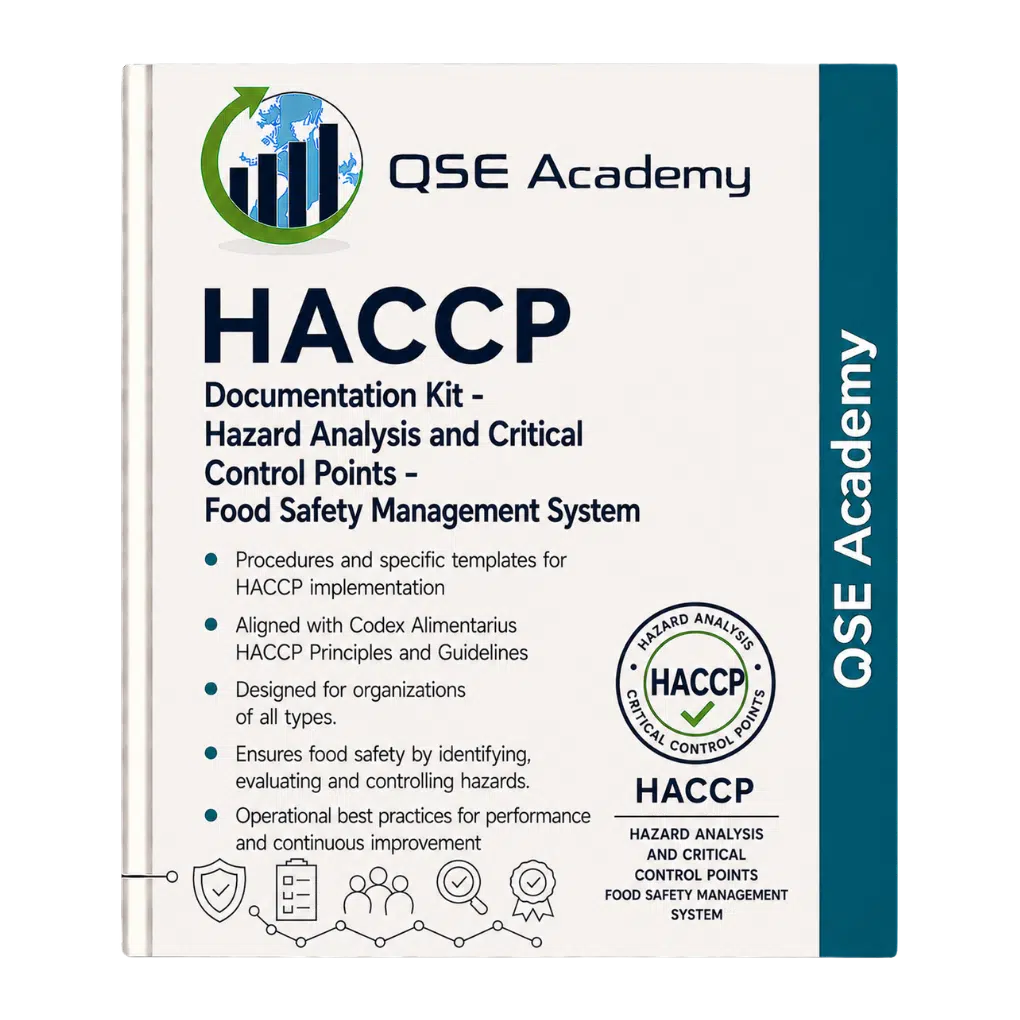
HACCP Documentation Package — Food Safety

Build your compliant HACCP system in weeks, not months.

  • 119 documents built principle by principle
  • Full mapping — Codex Alimentarius and FDA FSMA / 21 CFR 117
  • Prerequisite programs (PRPs), oPRPs, and CCPs included
  • Designed for FDA, USDA-FSIS, and customer audits
Get the HACCP Package — $489
Equivalent to $8,000 — $20,000 of consulting fees
Instant download 30-day guarantee Editable Word format
HACCP Documentation Package
119
Documents included
7 / 12
Codex principles & steps
100%
Requirements mapped
FSMA
FDA-aligned
Who this package is for

Designed for everyone who handles, processes, or distributes food.

The HACCP package is for any business required to implement HACCP under FDA FSMA, USDA-FSIS regulations, or international Codex-aligned standards — regardless of company size or position in the food chain.

1

Food manufacturers & processors

Production and processing facilities: meat, dairy, ready meals, industrial bakery, beverages. Reinforced HACCP requirements under 21 CFR 117 (Preventive Controls) and frequent retailer audits from Walmart, Kroger, Costco, Target.

2

Foodservice & institutional catering

Restaurants, central kitchens, school cafeterias, nursing homes, hospitals. HACCP obligation + FDA Food Code compliance + sector-specific best practice guides for retail and foodservice operations.

3

Specialty food & small producers

Bakeries, butchers, delis, caterers, fishmongers, cheesemakers, co-packers. Recurring FDA inspections, mandatory food safety manager certification, and the need for an operational documentation system that's simple to maintain.

4

Food logistics & distribution

Cold storage warehouses, refrigerated transport, distribution platforms, wholesalers. Mandatory downstream traceability (FSMA 204) and full cold chain control throughout the flow.

Why this package exists

An HACCP plan can't be drafted from a generic template.

Codex Alimentarius requires 7 principles and 12 implementation steps: hazard analysis, CCP determination, critical limits, monitoring, corrective actions, verification, documentation. Building all of this in-house takes 3 to 6 months of writing work, and exposes you to avoidable gaps on inspection day or audit day.

01

Generic templates don't cover your operation

Most templates downloaded online are written for simple foodservice and ignore the specifics of food manufacturing, specialty food production, institutional catering, or logistics. Hazards, CCPs, and PRPs differ by activity.

02

FDA inspections are unannounced and targeted

FDA, USDA-FSIS, and state-level inspections on food businesses are frequent, unannounced, and focused on HACCP documentation control. Without a current file, gaps can trigger warning letters, FDA Form 483 observations, or even facility shutdown.

03

Major buyers require HACCP before any listing

Retailers, buying groups, and food service distributors (Walmart, Kroger, Costco, Target, Sysco, US Foods) require a documented and verifiable HACCP system in their supplier specifications. Without a ready file, you don't get listed and the sale doesn't happen.

04

An HACCP consulting engagement costs $8,000 to $20,000

A complete HACCP implementation engagement billed by a specialized consulting firm represents 10 to 30 days of intervention. The documentation package gives you the complete written foundation — you keep your budget for field implementation and team training.

What is included

119 documents organized by HACCP and regulatory requirement.

The package covers the 12 implementation steps of HACCP per Codex Alimentarius (5 preliminary steps + 7 principles) and the requirements of FDA FSMA / 21 CFR 117 (Preventive Controls for Human Food), USDA-FSIS regulations, and FDA traceability requirements (FSMA 204).

Step 1

HACCP team

  • HACCP team formation procedure
  • Team composition and competencies sheet
  • Continuous team training procedure
  • HACCP meeting register
  • HACCP team leader appointment form
Step 2

Product description

  • Standard product description sheet
  • Physical-chemical characteristics sheet
  • Microbiological characteristics sheet
  • Storage conditions and shelf-life dates
  • Packaging and labeling
Step 3

Intended use

  • Consumer intended use sheet
  • Identification of vulnerable populations
  • Standard consumer instructions
  • Allergen consideration procedure
Step 4

Process flow diagram

  • Standard flow diagram (sector-specific template)
  • Product / personnel / waste flow diagram
  • Clean / dirty zoning plan
  • Flow diagram construction guide
Step 5

On-site verification

  • Field verification procedure for the flow diagram
  • Manufacturing flow diagram validation form
  • Register of deviations observed during verification
Principle 1

Hazard analysis

  • Hazard analysis procedure (biological, chemical, physical, allergens)
  • Step-by-step hazard analysis grid
  • Severity × likelihood matrix
  • List of significant hazards retained
  • Associated control measures
Principle 2

CCP determination

  • CCP determination procedure
  • Codex decision tree
  • CCP / oPRP / PRP distinction
  • CCP justification sheet
  • Register of identified CCPs
Principle 3

Critical limits

  • Critical limits establishment procedure
  • Standard critical limit sheet per CCP
  • Scientific justification of thresholds
  • Regulatory and bibliographic references
Principle 4

CCP monitoring

  • CCP monitoring procedure
  • CCP monitoring record form
  • Monitoring schedule
  • Temperature register (cooking, cooling, cold chain)
  • Measuring instrument calibration procedure
Principle 5

Corrective actions

  • Corrective action procedure for CCPs
  • Standard corrective action form
  • Nonconforming product disposition procedure
  • Critical limit deviation register
  • Root cause analysis
Principle 6

Verification

  • HACCP verification procedure
  • HACCP internal audit plan
  • Complete HACCP audit checklist
  • Release testing plan (control plan)
  • Annual HACCP system review procedure
Principle 7

Documentation & records

  • Complete HACCP manual
  • Document control procedure
  • Master list of HACCP documents
  • Records management procedure
  • Archiving and traceability procedure
PRP · ISO 22002:2025

Prerequisite Programs — Hygiene

  • Cleaning and sanitization plan
  • Personnel hygiene procedure
  • Pest control plan (rodents, insects)
  • Premises and equipment maintenance plan
  • Food waste management procedure
  • Water potability procedure
Traceability

Upstream & downstream traceability

  • Lot-by-lot traceability procedure
  • Raw material receiving form
  • Supplier specifications
  • Product recall / withdrawal procedure
  • Crisis communication plan
  • Annual mock recall exercise
Allergens

Allergen management

  • Major US/EU allergen management procedure (FDA Big 9 + EU 14)
  • Per-product allergen matrix
  • Cross-contamination prevention procedure
  • Allergen labeling template
  • Reinforced allergen cleaning plan
FSMA & FDA

US regulatory compliance

  • FDA facility registration procedure (21 CFR 1.225)
  • FSMA 204 traceability procedure (Food Traceability Rule)
  • Reportable Food Registry notification procedure
  • Food Safety Plan structure (21 CFR 117 Subpart C)
  • HACCP ↔ FSMA Preventive Controls mapping matrix
  • Mandatory food handler training procedure (FDA Food Code)
Delivery format: all documents are delivered as fully editable Microsoft Word (.docx) files, with a neutral graphic charter ready to receive your logo. No locked PDFs, no proprietary software dependency. The mapping matrix and the control plan are delivered in Excel format.
HACCP mapping

Every Codex step and HACCP principle → one document in the package.

FDA Food Safety Modernization Act (FSMA) and 21 CFR 117 require all food facilities to implement and maintain procedures based on HACCP principles. Below is the step-by-step mapping between Codex Alimentarius CAC/RCP 1-1969 and the documents provided — this is what an FDA inspector or a customer auditor asks to see first.

Step / Principle Codex Alimentarius requirement Documents provided in the package
Step 1 HACCP team formation: multidisciplinary skills, training, responsibilities Team formation Composition sheet Team training Meeting register Leader appointment
Step 2 Product description: composition, physical-chemical and microbiological characteristics, shelf life, storage Product description Physical-chemical Microbiology Use-by / Best-by dates Packaging
Step 3 Identification of intended use: target consumer, vulnerable populations, declared allergens Intended use Vulnerable populations Consumer instructions Allergens
Step 4 Process flow diagram development: all process steps, flows, zoning Flow diagram Flow scheme Zoning plan Flow construction guide
Step 5 On-site flow diagram verification: consistency between theory and field practice Verification procedure Validation form Deviation register
Principle 1 Hazard analysis: biological, chemical, physical, allergens; severity × likelihood; control measures Hazard analysis Step-by-step grid Severity × likelihood Significant hazards Control measures
Principle 2 CCP determination: application of the Codex decision tree, distinction between CCP / oPRP / PRP CCP determination Decision tree CCP / oPRP / PRP CCP justification CCP register
Principle 3 Critical limits: measurable thresholds, scientific basis, regulatory references Critical limits Per-CCP limit sheet Scientific justification Regulatory references
Principle 4 CCP monitoring: monitoring plan, records, calibration of measurement instruments CCP monitoring Record sheet Monitoring schedule Temperature register Instrument calibration
Principle 5 Corrective actions: critical limit deviation, product disposition, root cause analysis Corrective actions Corrective action form NC product disposition Deviation register Root cause analysis
Principle 6 Verification: internal audit, control plan, annual review, HACCP plan reassessment HACCP verification Internal audit plan Audit checklist Control plan Annual review
Principle 7 Documentation and records: documentation structure, records traceability, archiving HACCP manual Document control Master list Records management Archiving
PRPs Hygiene prerequisite programs: premises, personnel, cleaning, pests, maintenance, water, waste Cleaning & sanitization plan Personnel hygiene Pest control Maintenance Waste management Water potability
Traceability Upstream / downstream traceability (FSMA 204 Food Traceability Rule), recall and withdrawal procedure, FDA Reportable Food Registry notification Lot traceability Raw material receiving Supplier specifications Recall / withdrawal Crisis communication Mock recall
Allergens Major allergen management (FDA Big 9 + EU 14 if exporting): cross-contact prevention, labeling, reinforced cleaning Allergen management Per-product matrix Cross-contact prevention Labeling Reinforced cleaning
FSMA & FDA Additional US regulatory obligations: FDA facility registration (21 CFR 1.225), Food Safety Plan structure (21 CFR 117 Subpart C), applicable best practice guides, mandatory food safety manager certification FDA registration Food Safety Plan Reportable Food Registry Food handler training HACCP ↔ FSMA mapping
Not included Site- and product-specific documents — which must be drafted case by case by your HACCP team according to your actual operation Final HACCP plan (per product / process) Filled-in hazard analysis (per actual step) CCPs identified on your real process Product recipes and technical sheets Site facility plans (specific to each site) Filed and approved FDA registration Results of your release analyses
Why these documents can't be in a documentation package — from any supplier.

The final HACCP plan, filled-in hazard analysis, identified CCPs, recipes, and facility plans are by nature specific to each site and each operation. They depend on the actual process, raw materials used, equipment in place, site configuration, and products manufactured.

A package claiming to deliver these documents pre-filled would expose the buyer to a major nonconformity: a generic HACCP plan isn't an HACCP plan, an unpersonalized hazard analysis has no probative value, and a decision tree not applied to your real process protects no one. These deliverables must be built by your HACCP team, on the ground, from your real flow diagram.

The QSE Academy package provides instead all the procedures, methods, and templates that frame the production of these site-specific documents: hazard analysis procedure, Codex decision tree, severity × likelihood matrix, CCP monitoring sheet — the complete documentation framework within which your real HACCP plan fits.
In addition, this mapping is delivered as an Excel matrix in the package. It can be presented as-is to an FDA inspector, to a customer, or in a second-party audit as proof of complete HACCP and regulatory coverage.
For experienced professionals

Technical conformance — the points an experienced HACCP auditor checks first.

Beyond the step-by-step mapping, here are the technical rigour points that Quality Managers, Operations Directors, and certified auditors verify first.

  • Strict application of the Codex decision tree — CCP justified by answering the 4 questions, never by intuition or copy-paste
  • CCP / oPRP / PRP distinction — the three categories explicitly differentiated with documented justification
  • Measurable critical limits — numerical values, scientifically grounded (regulatory references, studies, bibliography), not qualitative goals
  • Calibration of monitoring instruments — temperature probes, pH meters, scales tracked in a calibration plan with frequency and traceability
  • Cleaning validation — effectiveness evidence (ATP surface swabs or microbiological samples), not just a visual checklist
  • Downstream traceability — lot-by-lot recall capability, tested with an annual mock recall documented with stopwatch (FSMA 204 Food Traceability Rule)
  • Release control plan — defined microbiological and physical-chemical analyses, justified frequency, ISO 17025 accredited laboratory
  • Major allergen management — product matrix, cross-contact prevention, FDA-compliant labeling (Big 9 allergens including sesame since 2023)
  • Cold chain — continuous records (probes with alarms), break procedure, traceability through delivery
  • Annual HACCP plan review — after product change, new equipment, lessons learned, regulatory evolution
G

HACCP: international recognition

HACCP from Codex Alimentarius is recognized worldwide as the reference method for food safety. A documented HACCP system positions you for export and for sector-specific certifications across the following markets.

United States (FDA FSMA, USDA-FSIS) Canada (SFCR / CFIA) European Union United Kingdom (FSA) Australia / New Zealand (FSANZ) ASEAN ISO 22000 compatible IFS V8 / BRCGS V9 / SQF compatible
Normative reference for PRPs

ISO 22002:2025 — the normative foundation for Prerequisite Programs.

PRPs (Prerequisite Programs) structure the basic hygiene foundation on which any operational HACCP system rests: premises, personnel, cleaning, maintenance, pests, water, waste, cross-contamination control. As of July 29, 2025, the ISO 22002 family has been fully revised: "ISO/TS" technical specifications became international "ISO" standards, and a new core standard ISO 22002-100:2025 consolidates the requirements common to the entire food chain, complemented by a sector-specific standard depending on your activity.

Standard Target sector Applicable to you if
ISO 22002-100:2025 Common foundation, full chain Any food business — applies in addition to your sector-specific standard
ISO 22002-1:2025 Food manufacturing You manufacture, process, or pack food products
ISO 22002-2:2025 Catering Foodservice, institutional catering, central kitchens, caterers
ISO 22002-4:2025 Food packaging You manufacture food contact materials and packaging
ISO 22002-5:2025 Transport and storage Cold storage warehouses, refrigerated transport, food logistics
ISO 22002-6:2025 Animal feed Feed / pet food production
ISO 22002-7:2025 Retail and wholesale Retailers, wholesalers, specialty stores (new standard — replaces PAS 221)
ISO/TS 22002-3:2011 Primary production (agriculture, livestock) Primary production — standalone standard, not updated in 2025

The PRP procedures in the QSE Academy package (cleaning and sanitization plan, personnel hygiene, pest control, water potability, maintenance, waste management) are aligned with the ISO 22002:2025 structure and remain compatible with certification standards built on this family (ISO 22000:2018, FSSC 22000 v6.0, IFS V8, BRCGS V9, SQF). In case of future evolution (FSSC 22000 v6.1 expected, new ISO 22000 version in development), you receive updates within the 12 months included with the package.

Comparison

Why the QSE Academy package over the alternatives.

Criterion QSE Academy HACCP
$489
Free templates
$0
Consulting firm
$8,000 — $20,000
Food safety specific (not generic quality)
Coverage of 7 principles and 12 Codex steps ✓ 100% Partial ✓ 100%
FDA FSMA / 21 CFR 117 compliance ✓ Included Per engagement
Step-by-step & principle-by-principle mapping ✓ Excel matrix Per engagement
Editable Word format, neutral charter Variable
Delivery time Instant Instant 3 to 6 months
Money-back guarantee ✓ 30 days
Field implementation & team training On you On you Included
The package doesn't replace field implementation — it gives you the complete written foundation. That's precisely the part where consulting firms charge the most. For implementation support and team training, we also offer custom services.
HACCP flash audit

Where do you stand today?

Answer the 12 questions step by step to get your HACCP maturity score. Instant result, free, no personal information required.

Question 1 / 12
Step 1 — HACCP team
0
/ 100

Get the HACCP Package — $489
Deployment process

From order to mock audit, here is the path.

The package isn't just delivered. Here is the concrete path to bring it into production at your facility, step by step.

1
Day 1

Download

Secure payment, immediate access to the full package as a ZIP. Within minutes, you have all 119 Word documents, the Excel matrices, and the user guide.

2
Weeks 1 — 3

Customization

Adapting the documents to your operation: logo, real flow diagram, raw materials, equipment, CCPs specific to your process. Plan 2 to 3 weeks for serious customization.

3
Weeks 4 — 8

Implementation

Team training on food safety and the HACCP plan, rollout of CCP monitoring records, field deployment. Real records start feeding the live traceability evidence base.

4
Weeks 8 — 10

Mock audit

Internal audit using the checklist provided in the package, mock recall, release testing. Identification of remaining gaps, corrective action plan, preparation for FDA inspection or customer audit.

Typical timeline: 8 to 10 weeks between order and a "ready for audit" state. The most structured companies reach this state in 6 weeks; those starting from zero may take up to 14 weeks. It's your internal resources and your HACCP team that make the difference, not the package.
Used by food safety teams worldwide

What companies that adopted it say.

★★★★★

A massive time-saver for structuring our food safety plan. The procedures are directly usable, the vocabulary is accurate, and our FDA inspection went very smoothly.

P
Patrick
Quality Manager · SME food manufacturer, USA
★★★★★

The principle-by-principle mapping and the Codex decision tree were exactly what we needed to justify our CCPs to our retail customer.

C
Catherine
Site Director · Industrial caterer, UK
★★★★★

Unbeatable value. We deployed our HACCP in 7 weeks at our central kitchen, mock audit cleared, without bringing in an external consultant.

S
Sarah
Owner · School central kitchen, Canada
★★★★★

Fully customizable Word documents, clear allergen matrix, well-built cleaning plan. A real professional package, not a sloppy template.

M
Mike
HSE Manager · Refrigerated transport, Australia
Risk-free

30-day guarantee, no questions asked.

30-day money-back guarantee

You test the package. If you change your mind, we refund you.

You have 30 days to download the package, review its content, open the documents, and verify that the writing quality matches your expectations. If something is off, you write us an email — no justification needed — and the refund is processed within 5 business days. That simple.

The package evolves with you

Updates included for 12 months.

Food safety regulations evolve. The package you buy today shouldn't become obsolete in 6 months. That's why updates are included.

12 months of regulatory and normative updates

In case of a Codex Alimentarius revision, FDA FSMA evolution, USDA-FSIS guideline updates, or new FDA Food Code or food safety guidance impacting documentation, you receive relevant package updates free of charge for 12 months after your purchase.

  • Codex Alimentarius revisions
  • FDA FSMA updates
  • USDA-FSIS & FDA guidance
  • Email notifications upon publication
Frequently asked questions

Answers to your most common questions.

Is the package enough to pass an FDA inspection or a customer audit?

The package gives you the complete documentation foundation required by Codex Alimentarius and FDA FSMA / 21 CFR 117. To pass an FDA inspection or a customer audit, you also need to implement the procedures in the field: train staff on food safety, populate CCP monitoring records, demonstrate real lot traceability, and keep the cleaning plan current. The package saves you the 3 to 6 months of writing. Operational implementation remains your work (typically 4 to 8 weeks depending on facility size).

What's the difference between this and a free HACCP template downloaded online?

A generic template is usually written for simple foodservice and ignores the specifics of food manufacturing, specialty food production, or logistics. It doesn't cover the Codex decision tree, the CCP / oPRP / PRP distinction, the severity × likelihood matrix, rigorous management of major allergens, or FSMA / 21 CFR 117 obligations and FSMA 204 traceability. The QSE Academy package is written specifically for food safety, with a verifiable step-by-step and principle-by-principle mapping.

Who actually inspects food businesses in the US?

Three main authorities: the FDA (Food and Drug Administration) for most food facilities under FSMA / 21 CFR 117 (Preventive Controls for Human Food); the USDA-FSIS (Food Safety and Inspection Service) for meat, poultry, and processed egg products; and state-level health departments for retail food and foodservice (FDA Food Code). Major retailers (Walmart, Kroger, Costco, Target) and foodservice distributors (Sysco, US Foods) also conduct their own supplier audits, often more demanding than government inspections.

How long does it take to adapt the package to my business?

Plan 2 to 3 weeks to customize the documents: logo, real flow diagram, raw materials, CCPs specific to your process, equipment, facility plan. Then plan time for operational implementation: staff training, records rollout, mock audit — 4 to 8 additional weeks depending on facility size and starting maturity level.

Is the package delivered in Word or PDF format?

All documents are delivered in fully editable Microsoft Word (.docx) format. No locked PDFs, no proprietary software dependency. The HACCP mapping matrix, the allergen matrix, and the release control plan are delivered in Excel format. The graphic charter is neutral, ready to receive your logo and colors.

Is HACCP really mandatory in the US?

Yes. The FDA Food Safety Modernization Act (FSMA) and 21 CFR 117 (Preventive Controls for Human Food) require most food facilities to implement and maintain a Food Safety Plan based on HACCP principles. USDA-FSIS regulations require HACCP for meat, poultry, and processed egg facilities. The absence of a documented HACCP/Food Safety Plan is a major nonconformity that can trigger FDA Form 483 observations, warning letters, or even facility shutdown depending on the severity of findings during an inspection.

Does the package cover traceability and allergens?

Yes. Traceability is required by FSMA 204 (Food Traceability Rule), distinct from the HACCP method itself. The package covers both: the complete 7 HACCP principles and a dedicated lot-by-lot traceability procedure with recall plan and annual mock recall. For allergens, the package includes management procedures for the FDA Big 9 (milk, eggs, fish, shellfish, tree nuts, peanuts, wheat, soy, sesame — added in 2023), the per-product matrix, cross-contact prevention procedure, and reinforced cleaning plan.

Are the PRPs in the package aligned with ISO 22002:2025?

Yes. The Prerequisite Program procedures in the package (cleaning and sanitization plan, personnel hygiene, pest control, water potability, premises and equipment maintenance, waste management) are built consistent with the structure of the ISO 22002:2025 family (published July 29, 2025) and its new common foundation ISO 22002-100:2025. They cover the PRP requirements applicable to food manufacturing (ISO 22002-1), foodservice (ISO 22002-2), and food logistics (ISO 22002-5). If you're certified to FSSC 22000 or IFS, this PRP base serves as your documentation foundation — certification-specific requirements will be added on top depending on the standard chosen.

Is the package compatible with ISO 22000, IFS, BRCGS, or SQF?

Yes. HACCP is the common foundation for these certifications. The package provides all the required HACCP documents and the Prerequisite Programs (PRPs) expected by ISO 22000, IFS V8, BRCGS V9, and SQF. For full certification, additional documents specific to each standard (Food Safety Culture, Food Fraud, Food Defense, oPRP validation) are required — we offer dedicated ISO 22000, IFS V8, and BRCGS V9 packages as add-ons.

How many users / sites are covered by the license?

The $489 license covers a single site, with unlimited internal use (all your employees can use the package). For a multi-site rollout or consulting use across multiple clients, contact us for an adapted license.

Do I receive updates if regulations evolve?

Yes. In case of a Codex Alimentarius revision or significant FDA FSMA / USDA-FSIS regulatory evolution, you receive updates free of charge for 12 months after your purchase.

What happens if I'm not satisfied?

You're covered by a 30-day money-back guarantee, no conditions. You write us a simple email — no justification required — and the refund is processed within 5 business days.

Take action

Your HACCP system. Ready today.

119 documents, 7 HACCP principles, 12 Codex steps, FDA FSMA / 21 CFR 117 compliance, step-by-step mapping. Instant download after payment.

Equivalent to $8,000 — $20,000 of consulting fees
$489 Single-site license · Secure payment · Instant download
Get the HACCP Package — $489
30-day money-back guarantee Instant download 12 months of updates Editable Word format