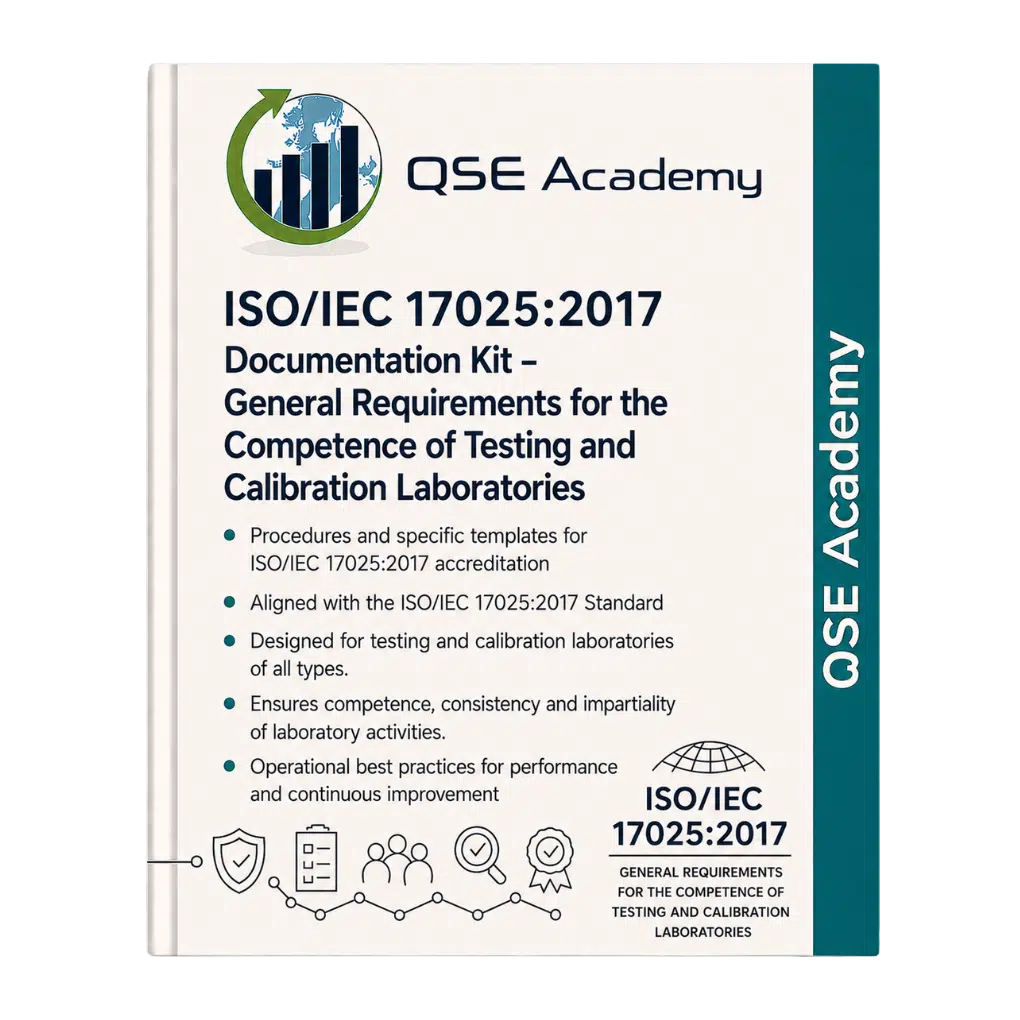
International standard recognized by ILAC, A2LA, ANAB, IAS, NIST — ISO/IEC 17025:2017 is the global reference for accreditation of testing and calibration laboratories.
ISO/IEC 17025:2017 · Testing & Calibration Laboratories

ISO/IEC 17025 Documentation Package — Testing & Calibration Laboratories

Build your A2LA / ANAB / IAS accreditation dossier in weeks, not months.

  • 109 documents built clause by clause
  • Full mapping ISO/IEC 17025:2017 + ILAC-G / A2LA / ANAB / IAS requirements
  • Editable procedures, technical records, and forms
  • Designed for accreditation assessments, FDA / EPA / DoD inspections, and customer audits
Get the ISO 17025 Package — $589
Equivalent to $15,000 — $30,000 of consulting fees
Instant download 30-day guarantee Editable Word format
ISO/IEC 17025:2017 Documentation Package
109
Documents included
5
Normative sections covered
100%
Requirements mapped
A2LA
ANAB / IAS / ILAC ready
Who this package is for

Designed for laboratories performing testing, calibration, or sampling.

The ISO/IEC 17025 package is for any organization that must demonstrate technical competence, impartiality, and the validity of its results to an accreditation body (A2LA, ANAB, IAS, NIST/NVLAP, or any ILAC MRA signatory) or to a customer — whether pursuing initial accreditation or scope extension.

1

Testing laboratories

Laboratories performing physical, chemical, microbiological, or biological testing on materials, products, or samples — in-house or as third-party service providers — pursuing A2LA, ANAB, or IAS accreditation. Includes environmental, food, pharma, materials, electrical safety, and product safety labs.

2

Calibration laboratories

Laboratories performing calibrations (dimensional, mass, temperature, pressure, electrical, force, chemistry metrology) that must demonstrate metrological traceability to the SI through NIST or another NMI, and that must master their measurement uncertainty budgets.

3

In-house industrial labs

QC departments embedded in manufacturing plants (food, pharma, medical devices, aerospace, automotive, energy, semiconductors) that want to structure their lab per ISO 17025 to satisfy customer requirements (FDA, DoD MIL-STD, AS9100 supplier audits, OEM CSRs) without pursuing formal accreditation.

4

Consultants & advisory firms

Quality consultants and accreditation advisors who want a validated ISO 17025 documentation foundation to start client engagements quickly (consultant license available on request).

Why this package exists

ISO/IEC 17025 accreditation cannot be prepared from a blank page.

ISO/IEC 17025:2017 covers 5 normative sections (general, structural, resource, process, management requirements) totaling roughly twenty demanding sub-clauses. Each requires written procedures, traceable technical records, and evidence of competence. Building all this in-house takes 6 to 12 months of writing work and exposes you to avoidable findings during the accreditation assessment.

01

Generic templates don't cover laboratory accreditation

Most online templates are derivatives of ISO 9001 adapted at the margins. They ignore lab-specific 17025 requirements: impartiality safeguards, metrological traceability to the SI, method validation, measurement uncertainty evaluation, decision rules, proficiency testing (PT), and statistical quality control (control charts, Levey-Jennings, Westgard rules).

02

Accreditation assessments don't forgive approximation

A2LA, ANAB, IAS, and NVLAP assessments are technical, deep, and conducted by domain-specialist assessors. An incomplete or poorly mapped dossier results in major findings, extended accreditation timelines, or initial denial — with direct impact on your ability to issue accredited reports under the ILAC MRA.

03

Customers require accreditation before any RFQ

Industrial buyers, federal agencies (FDA, EPA, DoD, DOE), and government contracts increasingly require ISO 17025 accreditation in their technical requirements. Without an appropriate accredited scope and an up-to-date dossier, RFQs are lost before they're even read.

04

A consulting engagement costs $15,000 to $30,000

A complete 17025 implementation engagement billed by a specialized firm represents 20 to 60 days of intervention. The documentation package gives you the complete written foundation — you keep your budget for technical method validation and accreditation assessment preparation.

What is included

109 documents organized by ISO/IEC 17025 normative requirement.

The package fully covers Sections 4 to 8 of ISO/IEC 17025:2017 (general, structural, resource, process, management requirements) plus the accreditation body requirements applicable to all labs (A2LA, ANAB, IAS, NVLAP, ILAC).

Section 4.1

Impartiality

  • Impartiality policy
  • Impartiality risk analysis procedure
  • Personnel impartiality declaration
  • Impartiality threats register
  • Periodic impartiality review
Section 4.2

Confidentiality

  • Confidentiality policy
  • Confidential information management procedure
  • Standard NDA (personnel & subcontractors)
  • Disclosure procedure under legal obligation (subpoena, court order)
Section 5

Structural requirements

  • Laboratory legal entity sheet
  • Organization chart and responsibilities
  • RACI responsibility matrix
  • Job descriptions (Lab Director, QM, Technical Manager, Technicians)
  • Accreditation scope definition
  • Activities outside the permanent lab procedure (customer sites, mobile)
Section 6.2

Personnel

  • Personnel competence management procedure
  • Technical personnel selection procedure
  • Training plan and qualification plan
  • Authorization grid by method / technical activity
  • Annual competence evaluation form
  • Authorization and supervision procedure
Section 6.3

Facilities & environmental conditions

  • Lab facility plan and zoning
  • Environmental conditions monitoring procedure
  • Access control procedure for technical areas
  • Standard environmental conditions record
Section 6.4

Equipment

  • Equipment fleet management procedure
  • Equipment logbook (metrology record)
  • Calibration and intermediate verification plan
  • IQ / OQ / PQ qualification procedure
  • Defective equipment management procedure
Section 6.5

Metrological traceability

  • Metrological traceability to the SI procedure (NIST-aligned for US labs)
  • Selection of accredited calibration providers procedure
  • Metrological linkage plan (NIST traceability chain)
  • External calibration certificates register
  • Certified Reference Materials (CRM) procedure (NIST SRM aligned, § 6.5.3)
Section 6.6

Externally provided products & services

  • Critical provider evaluation procedure
  • Provider specifications (testing subcontracting)
  • Provider evaluation and monitoring grid
  • Approved providers list
Section 7.1

Review of requests & contracts

  • Request, tender, and contract review procedure
  • Standard tender review form
  • Contractual deviation management procedure
  • Decision rule form (customer agreement)
Section 7.2

Selection & validation of methods

  • Method selection procedure (ASTM, EPA, AOAC, ISO standards aligned)
  • Method validation / verification procedure
  • Standard method validation file
  • Method deviation management procedure
Section 7.3 — 7.4

Sampling & handling of test items

  • Sampling procedure
  • Standard sampling plan
  • Test item handling, transport, and storage procedure (chain of custody for legal/forensic samples)
  • Sample identification and traceability form
  • Receipt deviations register (§ 7.4.3)
Section 7.5 — 7.6

Technical records & uncertainty

  • Technical records control procedure
  • Standard technical record template (bench sheets)
  • Measurement uncertainty evaluation procedure
  • Standard uncertainty budget (GUM-aligned, NIST TN 1297)
  • Decision rule and guard band procedure (ANSI/NCSL Z540.3, ILAC-G8)
Section 7.7

Ensuring validity of results

  • Internal quality control procedure
  • Control charts plan (Levey-Jennings, Westgard rules for clinical/chemistry labs)
  • Proficiency Testing (PT) participation procedure (ILAC P9, A2LA R104)
  • Interlaboratory comparison procedure
  • Out-of-tolerance results action register
Section 7.8 — 7.10

Reports, complaints & nonconforming work

  • Report issuing procedure
  • Accredited test report template (with A2LA / ANAB / IAS logo placement)
  • Calibration certificate template (NIST traceability statement)
  • Opinions and interpretations procedure (§ 7.8.7)
  • Complaint handling procedure
  • Complaints register
  • Nonconforming work control procedure
Section 7.11

Data control & LIMS

  • Data and information system control procedure
  • Backup and archiving procedure
  • Computer system validation procedure (LIMS, FDA 21 CFR Part 11 aligned for regulated labs)
  • Lab IT security plan
Section 8

Management system (Option A)

  • ISO 17025 lab quality manual
  • Document control procedure
  • Quality records control procedure
  • Risk and opportunity management procedure
  • Continual improvement and CAPA procedure
  • Internal audit procedure & ISO 17025 audit checklist
  • Multi-year audit plan
  • Management review procedure
A2LA / ANAB / IAS / NVLAP

Accreditation body requirements

  • Accreditation symbol use procedure (A2LA R101, ANAB AR-2250, IAS AC89)
  • Notification of changes to accreditation body procedure
  • Scope extension / reduction management procedure
  • Mapping matrix ISO 17025 ↔ A2LA R101/R104 ↔ ANAB AR-2250 ↔ IAS AC89
Delivery format: all documents are delivered as fully editable Microsoft Word (.docx) files, with a neutral graphic charter ready to receive your logo. No locked PDFs, no proprietary software dependency. The mapping matrix and standard uncertainty budget are delivered in Excel format.
Clause-by-clause mapping

Every ISO/IEC 17025 requirement → one document in the package.

ISO/IEC 17025:2017 is the international reference standard for laboratory competence, recognized in the US through A2LA, ANAB, IAS, NVLAP (NIST National Voluntary Laboratory Accreditation Program), all signatories to the ILAC MRA. Below is the clause-by-clause mapping between the standard and the documents provided — this is what a technical assessor or customer expects to see first.

Section ISO/IEC 17025:2017 requirement Documents provided in the package
4.1 Impartiality: risk identification, personnel commitments, periodic threat analysis Impartiality policy Risk analysis Personnel commitment Threat register Risk review
4.2 Confidentiality: information management, agreements, legal disclosure obligations Confidentiality policy Information management Standard NDA Legal disclosure procedure
5.1 — 5.7 Structural requirements: legal entity, organization, responsibilities, scope, off-site activities, technical management Legal entity sheet Organization chart RACI matrix Job descriptions Accreditation scope Off-site activities
6.2 Personnel: competence, selection, training, qualification, authorization, supervision Competence management Personnel selection Training plan Authorization grid Competence evaluation Authorization & supervision
6.3 Facilities & environmental conditions: adequacy, monitoring, access control Facility plan Environmental monitoring Access control Conditions record
6.4 Equipment: selection, calibration, verification, IQ/OQ/PQ qualification, maintenance, defective equipment handling Equipment fleet management Equipment logbook Calibration plan IQ/OQ/PQ qualification Defective equipment
6.5 Metrological traceability: linkage to the SI (NIST traceability for US labs), CRMs for cases under § 6.5.3 (NIST SRMs), selection of accredited providers, documented chain SI traceability (NIST) CRM (§ 6.5.3) Provider selection Linkage plan Certificates register
6.6 Externally provided products and services: evaluation, specifications, monitoring, qualification Provider evaluation Provider specifications Monitoring grid Approved providers list
7.1 Review of requests and contracts: capability, method, decision rule, contractual deviations Request review Tender review form Deviation management Decision rule
7.2 Selection, verification and validation of methods: scope, performance, deviations Method selection Validation / verification Validation file Method deviations
7.3 — 7.4 Sampling and handling of test items: representativeness, transport, storage, identification, receipt deviations, chain of custody Sampling procedure Sampling plan Handling & storage Item identification Receipt deviations
7.5 — 7.6 Technical records & measurement uncertainty evaluation (GUM, NIST TN 1297) Technical records Bench sheets Uncertainty evaluation GUM uncertainty budget Decision rule
7.7 Ensuring the validity of results: internal QC, control charts, proficiency testing, interlaboratory comparisons Internal QC Control charts (Levey-Jennings, Westgard) Proficiency Testing (PT) Interlab comparisons Out-of-tolerance results
7.8 — 7.10 Reporting of results, opinions and interpretations, complaints, nonconforming work: content, processing, investigation Report issuing Accredited test report template Calibration certificate Opinions & interpretations Complaint handling Complaints register Nonconforming work
7.11 Control of data and information systems: validation, backup, LIMS data integrity (FDA 21 CFR Part 11 for regulated labs) Data control Backup & archiving LIMS validation (Part 11) IT security
8.1 — 8.9 Management system (Option A): documentation, document control, risk-based thinking, CAPA, scheduled internal audit, management review (15 inputs in § 8.9.2) Lab quality manual Document control Quality records Risk & opportunities Improvement & CAPA Internal audit & checklist Multi-year audit plan Management review
A2LA / ANAB / IAS / NVLAP US accreditation body requirements: A2LA R101 (general), R104 (PT requirements), ANAB AR-2250, IAS AC89, NVLAP NIST Handbook 150 series, including accreditation symbol use, change notification, scope extension management Accreditation symbol use Change notification Scope extension procedure Mapping matrix A2LA / ANAB / IAS / NVLAP
Not included Documents specific to each laboratory, each method, and each piece of equipment — which must be produced case by case by your technical team based on your accreditation scope Complete validation protocols (per method) Quantified uncertainty budgets (per method) External calibration certificates (per equipment) Filled-in control charts (per analysis) External PT reports (per scope domain) Detailed accreditation scope file (A2LA / ANAB scope template) Filled-in equipment qualification results
Why these documents can't be in any documentation package — from any supplier.

Quantified validation protocols, uncertainty budgets, filled-in control charts, calibration certificates, and PT results are by nature specific to each laboratory, each method, and each equipment fleet. They depend on materials analyzed, measurement ranges, the actual performance of your instruments, and the targeted accreditation scope.

A package claiming to provide these documents pre-filled would expose the buyer to a major nonconformity with ISO/IEC 17025: a generic uncertainty budget is not a budget, a copy-pasted control chart has no statistical value, and a PT report must be produced by an external proficiency testing provider (such as A2LA-recognized PT providers, NIST CAT-issued PT samples, or AOAC PTM). These deliverables must be built method by method, equipment by equipment, by your technically competent staff.

The QSE Academy package, however, provides all the procedures, templates, and frameworks that frame the production of these specific deliverables: validation procedure, GUM-aligned uncertainty budget template, control charts plan, PT participation matrix — the full documentation framework within which your technical validation takes shape.
This mapping is delivered as an Excel matrix in the package. It can be presented as-is to an A2LA / ANAB / IAS / NVLAP technical assessor, customer, or auditor as proof of complete normative coverage.
For experienced lab professionals

Technical conformance — the points an experienced A2LA / ANAB assessor checks first.

Beyond the clause-by-clause mapping, here are the technical rigor points that experienced lab directors, quality managers, and accreditation body assessors verify first.

  • Impartiality risk analysis — factual identification of financial, commercial, and ownership relationships — not a simple statement of principle
  • Metrological traceability to the SI — documented linkage chain through accredited calibration providers (NIST traceable for US labs), calibration uncertainty integrated into the lab uncertainty budget
  • Method validation vs. verification — clear distinction based on intended use: standard method (ASTM, EPA, AOAC, USP) = verification; non-standard or in-house developed method = full validation
  • Uncertainty evaluation (GUM) — component decomposition approach (Type A / Type B), propagation per the law of uncertainty propagation, k=2 expansion factor, NIST TN 1297-aligned
  • Decision rules & guard bands — documented, discussed with the customer before contract, applied in accredited test reports (statement of conformity per ANSI/NCSL Z540.3, ILAC-G8)
  • Proficiency Testing (PT) — multi-year plan covering the entire scope, documented actions on unsatisfactory results (z-score > 2 or per A2LA R104 / ANAB requirements)
  • Control charts — Levey-Jennings, Westgard rules (for clinical / chemistry labs), or equivalent; alarm criteria and reaction rules documented per method
  • LIMS validation — lab IT system qualification, automated calculation tests, data integrity (ALCOA+) and audit trail. FDA 21 CFR Part 11 alignment for regulated labs (pharma, food)
  • Flexible scope vs. fixed scope — understanding the difference, procedure for method changes within the limits of accredited flexible scope (A2LA P102, ANAB equivalent)
  • Management review — comprehensive agenda per § 8.9.2 (15 input elements a to o), documented action follow-up from one review to the next
G

ISO/IEC 17025: international recognition

A2LA, ANAB, IAS, and NVLAP accreditation under ISO/IEC 17025 benefits from ILAC multilateral recognition agreements that make your accredited reports usable worldwide — a decisive advantage for export and international markets.

ILAC MRA (worldwide, 100+ countries) A2LA ANAB IAS NVLAP (NIST) APAC (Asia-Pacific) EA (Europe) IAAC (Americas)
Comparison

Why the QSE Academy package over the alternatives.

Criterion QSE Academy ISO 17025
$589
Free templates
$0
Lab consulting firm
$15,000 — $30,000
Lab-specific (not generic ISO 9001)
Coverage of 5 ISO/IEC 17025 sections ✓ 100% Partial ✓ 100%
A2LA / ANAB / IAS / NVLAP requirements integrated ✓ Included Per engagement
Clause-by-clause mapping ✓ Excel matrix Per engagement
GUM-aligned uncertainty budget template ✓ Excel Per engagement
Editable Word format, neutral charter Variable
Delivery time Instant Instant 6 to 12 months
Money-back guarantee ✓ 30 days
Method technical validation & on-site assessment support On you On you Included
The package doesn't replace technical method validation or on-site assessment support — it gives you the complete written foundation, which is precisely the part where consulting firms charge the most. For implementation support (method validation campaigns, mock assessment, A2LA/ANAB application coaching), we also offer custom services.
Lab flash audit

Where do you stand today?

Answer the 14 questions clause by clause to get your ISO/IEC 17025 maturity score. Instant result, free, no personal information required.

Question 1 / 14
Section 4.1 — Impartiality
0
/ 100

Get the ISO 17025 Package — $589
Deployment process

From order to accreditation-ready, here is the path.

The package isn't just delivered. Here is the concrete path to bring it into production in your laboratory, step by step.

1
Day 1

Download

Secure payment, immediate access to the full package as a ZIP. Within minutes you have the 109 Word documents, the ISO 17025 ↔ A2LA / ANAB / IAS mapping matrix, the GUM uncertainty budget template, and the user manual.

2
Weeks 1 — 4

Customization

Adapting the documents to your lab: logo, organization chart, accreditation scope (testing or calibration, sectoral fields), real equipment, regular providers, target accreditation body (A2LA, ANAB, IAS, or NVLAP). Plan 2 to 4 weeks for thorough customization.

3
Weeks 5 — 16

Technical validation & implementation

Method validation campaigns, uncertainty budgets, IQ/OQ/PQ qualifications, internal QC and control charts, PT participation, mock assessment. The package gives you the framework; the technical work is yours.

4
Weeks 16 — 24

Application & assessment

Submit application to A2LA / ANAB / IAS / NVLAP, document review, on-site assessment. Internal audit using the ISO 17025 checklist provided in the package. Identification of remaining gaps, corrective action plan, accreditation decision.

Typical timeline: 16 to 24 weeks between order and "ready for accreditation assessment". The most structured organizations reach this state in 12 weeks; those starting from scratch may take up to 36 weeks. Method validation work and technical staff competence make the difference.
Used by accredited labs worldwide

What labs that adopted it say.

★★★★★

A massive time-saver. The procedures were clear, complete, and directly usable. We obtained our A2LA accreditation on the first attempt, and the GUM uncertainty budget template was a game-changer for our calibration scope.

M
Megan
Lab Director · Calibration laboratory, USA
★★★★★

Written by professionals who really know lab accreditation. The impartiality risk analysis, the LIMS validation procedure (FDA 21 CFR Part 11 aligned), and the decision rule framework were exactly what I needed for our pharma testing scope.

R
Robert
Quality Manager · Pharma testing lab, USA
★★★★☆

Unbeatable value. We rolled out our 17025 system in 18 weeks instead of the 9 months we expected with an external lab consultant. The dual A2LA / ANAB mapping was particularly well thought out for our multi-state operations.

D
David
Technical Director · Environmental testing lab, Canada
★★★★★

Fully customizable Word documents, neutral charter, accurate metrology terminology, ISO 17025 fully aligned with A2LA / ANAB / IAS. The PT participation framework and the control charts plan are operational. Solid work.

A
Amanda
Quality Director · Materials testing lab, UK
Risk-free

30-day guarantee, no questions asked.

30-day money-back guarantee

You test the package. If you change your mind, we refund you.

You have 30 days to download the package, review its content, open the documents, and verify that the writing quality matches your expectations. If something is off, you write us an email — no justification needed — and the refund is processed within 5 business days. That simple.

The package evolves with you

Updates included for 12 months.

Lab accreditation requirements evolve with new ILAC guidance, accreditation body changes, and emerging technical standards. The package you buy today shouldn't become obsolete in 6 months. That's why updates are included.

12 months of regulatory and normative updates

The package already integrates ISO/IEC 17025:2017, ILAC P series and G series, A2LA R101/R104, ANAB AR-2250, IAS AC89, NVLAP NIST Handbook 150, ANSI/NCSL Z540.3, and FDA 21 CFR Part 11. In case of new ILAC guidance, accreditation body policy revisions, or significant technical guidance, you receive package updates free of charge for 12 months after your purchase.

  • ILAC policy and guidance updates (P series, G series)
  • A2LA R101 / R104 revisions
  • ANAB AR-2250 updates
  • IAS AC89 updates
  • NVLAP NIST Handbook 150 series revisions
  • ASTM, EPA, AOAC, USP method updates affecting common scopes
  • Email notifications upon publication
Frequently asked questions

Answers to your most common questions.

Is the package enough to obtain ISO/IEC 17025 accreditation from A2LA, ANAB, IAS, or NVLAP?

The package gives you the complete documentation foundation required by ISO/IEC 17025:2017 and aligned with the major US accreditation bodies (A2LA, ANAB, IAS, NVLAP). To obtain accreditation, you also need to fill in the documents with your real data (method validations, uncertainty budgets, control charts, PT participation), demonstrate technical competence, and pass an on-site assessment. The package saves you the 6 to 12 months of writing work. Technical validation and assessment readiness remain your work (typically 12 to 24 additional weeks depending on lab size and scope complexity).

Which US accreditation body should I choose — A2LA, ANAB, IAS, or NVLAP?

All four are recognized signatories to the ILAC MRA, so any accreditation under one of them is internationally recognized. A2LA is the largest US lab accreditation body, broadly applicable to testing and calibration. ANAB (ANSI National Accreditation Board) is a major alternative, especially strong in calibration and forensic testing. IAS (International Accreditation Service) is well-established for construction materials testing and inspection. NVLAP (NIST National Voluntary Laboratory Accreditation Program) operates specific programs (energy efficiency, asbestos, electromagnetics, calibration). The package documents are agnostic and adapt to whichever body you choose.

Does the package cover both testing and calibration laboratories?

Yes. ISO/IEC 17025:2017 covers both testing and calibration laboratories under a single standard. The package includes procedures applicable to both (impartiality, confidentiality, structural requirements, personnel, facilities, management system) and specific procedures for each (sampling for testing labs, metrological traceability and uncertainty for calibration labs). The decision rule procedure is critical for both. The mapping matrix shows which clauses are particularly relevant for testing vs. calibration scopes.

What's the difference between this and free lab GMP templates?

Most free templates are derivatives of ISO 9001 adapted at the margins. They ignore lab-specific 17025 requirements: impartiality safeguards, metrological traceability to the SI, method validation, measurement uncertainty (GUM), decision rules, proficiency testing, statistical quality control. The QSE Academy package is written specifically for ISO/IEC 17025 + A2LA / ANAB / IAS / NVLAP requirements and includes the verifiable clause-by-clause mapping plus the GUM uncertainty budget template.

How long does it take to adapt the package to my laboratory?

Plan 2 to 4 weeks to customize the documents: logo, organization chart, accreditation scope (testing fields, calibration parameters), specific equipment, regular providers, target accreditation body. Then plan technical validation and implementation: method validations, uncertainty budgets, IQ/OQ/PQ qualifications, internal QC and control charts, PT participation, mock assessment — that's 12 to 24 additional weeks depending on lab size and scope complexity.

Is the package delivered in Word or PDF format?

All policies, procedures, and templates are delivered in fully editable Microsoft Word (.docx) format. The mapping matrix (ISO 17025 ↔ A2LA / ANAB / IAS) and the GUM uncertainty budget template are delivered in Excel format. No locked PDFs, no proprietary software dependency. The graphic charter is neutral, ready to receive your logo and colors.

Does the package help with method validation?

The package includes a method validation procedure, a standard validation file template, and the framework for evaluating method performance characteristics (selectivity, linearity, range, accuracy, precision, LOD, LOQ, robustness, ruggedness). It does NOT include filled-in method validation studies, since these depend on your specific methods, matrices, and equipment. The package gives you the structural and methodological framework; the technical validation work itself remains yours.

Does the package address LIMS validation and 21 CFR Part 11 for regulated labs?

Yes. The package includes a computer system validation (CSV) procedure covering the lab IT environment (LIMS, instrument software, automated calculation systems). For regulated labs (pharma, food, medical devices, clinical) the procedure aligns with FDA 21 CFR Part 11 (electronic records and signatures, audit trails, system access controls) and ISO/IEC 17025 § 7.11 (data integrity, ALCOA+ principles).

How many users / sites does the license cover?

The $589 license covers a single legal entity, with unlimited internal use (all your lab personnel can use the package). For multi-site rollout, a group with multiple subsidiaries, or consulting use across multiple clients, contact us for an adapted license.

Do I receive updates if standards or accreditation rules evolve?

Yes. The package already integrates the latest 2025-2026 lab accreditation landscape (ISO/IEC 17025:2017, ILAC policies, A2LA R101/R104, ANAB AR-2250, IAS AC89, NVLAP NIST Handbook 150). In case of significant ILAC guidance updates, accreditation body policy revisions, or new technical guidance documents, you receive package updates free of charge for 12 months after your purchase.

What happens if I'm not satisfied?

You're covered by a 30-day money-back guarantee, no conditions. You write us a simple email — no justification required — and the refund is processed within 5 business days.

Take action

Your ISO/IEC 17025 accreditation foundation. Ready today.

109 documents, 5 ISO/IEC 17025 sections covered + A2LA / ANAB / IAS / NVLAP requirements + GUM uncertainty budget template + clause-by-clause matrix included. Instant download after payment.

Equivalent to $15,000 — $30,000 of consulting fees
$589 Single-organization license · Secure payment · Instant download
Get the ISO 17025 Package — $589
30-day money-back guarantee Instant download 12 months of updates Editable Word format