Global OEM requirement — IATF 16949 certification is mandatory to enter the supply chain of major automakers (Ford, GM, Stellantis, Toyota, Honda, BMW, VW, Mercedes-Benz, Tesla, Rivian).
IATF 16949:2016 · Automotive Quality Management System

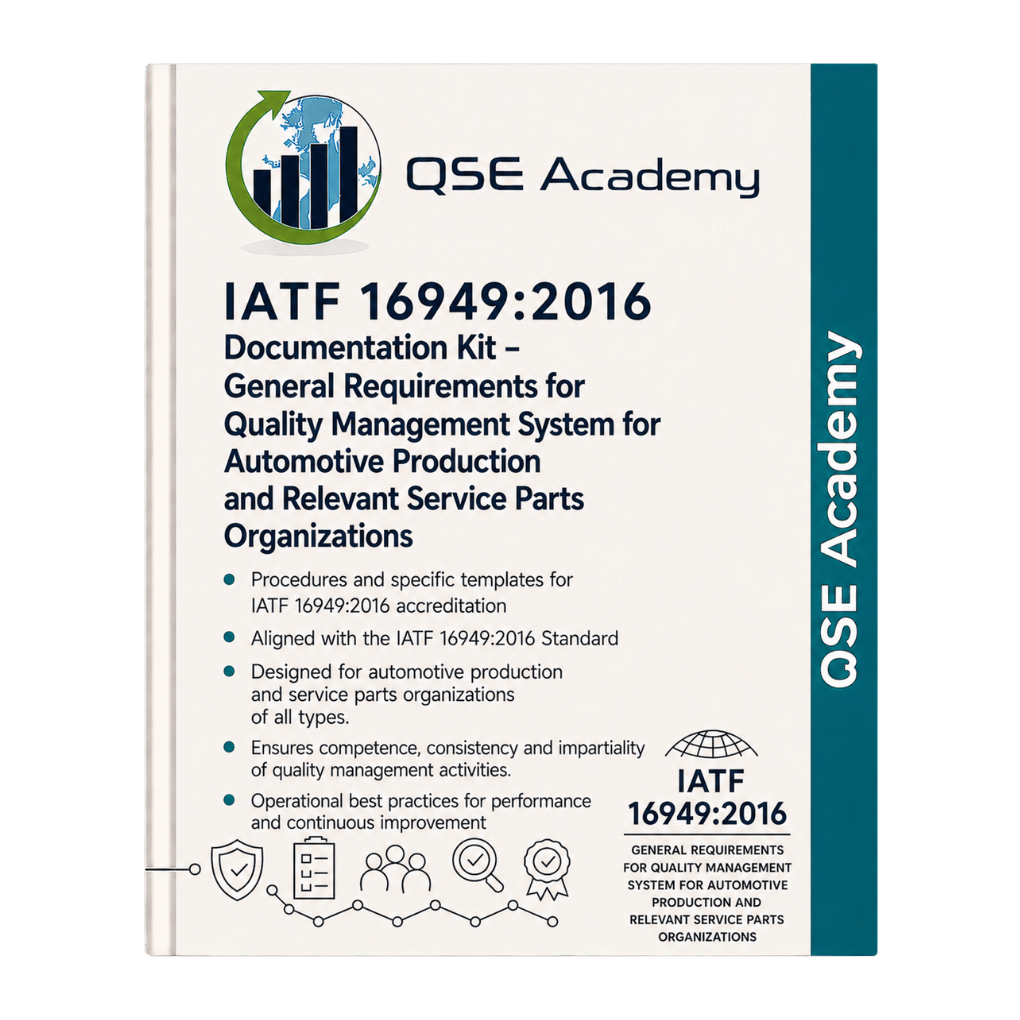
IATF 16949 Documentation Package — Automotive Quality Management

Structure your automotive QMS in weeks, not months.

  • 147 documents built section by section
  • Full mapping IATF 16949 + ISO 9001:2015
  • Core Tools integrated — APQP, PPAP, FMEA, SPC, MSA
  • Designed for OEM audits and Customer-Specific Requirements (CSRs)
Get the IATF 16949 Package — $789
Equivalent to $15,000 — $35,000 of consulting fees
Instant download 30-day guarantee Editable Word format
IATF 16949:2016 Documentation Package
147
Documents included
10
IATF 16949 sections covered
5
Core Tools integrated
100%
Requirements mapped
Who this package is for

Designed for organizations supplying the automotive industry.

The IATF 16949 package is for any organization in the automotive value chain: parts manufacturers, OEM suppliers, Tier 1 / Tier 2 / Tier 3 subcontractors, and production sites pursuing certification or maintaining an existing system.

1

OEM suppliers & Tier 1

Direct suppliers to automakers (OEMs) who must comply with IATF 16949 and the Customer-Specific Requirements (CSRs) of each customer: Ford, GM, Stellantis, Toyota, Honda, BMW, VW, Mercedes-Benz, Tesla, Rivian.

2

Tier 2 & Tier 3 subcontractors

Component manufacturers, sub-assemblers, and production-service providers supplying Tier 1 firms. IATF certification has become mandatory to remain on RFQs and to stay listed in OEM-mandated supply chain contracts.

3

Certification candidates

Companies already ISO 9001 certified preparing their transition to IATF 16949, or new automotive sites that must structure their QMS from day one with the right methods (APQP, PPAP, FMEA, SPC, MSA).

4

Consultants & quality managers

Automotive-specialized consultants and internal quality managers who want a validated documentation foundation aligned with the 10 IATF sections and AIAG-VDA Core Tools (consultant license available on request).

Why this package exists

IATF 16949 cannot be drafted from a blank page.

IATF 16949:2016 builds on the 10 sections of ISO 9001:2015 and adds particularly dense automotive-specific requirements: APQP, PPAP, FMEA (AIAG-VDA), control plans, MSA, SPC, internal labs, CSRs. Building all this in-house takes 6 to 12 months and exposes you to major nonconformities at the certification audit.

01

Generic ISO 9001 templates aren't enough

Most online templates cover ISO 9001:2015 but ignore automotive-specific requirements: PPAP submission process, APQP project files, process and design FMEA (AIAG-VDA aligned), control plans, serial production management, CSR compliance — which represent the majority of the IATF differential.

02

IATF audits are particularly strict

IATF third-party auditors are qualified under specific IATF rules and follow detailed audit plans with scoring. A major nonconformity not addressed within deadlines can lead to certificate suspension — and immediate de-listing by OEMs.

03

OEMs require IATF before any sourcing

Ford, GM, Stellantis, Toyota, Honda, BMW, VW, Mercedes-Benz, Tesla, Rivian and other automakers require IATF 16949 certification in their supplier requirements. Without a valid certification: no nomination on new vehicle programs — and removal from the supplier panel in the medium term.

04

A consulting engagement costs $15,000 to $35,000

A complete IATF 16949 implementation engagement billed by a specialized firm represents 20 to 60 days of intervention depending on site size. The documentation package gives you the complete written foundation — you keep your budget for field implementation, team training, and Core Tools rollout.

What is included

147 documents organized by normative section and Core Tool.

The package covers the 10 sections of IATF 16949:2016, the additional automotive requirements, and the 5 AIAG-VDA Core Tools (APQP, PPAP, FMEA, SPC, MSA).

Section 4

Context & Product Safety

  • Context analysis and interested parties (4.1, 4.2)
  • QMS scope (4.3)
  • Automotive process map (4.4)
  • Product Safety procedure (4.4.1.2)
  • CSR identification and management procedure
Section 5

Leadership & responsibility

  • Automotive quality policy (5.2)
  • Roles, responsibilities and authorities (5.3)
  • Personnel responsibility policy
  • Management escalation procedure
Section 6

Planning & risks

  • Risk and opportunity analysis (6.1.2.1)
  • Preventive action register (6.1.2.2)
  • Business Continuity Plan (6.1.2.3)
  • Quality objectives and achievement plans (6.2)
  • Management of change procedure
Section 7.1 — 7.3

Support & competence

  • Competence, training & awareness procedure (7.2.1, 7.3)
  • Skills matrix and training plan
  • Personnel motivation procedure (7.3.2)
  • Quality manual (7.5.1.1)
  • Documented information and records control procedure (7.5)
  • Records retention policy (7.5.3.2.1)
Section 7.1.5

Infrastructure & measurement

  • TPM preventive and predictive maintenance plan (8.5.1.5)
  • Measurement equipment management procedure (7.1.5)
  • Calibration and metrological traceability procedure (7.1.5.2)
  • Maintenance & calibration records (7.1.5.2.1)
  • Alternative measurement methods — customer acceptance (7.1.5.1.1)
Section 7.5.3

Customer engineering standards

  • Customer engineering standards management procedure (7.5.3.2.2)
  • Distribution and implementation of revisions procedure
  • CSR compliance matrix per OEM (Ford Q1, GM CG1859, Stellantis CSR-EQM, Toyota TES, Honda HSE, BMW VDA 6.3, etc.)
Section 8.1 — 8.2

Customer requirements

  • Contract review and customer requirements review procedure (8.2.3)
  • Customer complaints register (8.2)
  • Manufacturing feasibility study
  • Customer change management procedure
Section 8.3 — APQP

Design & development

  • APQP procedure — 5 phases including Process Design (8.3.1.1, 8.3.3.2)
  • Product design and development procedure (8.3.1)
  • Special characteristics identification procedure (KPC/KCC) (8.3.3.3)
  • Embedded software development self-assessment (8.3.2.3)
  • Design review minutes (8.3.2, 8.3.5)
Section 8.3.5 — FMEA

Risk analysis (AIAG-VDA)

  • FMEA procedure AIAG-VDA aligned (8.3.5)
  • Design FMEA template
  • Process FMEA template
  • S/O/D rating tables and Action Priority (AP) methodology
  • Design change records (8.3.6)
Section 8.4

Supplier control

  • Supplier selection and qualification procedure (8.4.1.2)
  • Supplier panel and annual evaluation (8.4.2.4)
  • Second-party audit checklist (8.4.2.4.1)
  • Statutory and regulatory compliance of purchasing procedure (8.4.2.2)
  • Supplier Development Program (SDP) procedure
Section 8.5 — Production

Serial production

  • Control Plan (8.5.1.1)
  • Production and service provision procedure (8.5.1)
  • Standardized work instructions
  • Run at Rate / Production Demonstration procedure
  • Lot identification and traceability procedure (8.5.2.1)
  • Customer property management procedure (8.5.3)
Section 8.5.6

Production change control

  • Production change control procedure (8.5.6.1)
  • Change records and customer approval
  • List of alternative inspection methods (8.5.6.1.1)
Section 8.5 — PPAP

Approval process

  • PPAP procedure — 18 elements (8.3.4.4)
  • Part Submission Warrant (PSW) form
  • PPAP submission package checklist
  • Deviations / concessions management procedure (8.7.1.1)
  • PPAP re-submission procedure
Section 8.6 — 8.7

Release & nonconformities

  • Product / service release procedure (8.6)
  • NC management with customer notification (8.7.1.6, 8.7.1.7, 8.7.2)
  • Rework with disposition procedure (8.7.1.4)
  • Repair with customer authorization procedure (8.7.1.5)
  • Recall management procedure (NHTSA / Part 573 alignment)
Section 9.1 — SPC/MSA

Statistical surveillance

  • SPC procedure — Statistical Process Control (9.1.1)
  • Capability studies Cp / Cpk / Pp / Ppk — templates
  • Control charts — templates
  • MSA procedure — Measurement System Analysis
  • Gage R&R study — Repeatability & Reproducibility
Section 9.2 — 9.3

Internal audit & management review

  • IATF internal audit program and procedure (9.2, 9.2.2.1)
  • Layered Process Audit (LPA) procedure
  • Management review with CSR action plan procedure (9.3, 9.3.3.1)
Section 10 & Core Tools

Continual improvement & Core Tools

  • 8D problem-solving procedure (10.2.3)
  • Error-proofing / Poka-Yoke procedure (10.2.4)
  • Continual improvement procedure (10.3.1)
  • 5 Core Tools AIAG-VDA manual + IATF ↔ ISO 9001 ↔ Core Tools matrix
Delivery format: all documents are delivered as fully editable Microsoft Word (.docx) files, with a neutral graphic charter ready to receive your logo. Forms (PSW PPAP, FMEA worksheets, control plans, control charts) are delivered as editable Excel files. No locked PDFs, no proprietary software dependency.
Clause-by-clause mapping

Every IATF 16949 requirement → one document in the package.

IATF 16949:2016 is the global reference standard for automotive quality management systems, jointly published by the IATF (International Automotive Task Force) and adopted by all major manufacturers. Below is the section-by-section mapping between the normative text and the documents provided — this is what an IATF third-party auditor expects to see first.

IATF clause Normative requirement Documents provided in the package
4.1 — 4.4.1.2 Context of the organization, QMS, process mapping, Product Safety (4.4.1.2), CSR identification Context analysis QMS scope Process mapping Product Safety procedure CSR identification
5.1 — 5.3 Leadership, quality policy (5.2), responsibilities and authorities (5.3), personnel responsibility Quality policy Roles & responsibilities Personnel responsibility policy Escalation procedure
6.1 — 6.3 Risk analysis (6.1.2.1), preventive actions (6.1.2.2), business continuity plan (6.1.2.3), quality objectives (6.2), management of change Risks & opportunities Preventive action register Contingency plan Quality objectives Management of change
7.1 — 7.3, 7.5 Competence & training (7.2.1), motivation (7.3.2), quality manual (7.5.1.1), document control (7.5), records retention (7.5.3.2.1) Competence & training procedure Skills matrix Motivation procedure Quality manual Document control Records retention policy
7.1.5 Monitoring and measuring resources, maintenance (TPM 8.5.1.5), calibration (7.1.5.2), alternative measurement methods (7.1.5.1.1) TPM maintenance plan Measurement equipment management Calibration procedure Maintenance & calibration records Alternative measurement methods
7.5.3.2.2 Customer engineering standards and specifications management, distribution, and implementation Customer engineering standards procedure Engineering change distribution procedure CSR compliance matrix
8.1 — 8.2 Operational planning, customer requirements review (8.2.3), customer complaints, feasibility study, customer changes Contract review Customer complaints register Feasibility study Customer change management
8.3.1 — 8.3.4 APQP (8.3.1.1), product and process design (8.3.3.2), special characteristics (8.3.3.3), software self-assessment (8.3.2.3), design review APQP procedure (incl. Process Design) Product design & development Special characteristics KPC/KCC Embedded software self-assessment Design review report
8.3.5 — 8.3.6 Design and process FMEA (AIAG-VDA), Action Priority, design change records (8.3.6) FMEA procedure (AIAG-VDA) Design FMEA (DFMEA) Process FMEA (PFMEA) S/O/D rating grid + AP Design change records
8.4 Supplier selection (8.4.1.2), statutory/regulatory compliance (8.4.2.2), evaluation (8.4.2.4), second-party audit (8.4.2.4.1), SDP Supplier selection & qualification Panel & annual evaluation Second-party audit checklist Purchasing regulatory compliance Supplier Development Program
8.5.1 — 8.5.3 Production and service (8.5.1), control plan (8.5.1.1), TPM, identification & traceability (8.5.2.1), customer property (8.5.3) Control Plan Production & service procedure Standardized work instructions Run at Rate Lot identification & traceability Customer property management
8.5.6 Production change control (8.5.6.1), customer approval, alternative control methods (8.5.6.1.1) Production change control Customer change approval Alternative control methods
8.3.4.4 & 8.7.1.1 PPAP — 18 elements, PSW form, checklist, deviations/concessions (8.7.1.1), re-submission PPAP procedure PSW form PPAP checklist Deviations/concessions PPAP re-submission
8.6 — 8.7 Release (8.6), NC management with customer notification (8.7.1.6, 8.7.1.7, 8.7.2), rework with disposition (8.7.1.4), repair with customer authorization (8.7.1.5), recalls Product/service release NC management with customer notification Rework with disposition Repair with customer authorization Recall management (NHTSA-aligned)
9.1 Monitoring and measurement (9.1.1), SPC, capability studies, MSA, Gage R&R SPC procedure Capability Cp/Cpk/Pp/Ppk Control charts MSA procedure Gage R&R study
9.2 — 9.3 Internal audit (9.2, 9.2.2.1), Layered Process Audit, management review (9.3) with customer KPI action plan (9.3.3.1) IATF internal audit program LPA procedure Management review + CSR action plan
10.1 — 10.3 & Core Tools Improvement: corrective actions (10.1), 8D problem-solving (10.2.3), error-proofing / Poka-Yoke (10.2.4), continual improvement (10.3.1), + 5 AIAG-VDA Core Tools (APQP, PPAP, FMEA, SPC, MSA) 8D procedure Error-proofing / Poka-Yoke procedure Continual improvement procedure 5 Core Tools manual + IATF ↔ ISO 9001 matrix
Not included Documents specific to each customer project and each OEM — which must be drafted case by case by your project quality team, depending on the product and the target OEM APQP project file (per product) Filled-in PPAP file (per part) Filled-in FMEA (per product/process) Filled-in Control Plan (per part) Integrated CSRs from target OEM DV/PV test results Real Gage R&R studies on your measurement equipment
Why these documents can't be in any documentation package — from any supplier.

APQP / PPAP files, filled-in FMEAs, completed control plans, and integrated CSRs are by nature specific to each part and each target OEM. They depend on the exact product, the manufacturing process, the equipment used, the customer-specific requirements (CSRs) of each manufacturer, and the actual test results obtained at your site.

A package claiming to provide these pre-filled documents would expose the buyer to a major nonconformity at the IATF audit or PPAP submission: a PSW filled out for a part that isn't yours has no value, a generic FMEA will be systematically rejected by the auditor, and a copy-pasted control plan exposes you to serious process drift. These deliverables must be built part by part, by qualified people from your team (project quality manager, methods engineer, lab manager, supply chain manager).

The QSE Academy package, however, provides all the procedures, templates, and matrices that frame the production of these project-specific documents: APQP procedure, PPAP procedure with 18-element checklist, FMEA procedure with rating grid, control plan template, CSR compliance matrix — the full documentation framework within which your project files take shape.
This mapping is delivered as an Excel matrix in the package. It can be presented as-is to an IATF third-party auditor or to an OEM customer as proof of complete normative and functional coverage.
For experienced quality professionals

Technical conformance — the points an experienced IATF auditor checks first.

Beyond the section-by-section mapping, here are the technical rigour points that automotive quality managers, IATF third-party auditors, and OEM customer auditors verify first.

  • Risk-based approach — deployed in FMEA, control plan, contingency plan, and management of change, with downstream traceability from identified risks to control actions
  • Control Plan — aligned with the process FMEA, with special characteristics clearly identified (KPC/KCC), control means, frequencies, and reaction plans
  • FMEA AIAG-VDA 2019 — 7-step method (Planning, Structure, Function, Failure, Risk, Optimization, Documentation), substitution of RPN by Action Priority (AP)
  • PPAP — the 18 elements — from design record to Part Submission Warrant (PSW), including initial capability studies, MSA, and appearance (if required)
  • Run at Rate / Production Demonstration — demonstration of actual capacity at contractual rate over a representative duration, distinct from PPAP-phase capability studies
  • Layered Process Audit (LPA) — multi-level audit with manager participation, focus on critical quality points, frequency from daily to monthly depending on level
  • 8D — Problem-solving — structured 8-discipline method, with 30/60/90-day effectiveness verification, required by most OEMs for major NCs
  • Customer-Specific Requirements (CSRs) — integration of each manufacturer's specific requirements (Q1 for Ford, GP-12 for GM, SQ.00010 for Stellantis, Toyota Way for Toyota, Formel Q for VW group, etc.)
  • Business continuity plan — supply disruption scenarios, critical equipment failure, site loss, cyber-attack, pandemic, with quantified recovery plans
  • Product Safety — Escalation — product safety characteristics identification procedure, enhanced traceability, management escalation line aligned with NHTSA recall reporting
L

IATF 16949: global recognition

IATF 16949 is the international reference standard for automotive quality management systems, recognized by all major manufacturers. An IATF 16949-compliant package positions you for the entire global automotive supply chain.

United States (Ford, GM, Stellantis, Tesla, Rivian) Mexico (USMCA supply chain) Canada Europe (BMW, VW, Mercedes-Benz) Japan (Toyota, Honda, Nissan) South Korea (Hyundai, Kia) China & India Brazil & LATAM
Comparison

Why the QSE Academy package over the alternatives.

Criterion QSE Academy IATF 16949
$789
Free templates
$0
Consulting firm
$15,000 — $35,000
Automotive-specific (not generic ISO 9001)
Coverage of the 10 IATF 16949 sections ✓ 100% Partial ✓ 100%
Core Tools integrated (APQP, PPAP, FMEA, SPC, MSA) ✓ 5 Core Tools Per engagement
Verifiable section-by-section mapping ✓ Excel matrix Per engagement
Editable Word/Excel format, neutral charter Variable
Delivery time Instant Instant 6 to 12 months
Money-back guarantee ✓ 30 days
Field implementation & team training On you On you Included
The package doesn't replace field implementation — it gives you the complete written foundation and the Core Tools methods. That's precisely the part where consulting firms charge the most. For implementation support (APQP rollout on a real project, PPAP file build, process FMEA facilitation), we also offer custom services.
IATF flash audit

Where do you stand today?

Answer the 12 section-by-section questions to get your IATF 16949 maturity score. Instant result, free, no personal information required.

Question 1 / 12
Section 4 — Context
0
/ 100

Get the IATF 16949 Package — $789
Deployment process

From order to certification audit, here is the path.

The package isn’t just delivered. Here is the concrete path to bring it into production in your organization, step by step, all the way to the IATF third-party audit.

1
Day 1

Download

Secure payment, immediate access to the full package as a ZIP. Within minutes you have the 147 Word documents, the Excel forms (PSW, FMEA, Control Plan), and the user manual.

2
Weeks 1 — 6

Customization

Adapting the documents to your site: logo, organizational chart, processes, equipment, suppliers, target OEM CSRs. Plan 4 to 6 weeks for thorough customization including Core Tools.

3
Weeks 6 — 20

Implementation

Team training on Core Tools, field deployment of procedures, first APQP/PPAP files on pilot products, LPA, first capability and R&R studies. Records start feeding real traceability.

4
Weeks 20 — 28

Mock audit & certification

Internal audit with the checklist provided, complete LPA, management review. Identification of remaining findings, corrective action plan, then certification audit by an IATF-accredited third-party body (stage 1 + stage 2).

Typical timeline: 6 to 9 months between order and "ready for certification audit" state. Companies already ISO 9001 certified with a mature QMS reach this state in 4 to 6 months; those starting from scratch may take 10 to 12 months. Your internal resources and starting maturity make the difference, not the package.
Used by automotive suppliers worldwide

What companies that adopted it say.

★★★★★

A massive time-saver on the documentation side. The APQP and PPAP procedures were directly usable. Our IATF third-party audit was validated without any major nonconformity.

M
Michael
Quality Manager · Tier 1 supplier, USA
★★★★★

Written by professionals who really know automotive. The IATF ↔ ISO 9001 ↔ Core Tools matrix is exactly the tool I needed to prepare my Stage 2 audit.

C
Caroline
Quality Director · Component manufacturer, Canada
★★★★☆

Unbeatable value. We rolled out our IATF QMS in 5 months instead of the 12 months expected with an external consultant. The 8D procedure was adopted as-is.

R
Robert
Founder · Automotive metallurgy startup, UK
★★★★★

Fully customizable Word documents and Excel forms, accurate normative terminology, AIAG-VDA aligned for FMEA. Solid work, well documented.

S
Sebastian
Methods Manager · Automotive foundry Tier 2, Australia
Risk-free

30-day guarantee, no questions asked.

30-day money-back guarantee

You test the package. If you change your mind, we refund you.

You have 30 days to download the package, review its content, open the documents, and verify that the writing quality matches your expectations. If something is off, you write us an email — no justification needed — and the refund is processed within 5 business days. That simple.

The package evolves with you

Updates included for 12 months.

IATF requirements evolve — Sanctioned Interpretations, revisions of the Rules for Achieving and Maintaining IATF Recognition, AIAG-VDA Core Tools updates. The package you buy today shouldn’t become obsolete in 6 months. That’s why updates are included.

12 months of normative and methodological updates

In case of IATF Sanctioned Interpretations, IATF Rules revisions, or significant evolution of AIAG or AIAG-VDA Core Tools manuals, you receive relevant package updates free of charge for 12 months after your purchase.

  • IATF Sanctioned Interpretations
  • AIAG-VDA Core Tools updates
  • IATF Rules revisions
  • Email notifications upon publication
Frequently asked questions

Answers to your most common questions.

Is the package enough to pass an IATF certification audit?

The package gives you the complete documentation foundation required by IATF 16949 and the 5 AIAG Core Tools. To pass the third-party certification audit, you also need to implement the procedures in the field: train teams, deploy APQP on a real project, build effective PPAPs, run FMEAs, perform capability and R&R studies on your measurement equipment, conduct LPAs. The package saves you the 6 to 12 months of writing work. Operational implementation remains your work (typically 3 to 6 months depending on site size and starting maturity).

What’s the difference between this and an ISO 9001 template downloaded online?

A generic ISO 9001 template covers the basic quality system requirements but ignores all automotive-specific requirements: APQP (5 phases), PPAP (18 elements), product and process FMEA, control plan, SPC with capability studies, MSA with R&R studies, Layered Process Audit, 8D, product safety, contingency plan, CSR management per automaker. These requirements represent the bulk of the IATF ↔ ISO 9001 differential — the part that makes the certification audit pass or not.

Is the package compatible if I’m already ISO 9001 certified?

Yes, and that’s actually the most frequent case. IATF 16949:2016 fully integrates ISO 9001:2015 and adds automotive requirements on top. If you’re already ISO 9001 certified, you reuse your existing foundation and complete with IATF requirements: APQP, PPAP, FMEA, control plan, SPC, MSA, LPA, CSRs, contingency plan, escalation procedures. The package specifically provides these additional requirements, plus the ISO 9001 procedures if you want to harmonize everything.

How long does it take to adapt the package to my company?

Plan 4 to 6 weeks to customize the documents: logo, organizational chart, real process mapping, specific equipment, regular suppliers, integration of target OEM CSRs. Then plan operational implementation time: Core Tools training, APQP/PPAP deployment on a pilot project, first capability and R&R studies, mock audit — that’s 3 to 6 additional months depending on site size.

Does the package cover Customer-Specific Requirements (CSRs)?

Yes. The package covers the complete methodology for identifying, integrating, and tracking CSRs, with a transverse compliance matrix to cross-reference your internal processes with each automaker’s requirements (Ford, GM, Stellantis, Toyota, Honda, BMW, Volkswagen, Mercedes-Benz, Tesla, Rivian, etc.). Note: the CSRs themselves (contractual requirements specific to each OEM) cannot be provided — they are distributed by automakers directly to their suppliers via quality portals (Covisint, Ariba, SupplyOn). The package gives you the framework to receive, analyze, and deploy them.

Is the package delivered in Word or PDF format?

All procedural documents are delivered in fully editable Microsoft Word (.docx) format. Operational forms (PPAP PSW, FMEA, control plan, control charts, capability studies) are delivered in editable Excel format. No locked PDFs, no proprietary software dependency. The IATF ↔ ISO 9001 ↔ Core Tools mapping matrix is delivered in Excel format.

Is IATF 16949 mandatory to supply automotive?

IATF 16949 certification is not a regulatory obligation, but it is a contractual requirement of nearly all automakers to be on their approved supplier panel. Without valid IATF 16949 certification, OEMs (Ford, GM, Stellantis, Toyota, Honda, BMW, Volkswagen, Mercedes-Benz, Tesla, Rivian, etc.) don’t nominate new programs and progressively de-list non-certified suppliers. The requirement also cascades to Tier 2 and Tier 3 through Tier 1 customers.

Does the package cover the 5 AIAG Core Tools (APQP, PPAP, FMEA, SPC, MSA)?

Yes, all 5 Core Tools are fully covered by the package: APQP procedure and methodological manual (5 phases), PPAP procedure with 18-element checklist and PSW form, FMEA procedure aligned with the AIAG-VDA 2019 method (7 steps, Action Priority), SPC procedure with control chart templates and capability studies (Cp, Cpk, Pp, Ppk), MSA procedure with R&R study methodology. Each Core Tool comes with ready-to-use templates.

How many users / sites does the license cover?

The $789 license covers a single production site, with unlimited internal use (all your employees can use the package). For multi-site rollout (industrial group with multiple plants) or consulting use across multiple clients, contact us for an adapted license.

Do I receive updates if the standard evolves?

Yes. In case of IATF Sanctioned Interpretations, revision of the Rules for Achieving and Maintaining IATF Recognition, or significant evolution of AIAG-VDA Core Tools manuals, you receive package updates free of charge for 12 months after your purchase.

What happens if I’m not satisfied?

You’re covered by a 30-day money-back guarantee, no conditions. You write us a simple email — no justification required — and the refund is processed within 5 business days.

Take action

Your IATF 16949 automotive QMS. Ready today.

147 documents, 10 IATF 16949 sections, 5 AIAG Core Tools, section-by-section mapping. Instant download after payment.

Equivalent to $15,000 — $35,000 of consulting fees
$789 Single-site license · Secure payment · Instant download
Get the IATF 16949 Package — $789
30-day money-back guarantee Instant download 12 months of updates Editable Word format