BRCGS Food Safety Issue 9 — mandatory since February 1, 2023 for any GFSI-recognized certification.
BRCGS Food Safety · Issue 9

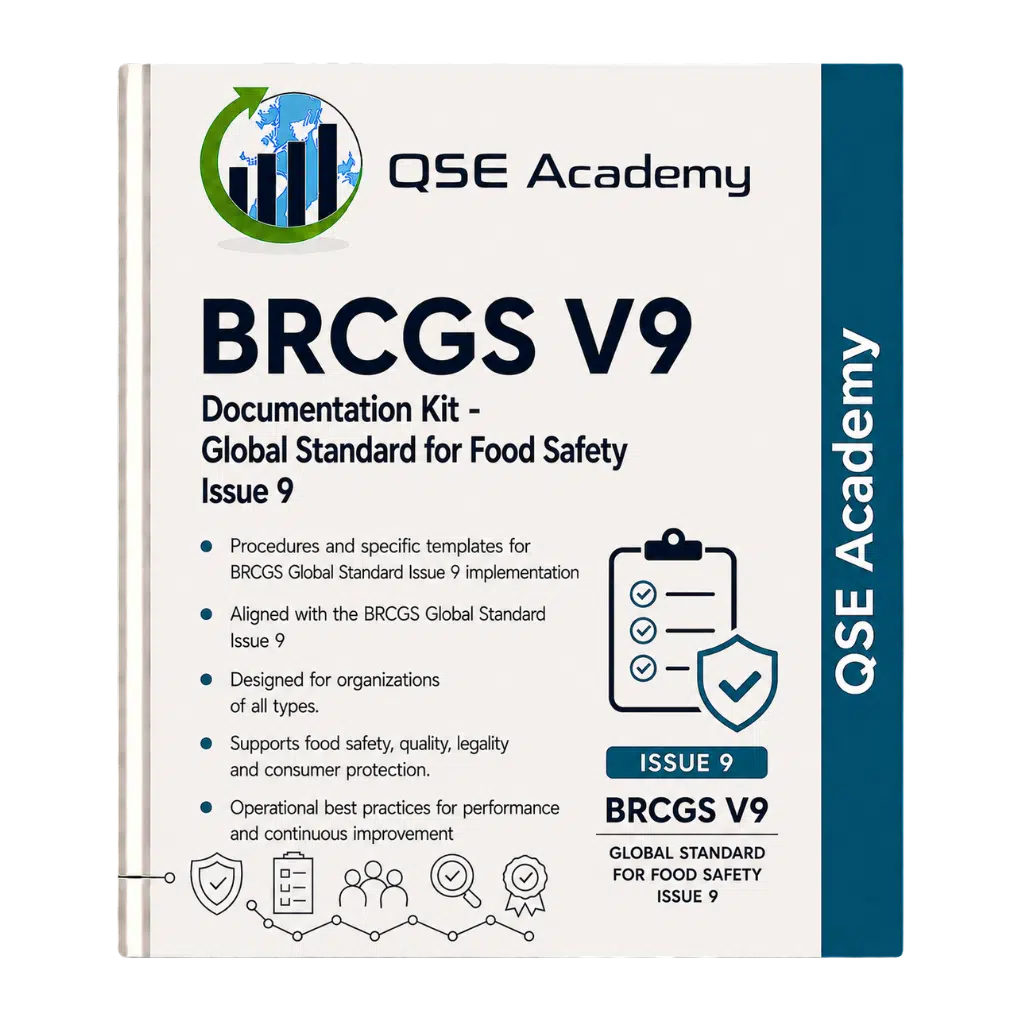
BRCGS V9 Documentation Package — Food Safety

Get your site BRCGS V9 audit-ready in weeks, not months.

  • 129 documents aligned clause by clause with Issue 9
  • Full coverage of 9 chapters and 12 fundamental clauses
  • Editable procedures, Codex HACCP plan, and records
  • Built for announced, blended, and unannounced audits
Get the BRCGS V9 Package — $789
Equivalent to $12,000 — $30,000 of consulting fees
Instant download 30-day money-back guarantee Editable Word format
BRCGS V9 Documentation Package
129
Documents included
9
BRCGS V9 chapters covered
12
Fundamental clauses addressed
GFSI
Globally recognized standard
Who this package is for

Built for food manufacturing, processing, and packing sites.

The BRCGS V9 package is for any food industry company pursuing or maintaining BRCGS Food Safety certification — from private-label manufacturers to co-packers, ingredient producers, and primary processing facilities.

1

Food manufacturers

Food production and processing sites, whether under their own brand, private label, or manufacturing on behalf of major retail chains and distributors.

2

Co-packers & contract manufacturers

Specialist sub-contractors in packing, assembly, or primary processing who must demonstrate BRCGS compliance to be listed with major US, UK, and European retailers.

3

Ingredient producers

Manufacturers of ingredients and raw materials destined for the food industry, foodservice, or pet food manufacturing.

4

Consultants & advisory firms

Food safety consultants and advisory firms who want a validated documentation foundation to accelerate client engagements (firm-wide license available on request).

Why this package exists

BRCGS V9 cannot be written from a blank page.

BRCGS Food Safety Issue 9 has 9 chapters and over 300 requirements, including 12 Fundamental Requirements. Each calls for written procedures, traceable records, and evidence of implementation. Building the whole system in-house takes 4 to 9 months of writing work and exposes you to major nonconformities on certification audit day.

01

V9 reinforced food safety culture

Fundamental clause 1.1.2 requires a documented plan for the development and continual improvement of a food safety culture. The plan must include communication, training, employee feedback, measured performance indicators, a dated action plan, and annual effectiveness review — not a single window-dressing document.

02

Mandatory unannounced audit every 3 years

GFSI requirement carried into V9: even on the announced program, every certified site must undergo at least one unannounced audit per 3-year cycle, with no advance date given. Without a living, up-to-date documentation system, a major nonconformity triggers a downgrade or certificate withdrawal.

03

Retailers require BRCGS before listing

BRCGS Food Safety certification is a gate-keeping requirement for most major US, UK, European, and Canadian retailers, particularly for private-label products. Walmart, Costco, Target, ALDI, Lidl, Tesco, M&S, Sainsbury's all require BRCGS or an equivalent GFSI-recognized standard. Without certification, listing doesn't happen — or happens at degraded commercial terms.

04

A consulting engagement runs $12,000 to $30,000

A full BRCGS implementation engagement billed by a specialized consulting firm represents 20 to 50 days of intervention. The documentation package gives you the written foundation aligned clause by clause with V9 — you keep your budget for field implementation, training, and the mock audit.

What is included

129 documents organized by BRCGS V9 chapter.

The package covers all 9 chapters of the BRCGS Food Safety Issue 9 standard and the 12 Fundamental Requirements — a single major nonconformity on any one of them triggers non-certification at the initial audit or certificate withdrawal at follow-up audits.

Chapter 1 · 8 docs

Senior management commitment

  • Food safety and quality policy (1.1.1)
  • Food safety and quality culture plan (1.1.2)
  • Food safety and quality objectives sheet (1.1.3)
  • Annual management review procedure (1.1.4)
  • Monthly food safety meetings program (1.1.5)
  • Confidential reporting procedure — whistleblowing (1.1.6)
  • Org chart and reporting lines (1.2.1)
  • Responsibility matrix and designated deputies (1.2.2)
Chapter 2 · 10 docs

Food safety plan — HACCP

  • Multidisciplinary HACCP team charter (2.1.1)
  • Prerequisite programs (PRP) list (2.2.1)
  • Product / product group description sheets (2.3.1)
  • Intended use identification and vulnerable populations (2.4.1)
  • Process flow diagrams per product (2.5.1)
  • Annual flow diagram verification sheet (2.6.1)
  • Hazard analysis (biological, chemical, physical, radiological, allergenic, fraud) (2.7.1)
  • CCP decision tree and determination table (2.8.1)
  • Master HACCP plan — critical limits, monitoring, corrective actions (2.9-2.11)
  • HACCP validation and verification procedure (2.12)
Chapter 3 · 15 docs

Food safety and quality management system

  • Food safety and quality manual (3.1.1)
  • Document control procedure (3.2.1)
  • Records creation and retention procedure (3.3.1)
  • Annual internal audit program — 4 dates minimum (3.4.1)
  • Documented monthly factory inspection procedure — exposed product zones (3.4.4)
  • Raw material risk assessment procedure (3.5.1.1)
  • Raw material and packaging supplier approval procedure (3.5.1.2)
  • Service provider management procedure (3.5.3)
  • Outsourced processing procedure (3.5.4)
  • Specifications management procedure — raw materials, packaging, finished products (3.6)
  • Corrective and preventive action procedure with root cause analysis (3.7)
  • Nonconforming product control procedure (3.8)
  • Traceability procedure — 4-hour test (3.9)
  • Customer complaint handling procedure (3.10)
  • Product incident, withdrawal and recall procedure (3.11)
Chapter 4 · 20 docs

Site standards

  • Site security and access control procedure (4.1)
  • Threat assessment and food chain protection plan — TACCP (4.2)
  • Site plan — layout, flows, risk zone separation (4.3)
  • Building envelope maintenance plan (4.4)
  • Utility management procedure — water, ice, air, gas (4.5)
  • Equipment management and qualification procedure (4.6)
  • Preventive maintenance plan (4.7)
  • Personnel-only facilities procedure (4.8)
  • Chemical and physical contamination control procedure (4.9)
  • Glass and brittle plastics register (4.9.3)
  • Wood and high-risk materials management procedure (4.9.5)
  • Foreign body detection and removal equipment procedure (4.10)
  • Metal and X-ray detector calibration procedure (4.10.3)
  • Documented cleaning and disinfection plan (4.11.2)
  • Clean-in-place (CIP) procedure (4.11.7)
  • Environmental monitoring program (4.11.8)
  • Waste management procedure (4.12)
  • Surplus and animal-feed product management procedure (4.13)
  • Pest control plan (4.14)
  • Dispatch, storage and transport procedure (4.15-4.16)
Chapter 5 · 10 docs

Product control

  • Product design and development procedure (5.1)
  • Compliant product labeling procedure (5.2)
  • Allergen risk assessment and product matrix (5.3)
  • Allergen cleaning validation and change-over procedure (5.3)
  • Food fraud vulnerability assessment — VACCP (5.4.2)
  • Authenticity and chain of custody procedure (5.4)
  • Product packaging management procedure (5.5)
  • Product inspection and laboratory testing procedure (5.6)
  • Product shelf-life validation procedure (5.6)
  • Finished product release procedure (5.7)
Chapter 6 · 6 docs

Process control

  • Operations control procedure (6.1)
  • Packed product labeling and control procedure (6.2)
  • Weight, volume and count control procedure (6.3)
  • Calibration and metrological verification plan (6.4)
  • Measuring and monitoring equipment register (6.4)
  • In-process control and rework procedure
Chapter 7 · 6 docs

Personnel

  • Food safety training plan (7.1)
  • Training and job qualification register (7.1)
  • Personal hygiene procedure (7.2)
  • Medical examination and illness management procedure (7.3)
  • Protective clothing procedure — staff and visitors (7.4)
  • Visitor and contractor management procedure (4.1.4 / 4.3.3)
Chapter 8 · 5 docs

High-risk and high-care zones

  • High-risk / high-care / ambient zone classification (Annex 2)
  • Layout, flow and sensitive zone separation procedure (8.1)
  • Sensitive zone envelope, equipment and maintenance procedure (8.2-8.3)
  • Personnel facilities and dedicated clothing procedure (8.4 / 8.7)
  • Reinforced cleaning and environmental monitoring plan for sensitive zones (8.5)
Chapter 9 · 4 docs

Traded products

  • HACCP plan specific to traded products (9.1)
  • Approval procedure for manufacturers and packers of traded products (9.2)
  • Traded product specifications and inspections (9.3-9.4)
  • Traded product traceability and legality procedure (9.5-9.6)
Transverse · 4 docs

Audits, fundamentals, and matrix

  • BRCGS V9 internal audit checklist — 9 chapters and 12 fundamentals
  • BRCGS V9 normative mapping matrix ↔ documents
  • 12 fundamental clauses checklist
  • Annual recall plan test procedure — mock recall (3.11.3)
Delivery format: all documents are delivered as fully editable Microsoft Word (.docx) files, with a neutral graphic charter ready to receive your logo. No locked PDFs, no proprietary software dependency. The mapping matrix, the BRCGS V9 internal audit checklist, the master HACCP plan, the CCP tables, and the allergen matrix are delivered in Excel format.
Clause-by-clause mapping

Every BRCGS V9 requirement → one document in the package.

BRCGS Food Safety Issue 9 is recognized by the Global Food Safety Initiative (GFSI) and aligned with the General Principles of Food Hygiene of Codex Alimentarius. Below is the chapter-by-chapter mapping between the normative text and the documents provided — this is what a BRCGS auditor or a customer asks to see first.

Chapter / Section BRCGS V9 requirement (Part II) Documents provided in the package
1.1 — Senior management commitment (Fundamental) Signed policy (1.1.1), food safety culture plan with 6 mandatory elements (1.1.2), quarterly objectives (1.1.3), annual management review (1.1.4), monthly meetings (1.1.5), confidential reporting (1.1.6) Signed food safety policy Food safety culture plan Food safety objectives Management review Monthly meetings minutes Whistleblowing procedure
1.2 — Organizational structure Org chart, clearly distributed responsibilities, designated deputies (1.2.1), staff awareness (1.2.2) Organization chart Responsibilities matrix
2 — HACCP (Fundamental) HACCP plan compliant with the 7 principles / 12 steps of Codex Alimentarius: team (2.1), PRPs (2.2), product description (2.3), intended use (2.4), flow diagram (2.5-2.6), hazard analysis (2.7), CCPs (2.8), critical limits (2.9), monitoring (2.10), corrective actions (2.11), validation and annual verification (2.12), documentation (2.13) HACCP team charter PRP list Product descriptions Flow diagrams Hazard analysis CCP decision tree Master HACCP plan HACCP validation
3.1 — 3.3 Documentation system Food safety manual (3.1), document control with master list (3.2), records retention shelf life + 12 months (3.3) Food Safety Manual Document control Records management
3.4 — Internal audits (Fundamental) Program with at least 4 staggered audit dates (3.4.1), competent and independent auditors (3.4.2), reports with objective evidence (3.4.3), separate documented factory inspections — monthly for open product zones (3.4.4) Internal audit program V9 audit checklist Factory inspection procedure
3.5.1 — Raw material/packaging suppliers (Fundamental) Documented raw material risk assessment updated every 3 years (3.5.1.1), risk-based approval procedure — GFSI certification, audit, or questionnaire (3.5.1.2), continuous performance monitoring (3.5.1.3), supplier database (3.5.1.4), traceability through agents/brokers (3.5.1.5-3.5.1.6) Raw material risk assessment Supplier approval Supplier performance Supplier database
3.5.2 — 3.5.4 Receiving, services, outsourced processing Risk-based raw material receiving procedure (3.5.2), service provider management (3.5.3), approved and controlled outsourced processing (3.5.4) Raw material receiving Service providers Outsourced processing
3.6 — Specifications Up-to-date specifications for raw materials / packaging / finished products, reviewed every 3 years (3.6.4) Raw material specs Finished product specs
3.7 — Corrective actions (Fundamental) Procedure for management and correction with root cause analysis and preventive actions (3.7.1), documented investigation / evaluation / deadline / responsible / effectiveness verification (3.7.2) CAPA procedure Root cause analysis
3.8 — Nonconforming products Identification, secure storage, documented disposition, traceability of nonconforming products (3.8.1) Nonconformity control
3.9 — Traceability (Fundamental) Documented procedure (3.9.1), identification at every step (3.9.2), annual mass-balance test — traceability under 4 hours (3.9.3), traceability of rework (3.9.4) Traceability procedure Traceability test
3.10 — 3.11 Complaints, incidents, withdrawal, recall Complaints with trend analysis (3.10), incident procedure including cybersecurity (3.11.1), withdrawal/recall procedure (3.11.2), annual recall plan test (3.11.3), CB notification within 3 business days in case of incident (3.11.4) Complaints management Incident management Recall procedure Mock recall
4.3 — Site layout, flow, separation (Fundamental) Risk assessment of production zones per Annex 2 (4.3.1), full site plan with personnel/raw material/waste/recycled flows (4.3.2), visitor information (4.3.3), flows that don't compromise safety (4.3.4-4.3.6) Site plan Risk zoning Process flows
4.1 — 4.2 Site exterior, security, and TACCP External standards and security (4.1), threat assessment and food chain protection plan against malicious acts, reviewed annually (4.2) Site security Threat assessment TACCP plan
4.4 — 4.8 Building envelope, utilities, equipment, maintenance Wall, floor, ceiling, door, lighting, ventilation finish (4.4), water/ice/air/gas management (4.5), equipment (4.6), preventive maintenance (4.7), staff facilities (4.8) Building envelope Utilities Equipment management Preventive maintenance Staff facilities
4.9 — 4.10 Contamination and foreign bodies Chemical and physical control (4.9), brittle glass and plastic register (4.9.3), wood (4.9.5), detection/removal equipment: filters (4.10.2), metal detectors/X-ray (4.10.3), magnets (4.10.4), optical sorting (4.10.5) Contamination control Glass/plastic register Foreign body detection Detector calibration
4.11 — Housekeeping and hygiene (Fundamental) Documented cleaning and disinfection procedures (4.11.2), acceptable limits (4.11.3), pre-use cleanliness verification (4.11.5), clean-in-place CIP (4.11.7), environmental monitoring (4.11.8) Cleaning & disinfection plan CIP procedure Environmental monitoring
4.12 — 4.16 Waste, pests, storage, transport Waste management (4.12), surplus and animal feed (4.13), pest control (4.14), storage (4.15), dispatch and transport (4.16) Waste management Pest control Storage Dispatch and transport
5.1 — 5.2 Design, labeling Design and development with risk study (5.1), labeling compliant with the legislation of the country of sale (5.2) Product design Labeling
5.3 — Allergen management (Fundamental) Per-product allergen risk assessment, allergen matrix, change-over procedure, allergen cleaning validation Allergen matrix Allergen change-over Cleaning validation
5.4 — 5.7 Authenticity, packaging, inspection, release Food fraud vulnerability assessment VACCP (5.4.2), claims and chain of custody (5.4), packaging (5.5), inspection and laboratory analyses (5.6), product release (5.7) VACCP Authenticity Packaging Product inspection Product release
5.8 — 5.9 Animal feed and primary conversion Pet food and animal feed (5.8), primary animal conversion (5.9) — applies only to relevant sites Animal feed Primary conversion
6.1 — Control of operations (Fundamental) Documented control of every key production operation, process parameters, in-process verifications, rework management Operations control In-process control
6.2 — Labeling and packed products (Fundamental) Verification of correct labeling at every line start-up and at every batch change, traceability of printed packaging Packed product labeling
6.3 — 6.4 Quantity and calibration Weight, volume, and count control (6.3), measuring device calibration and verification plan (6.4) Net quantity control Calibration plan Metrology register
7.1 — Training (Fundamental) Initial and ongoing training plan for all handling zones, HACCP training, position-specific qualification register, effectiveness evaluation Training plan Qualifications register
7.2 — 7.4 Hygiene, health, clothing Personal hygiene in handling zones (7.2), medical examinations and communicable diseases (7.3), personal and visitor protective clothing (7.4) Staff hygiene Medical examinations Protective clothing
8 — High-risk / high-care zones Classification per Annex 2, reinforced layout and flows (8.1), specific envelope (8.2), dedicated equipment (8.3), dedicated staff facilities (8.4), reinforced hygiene (8.5), waste (8.6), dedicated clothing (8.7) Zone classification HR/HC layout Reinforced hygiene Dedicated clothing
9 — Traded products (if applicable) HACCP plan specific to traded products (9.1), manufacturer/packer approval (9.2), specifications (9.3), inspections and analyses (9.4), legality (9.5), traceability (9.6) Traded products HACCP Manufacturer approval Traded product traceability
Not included Site-, line-, and product-specific documents — which must be drafted case by case by your HACCP team and your quality team Final site-specific HACCP study (per product family) Real flow diagrams of your lines Finished product technical sheets (per SKU) Signed supplier agreements (per raw material) Manufacturing formulations and recipes Production work instructions (per product) Finished product shelf-life studies (per SKU) Specific analytical control plans (per product)
Why these documents can't be in a documentation package — from any supplier.

The final HACCP plan, finished-product technical sheets, raw-material specifications, formulations, and manufacturing routings are by nature specific to each site, each product line, and each product. They depend on the manufacturing chain, the raw materials used, the equipment in place, the commercial target, and the claimed shelf life.

A package claiming to deliver these documents pre-filled would expose the buyer to a major BRCGS nonconformity: a generic HACCP isn't an HACCP, a copied technical sheet creates safety and regulatory compliance risks, and a formulation taken from another site won't match the raw materials actually used. These deliverables must be built product by product by the company's HACCP team.

The QSE Academy package provides instead all the procedures and all the templates that frame the production of these product-specific documents: HACCP methodology, technical sheet template, supplier specification template, hazard analysis grid — i.e. the complete documentation framework within which your HACCP and your product sheets fit.
In addition, this mapping is delivered as an Excel matrix in the package. It can be presented as-is to a BRCGS auditor, to a customer, or in a second-party audit as proof of complete normative coverage across the 9 chapters and the 12 fundamental clauses.
For experienced professionals

Technical conformance — the points an experienced BRCGS auditor checks first.

Beyond the clause-by-clause mapping, here are the technical rigor points that Quality Managers, Quality Directors, and seasoned BRCGS auditors check first — pulled directly from the requirements of Version 9 published in August 2022.

  • Food safety culture plan — 6 mandatory elements — communication, training, employee feedback, behaviors, measured indicators, dated action plan (fundamental clause 1.1.2)
  • Confidential reporting — system accessible to all staff to report safety issues, clearly communicated mechanism, documented evaluation (1.1.6)
  • Internal audits: minimum 4 dates — program staggered across the year, all activities audited at least once a year, independent auditors (fundamental clause 3.4.1-3.4.3)
  • Monthly factory inspections — separate from internal audits, monthly minimum for open product zones, hygiene + building and equipment condition (3.4.4)
  • Raw material risk assessment every 3 years — reviewed at each raw material/supplier change, on any new risk, on any recall involving the raw material (fundamental clause 3.5.1.1)
  • Traceability < 4 hours — annual test with mass balance, upstream-supplier and downstream-customer, rework included (fundamental clause 3.9.3)
  • CB notification within 3 business days — any significant incident (recall, regulatory nonconformity), root cause analysis + action plan within 21 days (3.11.4)
  • Cybersecurity in incident management — IT system failure or attack explicitly included in V9 incident procedures (3.11.1)
  • Annual recall plan test — procedure tested at least once a year with recording of timing of key activities (3.11.3)
  • Outsourced processing management — risk-based approval, customer communication, service specification, visual/chemical/micro testing (3.5.4)
  • Environmental monitoring — documented program, separate from cleaning, micro and allergen trend monitoring (4.11.8)
  • Clean-in-place CIP — distinct requirement — CIP validation and verification procedure handled separately from manual cleaning (4.11.7)
G

BRCGS: international recognition

The BRCGS Food Safety standard is recognized by the Global Food Safety Initiative (GFSI) and used by approximately 25,000 sites in over 120 countries. A BRCGS certification opens doors with UK, European, and North American retailers, and satisfies the GFSI requirements of major global customers.

USA (Walmart, Costco, Target) United Kingdom (Tesco, M&S, Sainsbury’s) Canada (Loblaw, Sobeys) Continental Europe Australia / New Zealand South Africa Asia (GFSI)
Comparison

Why the QSE Academy package over the alternatives.

Criterion QSE Academy BRCGS V9
$789
Free templates
$0
Consulting firm
$12,000 — $30,000
BRCGS V9 specific (not generic ISO 22000)
Coverage of all 9 BRCGS V9 chapters ✓ 100% Partial ✓ 100%
Treatment of all 12 fundamental clauses ✓ Dedicated checklist Per engagement
Codex HACCP plan + TACCP + VACCP ✓ Included
Clause-by-clause mapping ✓ Excel matrix Per engagement
Editable Word format, neutral graphic charter Variable
Delivery time Immediate Immediate 4 to 9 months
Money-back guarantee ✓ 30 days
Field implementation & training Your responsibility Your responsibility Included
The package doesn't replace field implementation — it gives you the complete written foundation. That's precisely the part where a consulting firm charges most. For implementation support, mock audits, or direct preparation for the certification audit, we also offer custom services.
BRCGS V9 flash audit

Where do you stand today?

Answer the 12 questions covering the 12 fundamental clauses of Version 9 — the requirements where a single major nonconformity triggers non-certification or certificate withdrawal. Instant result, free, no personal information required.

Question 1 / 12
Fundamental 1.1 — Senior management commitment
0
/ 100

Get the BRCGS V9 package — $789
Deployment process

From order to certification audit, here is the path.

The package isn't just delivered. Here is the concrete path to bring it into production at your site, all the way to your BRCGS audit, step by step.

1
Day 1

Download

Secure payment, immediate access to the full package as a ZIP. Within minutes, you have all 129 Word documents, the Excel matrices, and the user guide.

2
Weeks 1 — 6

Customization

Adapting the documents to your site: logo, org chart, product ranges, equipment, production lines, high-risk / high-care zones, suppliers. Plan 4 to 6 weeks for serious customization.

3
Weeks 6 — 14

Implementation

Team training, records rollout, field deployment of procedures, environmental monitoring, mock recall. Real records start feeding the live traceability evidence base.

4
Weeks 14 — 18

Mock audit

Full internal audit using the BRCGS V9 checklist provided. Identification of gaps, corrective action plan, preparation for the certification audit by the accredited body.

Typical timeline: 14 to 18 weeks between order and a "ready for BRCGS audit" state. Companies already certified to ISO 22000 or IFS reach this state in 10 to 12 weeks; those starting from zero may take up to 24 weeks. It's your internal resources and starting maturity that make the difference, not the package.
Used by food safety teams worldwide

What companies that adopted it say.

★★★★★

A massive time-saver. The procedures were clear, complete, and directly usable. Our BRCGS certification audit cleared at Grade A on the first attempt.

S
Steven
Quality Manager · Food manufacturer, USA
★★★★★

Written by professionals who really know V9. The food safety culture clause and the 12 fundamentals checklist are exactly what I was looking for.

T
Tom
Quality Director · Private label co-packer, UK
★★★★★

Unbeatable value. We moved from ISO 22000 to BRCGS V9 in 3 months instead of the 8 months estimated by our usual consulting firm.

A
Amanda
Food Safety Manager · Mid-sized food manufacturer, Canada
★★★★★

Fully editable Word documents, solid HACCP, clear mapping, accurate normative vocabulary. Nothing to add — this is serious work.

P
Patrick
Production Manager · Primary processing site, Australia
Risk-free

30-day guarantee, no questions asked.

30-day money-back guarantee

You test the package. If you change your mind, we refund you.

You have 30 days to download the package, review its content, open the documents, and verify that the writing quality matches your expectations. If something is off, you write us an email — no justification needed — and the refund is processed within 5 business days. That simple.

The package evolves with you

Updates included for 12 months.

The BRCGS standard evolves regularly — technical committee position statements, new annexes, GFSI alignment updates. The package you buy today shouldn't become obsolete in 6 months. That's why updates are included.

12 months of normative and regulatory updates

In case of a BRCGS position statement, a revision of the standard's annexes, a change in GFSI requirements, or the publication of new guidelines impacting documentation, you receive relevant package updates free of charge for 12 months after your purchase.

  • BRCGS position statements
  • Annex revisions to the standard
  • GFSI / Codex updates
  • Email notifications upon publication
Frequently asked questions

Answers to your most common questions.

Is the package enough to pass a BRCGS V9 certification audit?

The package gives you the complete documentation foundation aligned clause by clause with the 9 chapters of the BRCGS V9 standard and covers the 12 fundamental clauses. To pass the certification audit, you also need to implement the procedures in the field: train staff, populate records, demonstrate traceability in under 4 hours (clause 3.9.3), conduct an annual recall plan test (clause 3.11.3), and implement environmental monitoring (clause 4.11.8). The package saves you the 4 to 9 months of writing. Operational implementation remains your work — typically 8 to 16 weeks depending on site size and starting maturity level.

What's the difference between this and a free template downloaded online?

A generic template is written for ISO 22000 or another sector. It doesn't cover BRCGS V9-specific requirements: food safety culture plan with its 6 mandatory elements (clause 1.1.2), confidential reporting (clause 1.1.6), minimum 4 staggered internal audit dates (clause 3.4.1), separate monthly factory inspections (clause 3.4.4), 3-year reassessment of raw material risks (clause 3.5.1.1), zone classification per Annex 2 of the standard, 12 fundamental clauses checklist. The QSE Academy package is written specifically for V9 (August 2022), with verifiable clause-by-clause mapping.

What's the difference between BRCGS V9, ISO 22000, and IFS?

All three standards are GFSI-recognized and share common principles (Codex HACCP, traceability, continual improvement), but BRCGS is historically required by UK retailers and increasingly by European and North American chains, especially for private-label products. IFS Food is preferred by German and French retailers. ISO 22000 is more generic and less prescriptive on site-specific requirements. If your customers ask for BRCGS, they expect BRCGS — an ISO 22000 certificate will not be accepted as a substitute.

What is clause 1.1.2 on food safety culture?

Fundamental clause 1.1.2 of V9 requires site management to define and monitor a clear plan for the development and continual improvement of a food safety and quality culture. The plan must include six mandatory elements: clear and transparent communication, training, employee feedback, expected behaviors, performance measures, and a dated action plan. An annual effectiveness review is required. This is one of the most heavily audited points in V9 — a "for show" document won't pass. The QSE Academy package provides a complete plan template with activities, indicators, and effectiveness measurement methods.

Why 12 fundamental clauses and not 9 chapters?

The 12 fundamental clauses are critical requirements designated by BRCGS in Part II of the standard: senior management commitment (1.1), HACCP (full chapter 2), internal audits (3.4), supplier and raw material management (3.5.1), corrective actions (3.7), traceability (3.9), layout and flow (4.3), housekeeping and hygiene (4.11), allergen management (5.3), control of operations (6.1), labeling of packed products (6.2), and training (7.1). A single major nonconformity on any one of them triggers non-certification at the initial audit or certificate withdrawal at follow-up audits. The QSE Academy package includes a dedicated checklist specific to these 12 fundamentals.

How long does it take to adapt the package to my company?

Plan 4 to 6 weeks to customize the documents: logo, org chart, product ranges, specific equipment, zone classification per Annex 2, regular suppliers, HACCP study tailored to your products. Then plan time for operational implementation: staff training, records rollout, environmental monitoring, annual recall plan test, mock audit — 8 to 12 additional weeks depending on site size and starting maturity level.

Is the package delivered in Word or PDF format?

All documents are delivered in fully editable Microsoft Word (.docx) format. No locked PDFs, no proprietary software dependency. The BRCGS V9 mapping matrix, the internal audit checklist, the master HACCP plan, the CCP tables, and the allergen matrix are delivered in Excel format. The graphic charter is neutral, ready to receive your logo and colors.

Is BRCGS V9 mandatory?

The BRCGS Food Safety standard is not legally required — however, it is a contractual obligation imposed by UK, European, and North American major retailers, especially for private-label products. Walmart, Costco, Whole Foods, and many US retailers accept BRCGS as a GFSI-recognized certification. Version 9 has been mandatory for any certification since February 1, 2023. If you were still certified to V8, you've already moved to V9 at your renewal audit.

Does the package cover food defense and food fraud?

Yes. V9 requires a documented threat assessment and a food defense plan against malicious acts (clause 4.2, reviewed at least annually) as well as a food fraud vulnerability assessment (clause 5.4.2). The package includes the documented threat assessment, the food defense plan, the food fraud vulnerability assessment with mitigation plan, and the foreign body control plan (sections 4.9-4.10).

What about cybersecurity in V9?

V9 (clause 3.11.1) explicitly includes cybersecurity system failure or attack in the list of incidents that must be covered by incident management procedures and contingency plans. The package includes an incident management procedure that covers this specific point — a gap on this topic is one of the new V9 audit findings frequently raised by auditors.

How many users / sites are covered by the license?

The $789 license covers a single production site, with unlimited internal use (all your employees can use the package). For a multi-site rollout or consulting use across multiple clients, contact us for an adapted license.

Do I receive updates if the standard evolves?

Yes. In case of a BRCGS position statement (Part III §6.2 and Annex 9), an annex revision, or a significant GFSI evolution impacting documentation, you receive updates free of charge for 12 months after your purchase.

What happens if I'm not satisfied?

You're covered by a 30-day money-back guarantee, no conditions. You write us a simple email — no justification required — and the refund is processed within 5 business days.

Take action

Your BRCGS V9 audit file. Ready today.

129 documents aligned clause by clause with the 9 chapters of Issue 9, coverage of the 12 fundamental clauses, Codex Alimentarius HACCP plan, threat assessment (4.2) and food fraud vulnerability (5.4.2), Excel mapping matrix. Instant download after payment.

Equivalent to $12,000 — $30,000 of consulting fees
$789 Single-site license · Secure payment · Instant download
Get the BRCGS V9 Package — $789
30-day money-back guarantee Instant download 12 months of updates Editable Word format